
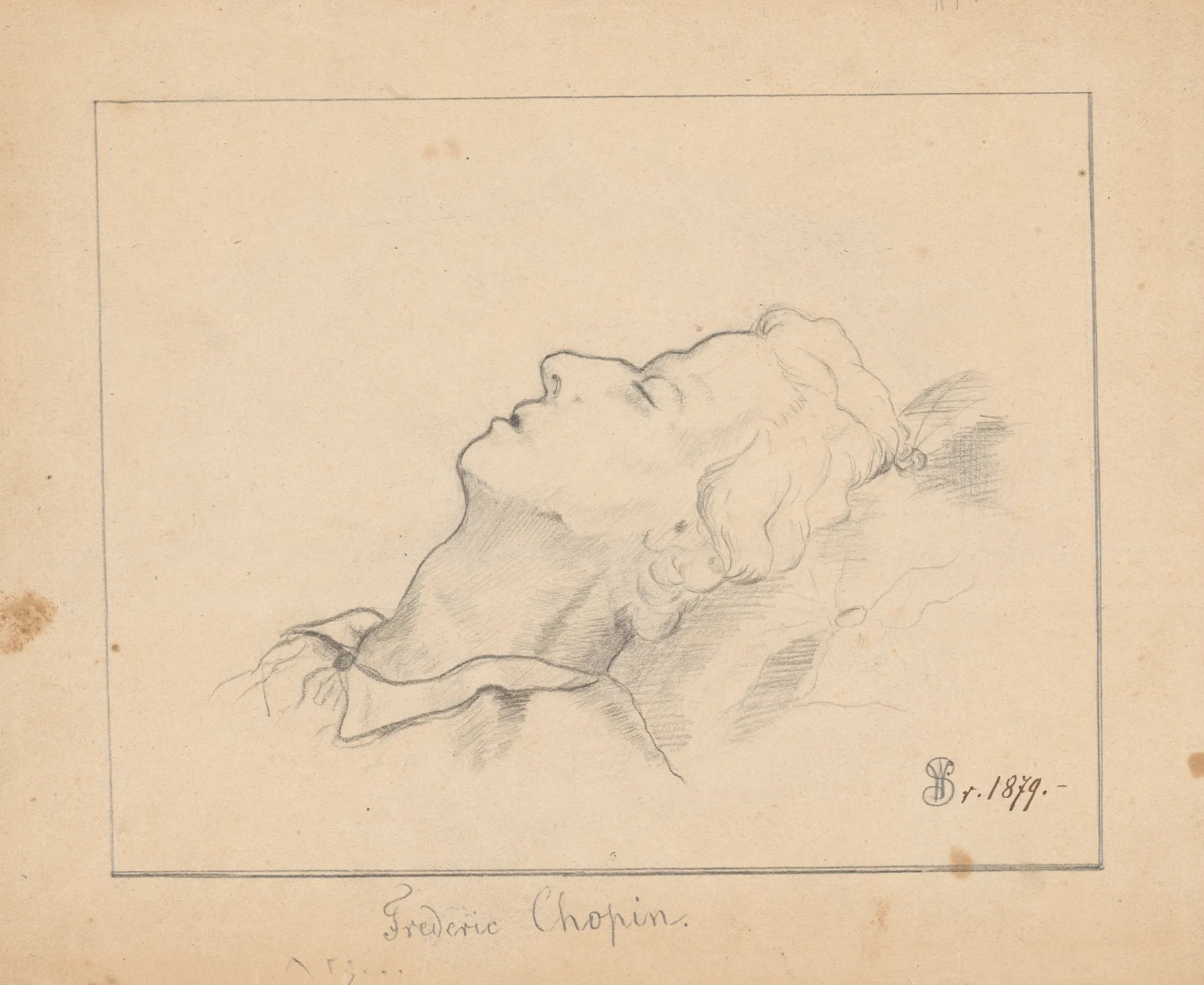
Copy of Teofil Kwiatkowski's composition 'Chopin on his deathbed'
1879
- Medium
- Drawing on paper (study)
- Collection
- National Museum in Krakow (Poland)
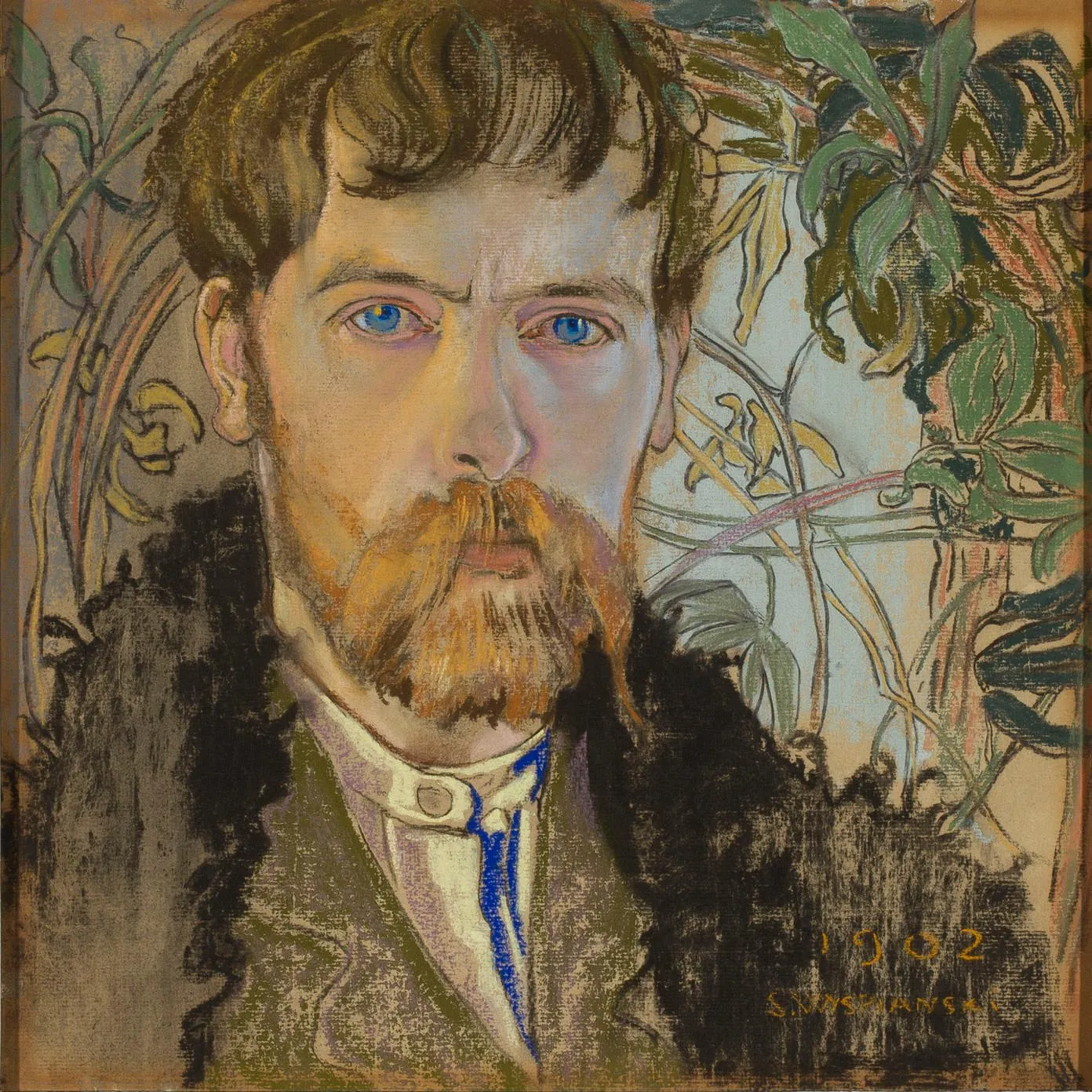
A leading figure of the "Young Poland" (Młoda Polska) movement, he was…
✦ Highlights (technique & color)
A rare and very early drawing on paper, created by a boy who was only ten years old at the time. By faithfully tracing and scaling down the intimate, introspective deathbed composition left by Kwiatkowski, it demonstrates a determination to directly engage with the subject's profound spirituality. Precisely because it is a monochromatic drawing devoid of color, the work directly conveys the refined draftsmanship that would astonish even Matejko, along with the quiet, palpable tension enveloping the deathbed.
✦ The setting of this painting
October 1849, a room in Chopin's final apartment at 12 Place Vendôme in Paris, France. Chopin's deathbed is quietly surrounded by close members of the Polish émigré community who loved him, including his sister Ludwika, Princess Marcelina Czartoryska, Father Jełowicki, Grzymała, and the painter Kwiatkowski, who sketched this very scene.
✦ Historical context
The year 1879, when this copy was made, was a dark period when Poland was partitioned and ruled by neighboring powers. Born in Krakow, the artist Wyspiański suffered severe personal loss: his mother died of tuberculosis when he was just seven, and due to his father's struggles with alcoholism, he was taken in by his aunt and uncle. Amid these circumstances, he attended the unique Saint Anne Gymnasium, where instruction in the Polish language was quietly maintained to thoroughly teach the nation's history and literature, and received his first lessons from the master of historical painting, Jan Matejko. This drawing was born from the intersection of his own profound grief and the collective mourning of his compatriots who had lost their homeland.
A dark room. People quietly gather around a man on the edge of death. The man’s name is Frédéric Chopin. This painting seems like nothing more than a simple copy—a painstaking trace of a composition by a celebrated artist. It was drawn by a ten-year-old boy. That is usually how we dismiss it.
And yet.
This was no boring exercise meant merely to refine technical skill. It may well have been a ritual of prayer—a moment where the boy projected his own profound, agonizing loss onto the page.
The boy’s name was Stanisław Wyspiański. The year was 1879, in Kraków. He was just ten years old.
In 1876, three years earlier, he had lost his mother, Maria, to tuberculosis. He was only seven. To make matters worse, his father, a sculptor, was consumed by alcoholism and unable to fulfill his duties as a parent. A total collapse of the home.
The young boy was taken in and adopted by his aunt Joanna and her husband Kazimierz. Their home was a vibrant hub for local intellectuals—a place frequented by Jan Matejko, the grand master of Polish historical painting. Matejko instantly recognized the child’s talent and began guiding his very first steps in art.
The St. Anne Gymnasium he attended was equally exceptional. In an era when the Polish language was strictly banned by the ruling powers, this school defiantly held its lectures in Polish. The teachers thoroughly instilled the nation’s history and literature into their students. Under harsh foreign rule, the young boy learned the deep sadness of a lost homeland and discovered his true roots.
Why choose a scene of death?
The original painting he traced was by Teofil Kwiatkowski, a painter with close personal ties to the Chopin family. Chopin held him in such high spiritual regard that he once inscribed a manuscript: "To my dear Teofil Kwiatkowski."
Paris, 1849. A raw, immediate record of death, sketched on the spot by a trusted friend as Chopin took his final breath.
The ten-year-old boy traced every line of this cold death with meticulous care.
The loss of his mother. The tears of mourning shed by a people stripped of their country.
Death.
These two shadows quietly merged within his ten-year-old heart.
Those around him thought it was just practice. But the boy was gazing directly into death itself.
By rendering death onto paper, wasn't he attempting to mend his own torn soul?
By drawing, he chose to live.
About 71 more words
Read stories of masterpieces for free
Stories featuring this painting
Your Note
Write down what this painting made you feel in your art notebook.
Please sign up to write notes.
Sign up for freeRecommended Artworks
More artists
If you find an error in this content, please let us know here
This site is protected by reCAPTCHA, and the Google Privacy Policy and Terms of Service apply.