
 日本語 (JA)
 English (EN)
- Dimensions
- 不明
- Medium
- Oil on canvas
- Collection
- Private collection, New York, USA
19世紀後半のヨーロッパにおけるアカデミズム絵画を代表する巨匠の一人。
To restore Poland's lost national prestige within the spiritual realm of intellect and refined art during a time of hardship under foreign partition, instilling pride and hope in the hearts of its people.
✦ Highlights (technique & color)
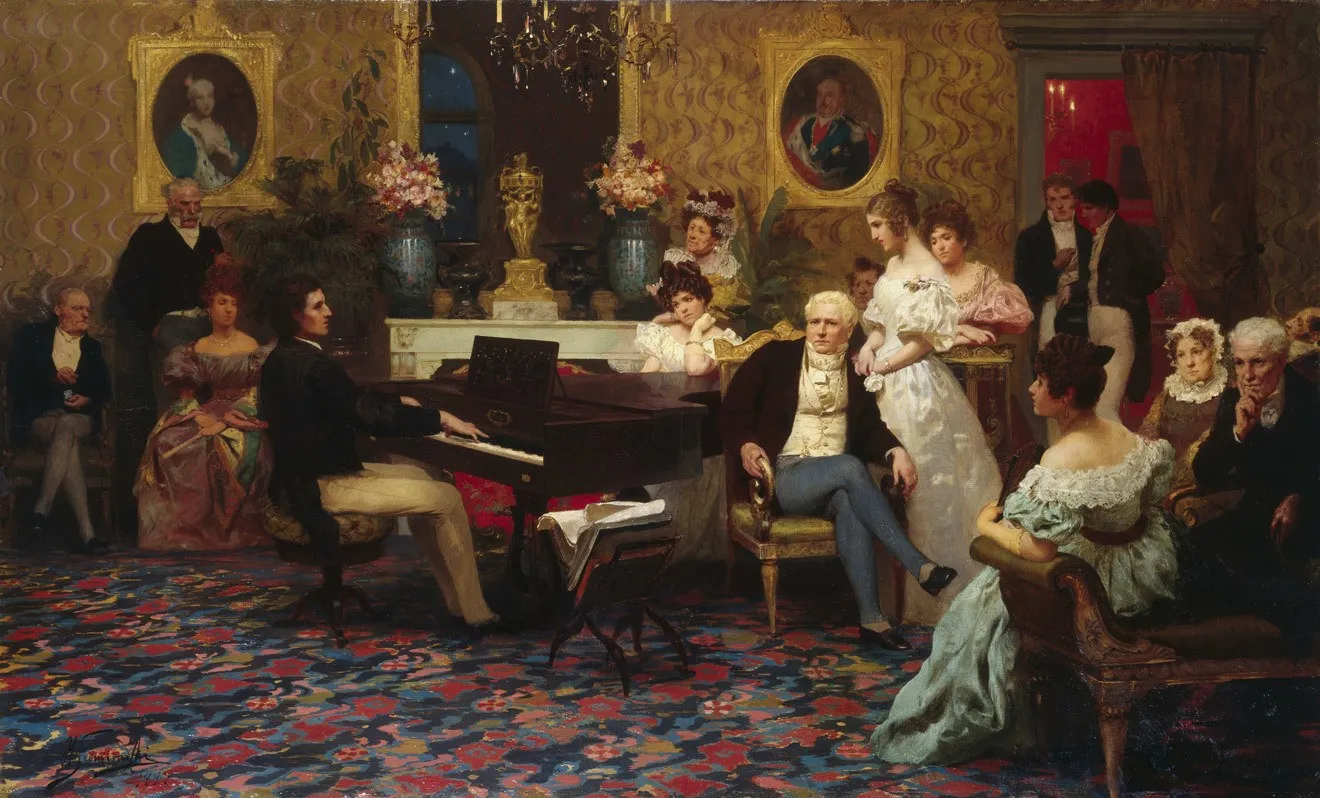
The composition is structured around a 'dual focus.' The viewer's attention is first drawn to the center, where Prince Radziwiłł and Princess Eliza are bathed in the brightest glow of the chandelier. Following their gazes and the rapt postures of the gathered company, one's eye is then naturally guided toward Chopin playing the piano on the left.
✦ The setting of this painting
The painting depicts an evening concert in 1829 at the salon of Prince Antoni Radziwiłł. Rather than a direct record of a specific occasion, however, it is an imagined space constructed by the artist in his Rome studio, inspired by literary anecdotes and modeled on the interior decoration of the Radziwiłł Palace in Berlin.
✦ Historical context
In the late 19th century, Poland had lost its sovereignty, divided under the rule of Russia, Prussia, and Austria. Throughout this era, Chopin stood as a symbol of national identity for the Polish people, and this work carries a context of cultural resistance, seeking to rekindle national pride through the medium of painting.
The soft glow of candlelight reflects off the opulent chandelier and gilded frames, imbuing the room with a warm, nocturnal atmosphere. On the left side of the canvas, the young Frédéric Chopin sits at the piano, striking the keys with passionate intensity radiating from his entire being. Yet, it is not him whom I placed at the center of this canvas. Seated in the chair at the center, listening intently to the music, is the proud Polish aristocrat Prince Antoni Radziwiłł and his family. Holding my brush in my studio in Rome, Italy, I sought to imbue this single painting with the lost glory of my homeland and the enduring soul of its art.
Evoking an Illusory Night on Canvas
In 1887, living in a sun-drenched villa in Rome, I enjoyed a privileged life as a painter, depicting historical scenes inspired by ancient Greece and Rome. My works garnered international acclaim, granting me days of financial stability. Yet a dark shadow always lingered over my heart. My homeland, Poland, had been partitioned and ruled by the great powers of Russia, Prussia, and Austria, its name wiped entirely from the map of the world. In this era of hardship, where our state was lost and our distinct culture and language were suppressed, the sole beacon of hope for my compatriots was Chopin, the musical genius who had once captivated all of Europe.
Around that time, a special commission arrived from Karol Kozłowski, a publisher based in Poznań. He asked me to paint an episode from Chopin's youth as an original for high-quality prints, aiming to remind our people of the composer's greatness. For me, having devoted myself almost entirely to the grandeur of antiquity, taking Polish history and music as a direct subject was an unusual challenge. Yet I felt a sense of destiny in this request.
The subject he proposed was the tale of the nineteen-year-old Chopin performing in 1829 at the salon of his patron, Prince Radziwiłł. I immediately immersed myself in historical documents and began gathering portraits and literature from the era. The setting was the salon of Prince Radziwiłł's residence in Berlin. Intricate carpets, heavy wood paneling, and the gentle artificial light illuminating the nocturnal darkness—little by little, within my Roman studio, I reconstructed the romantic ambiance of an early nineteenth-century salon.
Prince Radziwiłł was not merely a man of power; he was an accomplished, cultured figure who played the cello and composed music himself. He had recognized Chopin's talent early on and offered him warm patronage. Beside him, I included Princess Eliza, who was said to have received piano lessons directly from Chopin. Furthermore, among the guests I placed some of the foremost minds of nineteenth-century Europe, including the world-renowned naturalist Alexander von Humboldt and the author Rahel Varnhagen von Ense, host of a celebrated literary salon.
About 601 more words
Read the rest of this commentary —
and step into a secret gallery
opened just for you
An "art letter" delivered to you every Saturday morning
Works, music and words chosen for your sensibility, from your artist-type result and the paintings you love
A library of masterpieces and music you can enjoy "in your own words", not just look at
A "digital art notebook" (unlimited) where your impressions build into your own taste
Unlimited likes and notes
¥980 / month¥0 today
¥980/month (tax incl.) from day 8. Cancel anytime.
Already have an account? Log in
Stories featuring this painting
Premium Romanticism
The Severed Portrait: Chopin and George Sand, Where Nine Years of Love Led
Premium LonelinessLossRomanticismPlace of no returnWar
Delacroix x Chopin: Paris in Gunsmoke and a Foreign Piano. 1830: The Sound of Their Hearts
Premium PoignancyLossRomanticism
This Piece Was Never Truly About 'Farewell'
Your Note
Write down what this painting made you feel in your art notebook.
Please sign up to write notes.
Sign up for freeRecommended Artworks
Sources & references
More art movements
Pre-Baroque
1 artworks
Victorian era
10 artworks
Impressionism
48 artworks
Late Pre-Raphaelite
10 artworks
Baroque
2 artworks
American Impressionism
5 artworks
Realism
4 artworks
Pre-Raphaelite
3 artworks
Barbizon School
5 artworks
Academic art
5 artworks
Luminism
3 artworks
Rococo
2 artworks
Symbolism
22 artworks
Neo-Impressionism
3 artworks
Ukiyo-e
1 artworks
Japonism
4 artworks
Edo period
1 artworks
Fauvism
1 artworks
Naturalism
9 artworks
Russian Realism
1 artworks
Post-Impressionism
13 artworks
Genre painting
9 artworks
Neoclassicism
3 artworks
ウィーン分離派
7 artworks
自然主義
1 artworks
ナショナル・ロマンティシズム
1 artworks
未来派
1 artworks
More artists
If you find an error in this content, please let us know here
This site is protected by reCAPTCHA, and the Google Privacy Policy and Terms of Service apply.