
Jerusalem Artichoke Flowers
1880
- Dimensions
- 99.6 × 73.0 cm
- Medium
- Oil on canvas
- Collection
- National Gallery of Art (Washington, D.C.)
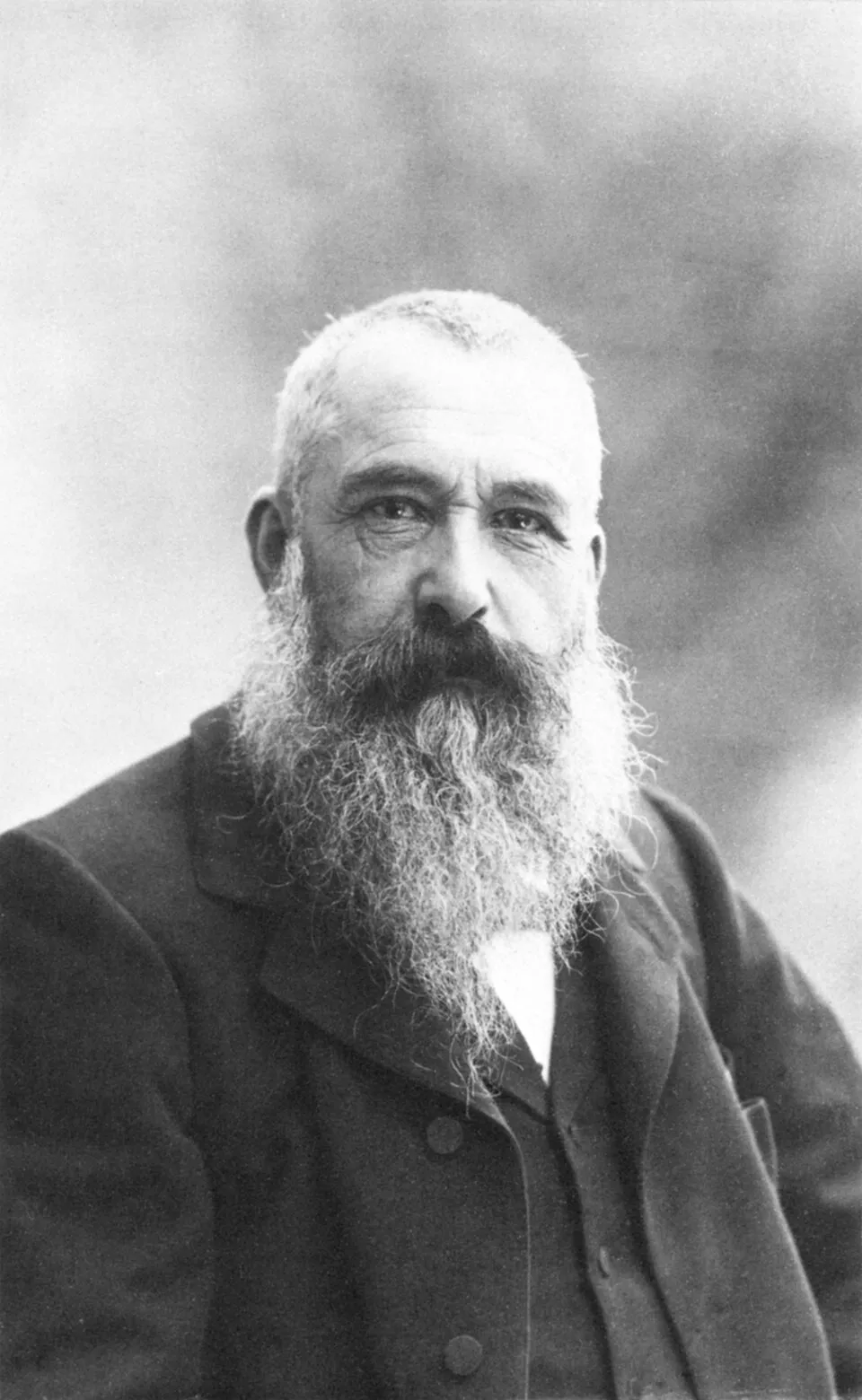
Celebrated as a founding figure of Impressionism, he is one of France’s most ren…
✦ Highlights (technique & color)
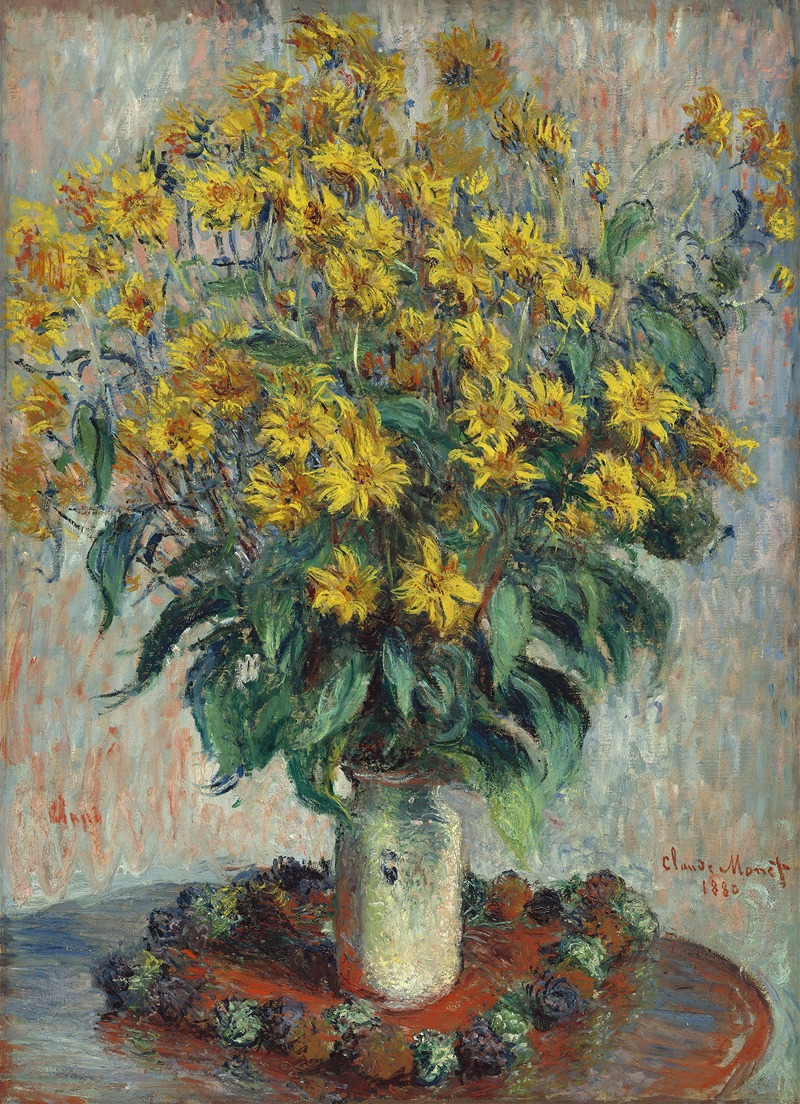
Canary-yellow petals and pumpkin-orange centers, framed by emerald- and pine-green foliage, create a striking chromatic contrast against the ivory white of the porcelain. In the background, thick layers of salmon-pink and pale-turquoise paint fill the canvas with bold, vertical brushstrokes.
✦ The setting of this painting
Jerusalem artichoke blossoms, likely cultivated in the garden of the home in Vétheuil or gathered from nearby wild meadows. Arranged in a slender, cylindrical ivory-white porcelain vase, they rest on a table covered with a circular cloth trimmed with sage-green and plum-purple pom-poms.
✦ Historical context
Early 1880s France. Native to North America and introduced to Europe in the seventeenth century, the Jerusalem artichoke was a common, practical plant in rural regions, grown for its edible tubers. This period was also defined by a turbulent history, shaped by early patrons who supported the Impressionists and young collectors whose lives were later claimed by World War I.
Yellow flowers bloom in profusion, spilling over the edge of an ivory-white porcelain vase.
Resting upon a cloth trimmed with sage green and plum purple, the arrangement is set against a background thickly layered with strokes of salmon pink and pale turquoise paint.
From 1942 until 1985, this painting was exhibited under the title Vase of Chrysanthemums at institutions such as the National Gallery of Art in Washington.
A splendid bouquet of chrysanthemums.
Introduced as such, hardly anyone would have questioned it.
Yet what is depicted here is not a cultivated chrysanthemum.
The slender, sharply pointed yellow petals and orange centers are botanically distinct from the chrysanthemum family.
Through analysis of the catalogue raisonné, the work was confirmed to be Jerusalem Artichoke Flowers, which Monet himself presented at the Seventh Impressionist Exhibition in 1882.
Having been known by the wrong name for more than half a century, this painting has only recently had its rightful title restored.
The year was 1880.
Monet was living in Vétheuil, a rural village along the Seine.
Native to North America, the Jerusalem artichoke was a common, utilitarian plant in the French countryside of the era, cultivated for its edible tubers.
Whether gathered from his own garden or picked from wild meadows, Monet placed these blossoms into a slender cylindrical vase and turned to his canvas.
At the time, Monet was enduring severe poverty, struggling even to afford painting supplies.
The man who steadfastly supported him through this ordeal was the homeopathic physician Dr. Georges de Bellio.
He treated Monet free of charge.
Moreover, he purchased the artist's then-unpopular paintings at generous prices, providing a vital lifeline.
This painting, too, after being sold to an individual named Cahuzac in November 1880, eventually entered de Bellio's collection.
It served as a financial shield during the painter's most harrowing days.
About 202 more words
Sign up free and enter Your Museum
Read the stories behind great paintings and music for free, in Your Museum
Your Note
Write down what this painting made you feel in your art notebook.
Please sign up to write notes.
Sign up for freeRecommended Artworks
_Claude_Monet_-_Muse%CC%81e_des_Beaux-Arts_de_Lyon_(W821)+(1).webp)
Sources & references
More artists

If you find an error in this content, please let us know here
This site is protected by reCAPTCHA, and the Google Privacy Policy and Terms of Service apply.