
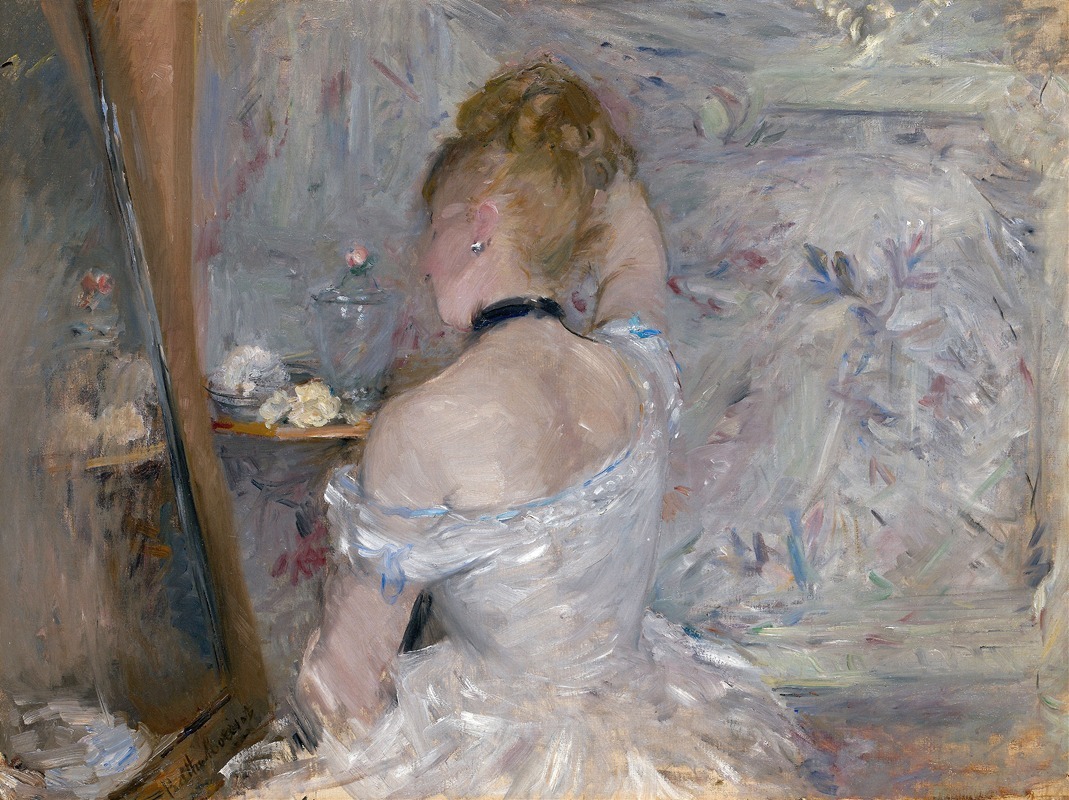
Woman at Her Toilette
1875
- Dimensions
- 60.3 × 80.4 cm
- Medium
- Oil on canvas
- Collection
- The Art Institute of Chicago
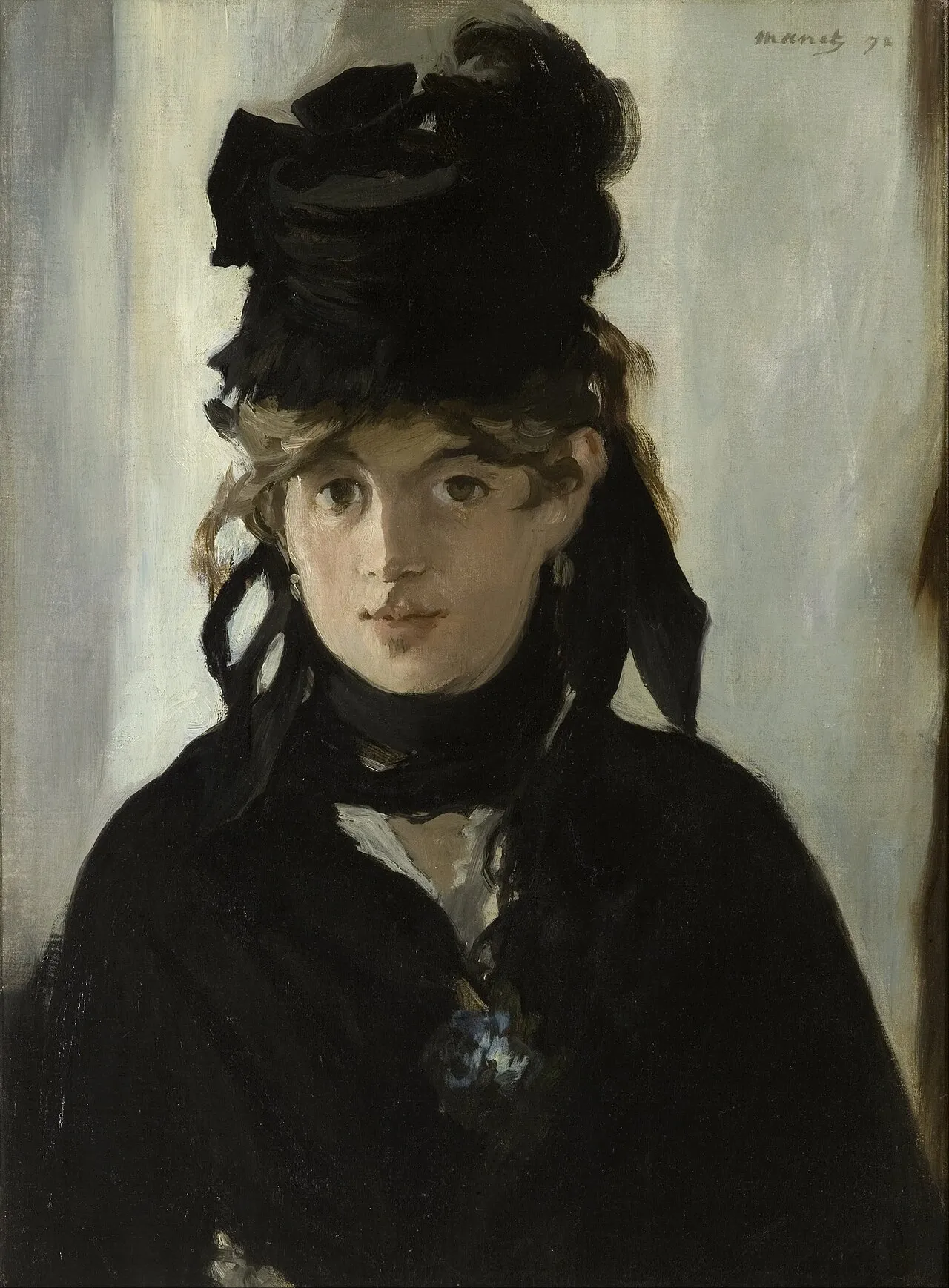
A leading French Impressionist painter of the nineteenth century, Berthe Morisot…
A quiet, definitive rejection of the traditional mirror motif as a symbol of female vanity subject to the male gaze, capturing instead a woman's autonomous inner life and authentic self, liberated from social expectations.
✦ Highlights (technique & color)
The painting is characterized by a refined, pearlescent palette of pastel tones, including silver-gray, lavender, pale pink, blue, and white. With feathery, loose brushstrokes, the drapery of the garments and the floral motifs in the background are rendered so that contours seem to dissolve into the surrounding atmosphere. The black velvet choker, bearing the deepest tone in the composition, provides a striking visual anchor amid the soft, muted hues.
✦ The setting of this painting
The setting is an intimately private bedroom or dressing room in an affluent bourgeois home. The Louis XVI-style bed in the background, as well as the powder puff, glass bottles, and white porcelain jars arranged on the vanity table, are all known to have been Morisot's own possessions from her bedroom. The painting captures a moment as a Parisian woman, having returned from an evening out, transitions from her public persona back to her private, authentic self.
✦ Historical context
In late 1870s France, social conventions severely restricted bourgeois women from unaccompanied movement in public spaces. While male painters were free to capture urban cafes and bustling boulevards, female artists were largely compelled to limit their subjects to the domestic sphere. Morisot turned this constraint to her advantage, elevating the private realm—governed by female interiority and autonomy—into an innovative testing ground for modern art.
A woman, having just returned from an evening gathering, is about to loosen her hair before a mirror.
Pearl earrings adorn her ears.
Around her neck gleams a black velvet choker.
Throughout art history, women seated before mirrors have been depicted countless times.
In most cases, they served to expose a woman's youth and beauty to the viewer's gaze, or functioned as moralistic warnings against vanity and the obsession with appearance.
At first glance, this painting might also seem like a typical genre scene, capturing an elegant moment in the daily life of a beautiful Parisian woman.
Yet in truth, this work directly rejects such traditional conventions.
In 1874, Berthe Morisot married Eugène Manet, the younger brother of Édouard Manet.
And in 1878, she gave birth to her only daughter, Julie.
In French society at the time, living as a professional painter was by no means easy for a bourgeois woman.
Unlike their male contemporaries, women were strictly constrained by social norms from roaming freely through urban cafés, cabarets, and bustling public venues to sketch.
Unable to paint the outside world.
Barred even from entering the École des Beaux-Arts, she honed her technique through private instruction and copying masterpieces at the Louvre, choosing her intimate domestic surroundings, her family, and the everyday lives of women as her primary artistic motifs.
Even with the heavy responsibilities of being a wife and mother, she transformed her immediate domestic world into an artistic laboratory.
The setting for this painting is her own deeply private bedroom.
The Louis XVI-style bed in the background.
The powder puff, glass bottles, and white porcelain jar arranged on the vanity shelf.
All of these were Morisot's personal possessions.
She captured the moment of shedding the "performed self" required in the public arena of the evening soirée and returning to the "vulnerable, authentic self" within a private sanctuary.
A single hand raised to unfasten her chignon.
It was a quiet ritual of release from the roles imposed by society.
About 172 more words
Unlock this story's ending, and every article on MusicStory
- 42
Stories1–2 new every week
An archive of paintings paired with great music, made for a weekend night and a cup of coffee
- 282
Paintings with commentarygrowing daily
From simply looking to truly reading — the brushwork and the obsession of the masters
- 10
Music Librarygrowing daily
Know it first, and what reaches your ear changes — background music becomes art you keep for life
My Notes, unlimited
Every reading adds to a digital art notebook that is yours alone
Already have an account? Log in
Your Note
Write down what this painting made you feel in your art notebook.
Please sign up to write notes.
Sign up for freeRecommended Artworks
_Claude_Monet_-_Muse%CC%81e_des_Beaux-Arts_de_Lyon_(W821)+(1).webp)
Sources & references
More artists






If you find an error in this content, please let us know here
This site is protected by reCAPTCHA, and the Google Privacy Policy and Terms of Service apply.