
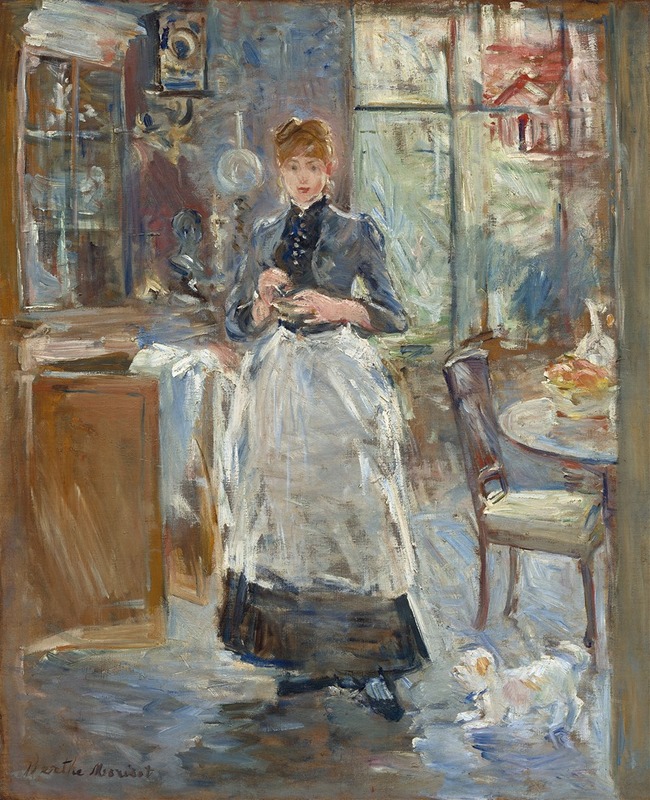
In the Dining Room
1886
- Dimensions
- 61.3 × 50.0 cm
- Medium
- Oil on canvas
- Collection
- National Gallery of Art, Washington
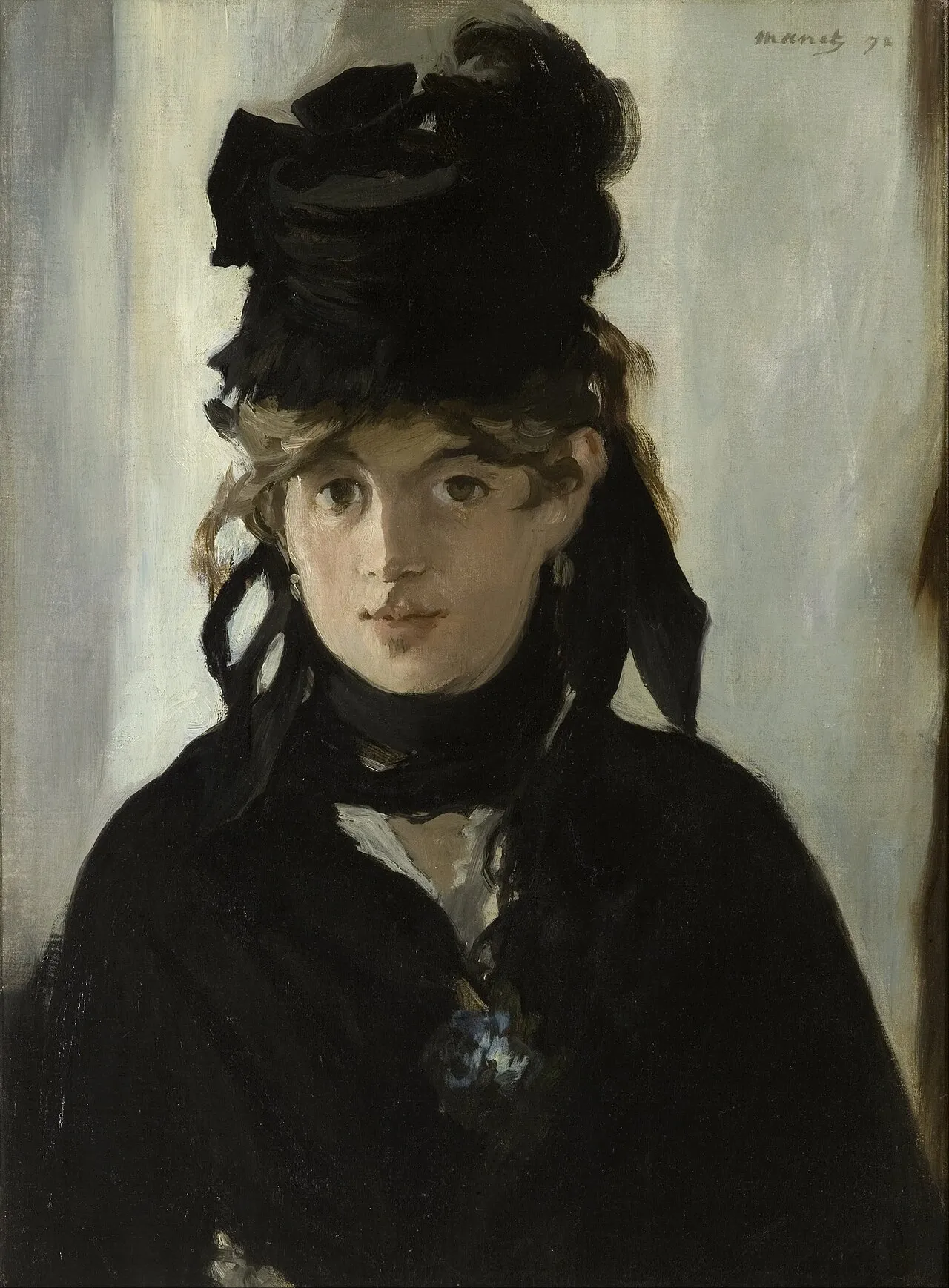
A leading French Impressionist painter of the nineteenth century, Berthe Morisot…
✦ Highlights (technique & color)
A highlight of the work is the rapid, vigorous brushwork that sweeps across the entire canvas in every direction. While the maid's dark blue dress and white apron create a striking tonal contrast, the surrounding walls and furniture are composed of blended touches of blue, pink, and purple, producing a visual blur where forms seem to dissolve into the background. Through this expressive touch, the painting brilliantly captures fleeting fragments of time—the rhythm of household chores, the bark of a dog, and the flickering play of light.
✦ The setting of this painting
This depicts the dining room of the home and studio that Berthe Morisot and her husband built around 1883 on Rue de Villejust (now Rue Paul-Valéry) in Paris. Morisot envisioned this new residence not merely as a private retreat, but as a combined salon and studio, using it as the primary setting for her major paintings. Featuring a tall sideboard and a round table, the scene captures the refined domestic life of a bourgeois household bathed in abundant light.
✦ Historical context
The year 1886 marked the eighth and final Impressionist exhibition, drawing the collective history of the movement to a close. In bourgeois society at the time, women's spheres of movement were severely restricted. While male painters freely depicted public life in cafés and on city streets, female artists were largely confined to domestic subjects. Morisot turned this limitation to her advantage, skillfully portraying the agency and modern identity of women of her era.
In the center of the canvas, a woman pauses in her work.
She wears a navy dress with a clean white apron.
At her feet, a small white dog with brown patches playfully frisks about.
This is Rue de Villejust in Paris,
the light-filled dining room of painter Berthe Morisot's home.
To the left stands a tall sideboard that reaches almost to the ceiling.
Behind its glass doors, silverware and porcelain tableware are neatly arranged.
On the round table to the right rest a decanter and brightly colored fruit.
She was a maid who worked in this household.
In late nineteenth-century France, female domestic servants were indispensable in supporting middle-class homes.
Male painters of the era frequently chose them as subjects as well.
Yet many of those works emphasized the harsh miseries of a callous class system,
or cast an overtly sexualized gaze upon them.
Nameless lower-class women exhausted by relentless labor—
such was the customary depiction of maids in the art of the period.
Morisot's gaze, however, was entirely different.
She portrayed the servant working in her own home with warm respect,
as a cherished presence who shared an intimate everyday life.
The woman who posed for this painting was named Pasie.
She had originally been discovered by Morisot's mother during a journey to the south of France.
An innocent teenage country girl at the time, she was brought to Paris as a maid.
Even after Morisot married Eugène Manet, Pasie accompanied them to their new home.
She became a trusted nursemaid to their only daughter, Julie, born in 1879.
She was a truly indispensable part of the family's life.
Morisot was an exceptionally quiet, reserved person,
so much so that high society sometimes rumored her to be cold.
Offering polite smiles and effortlessly charming everyone—
she possessed none of that social dexterity.
That was precisely why she placed such profound trust in Pasie, who shared her personal everyday sphere.
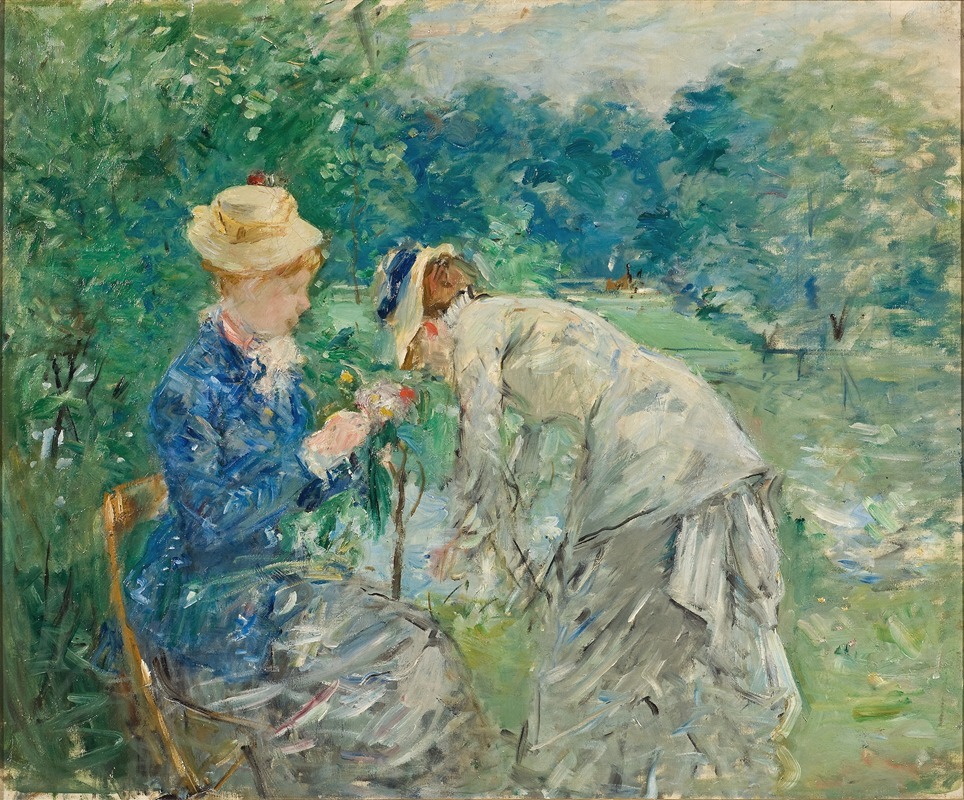
Morisot left behind numerous paintings featuring Pasie as her model.
About 205 more words
Unlock this story's ending, and every article on MusicStory
- 42
Stories1–2 new every week
An archive of paintings paired with great music, made for a weekend night and a cup of coffee
- 282
Paintings with commentarygrowing daily
From simply looking to truly reading — the brushwork and the obsession of the masters
- 10
Music Librarygrowing daily
Know it first, and what reaches your ear changes — background music becomes art you keep for life
My Notes, unlimited
Every reading adds to a digital art notebook that is yours alone
Already have an account? Log in
Your Note
Write down what this painting made you feel in your art notebook.
Please sign up to write notes.
Sign up for freeRecommended Artworks
Sources & references
- In the Dining Room - Wikipedia
- Berthe Morisot - In the dining room - PubHist
- In the Dining Room by Berthe Morisot - National Gallery of Art
- In the Dining Room by Morisot - World History Encyclopedia
- A Model Servant - Paula Butterfield
- Impression, Morisot - Mammafotogramma
- In the Dining Room by Berthe Morisot - TheHistoryOfArt.org
- Everyday Art - Minneapolis Institute of Art
- Pasie Sewing in Bourgival's Garden by Morisot - World History Encyclopedia
More artists






If you find an error in this content, please let us know here
This site is protected by reCAPTCHA, and the Google Privacy Policy and Terms of Service apply.