
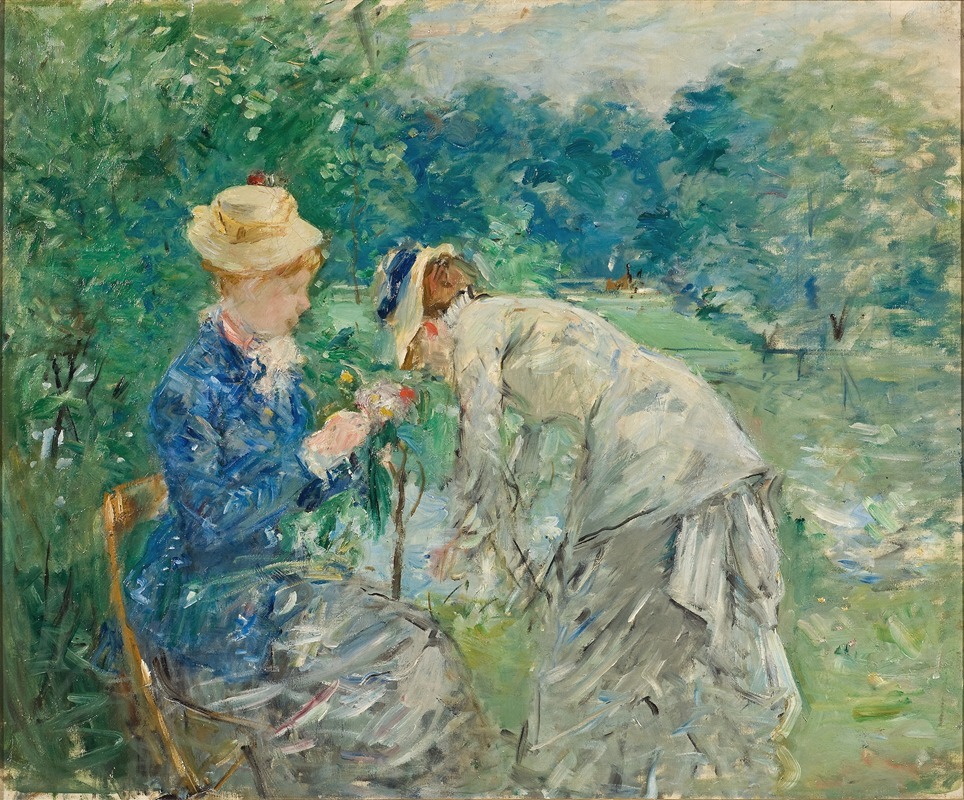
In the Bois de Boulogne
1828
- Dimensions
- 61.5 × 73.8 cm
- Medium
- キャンバスに油彩
- Collection
- スウェーデン国立美術館
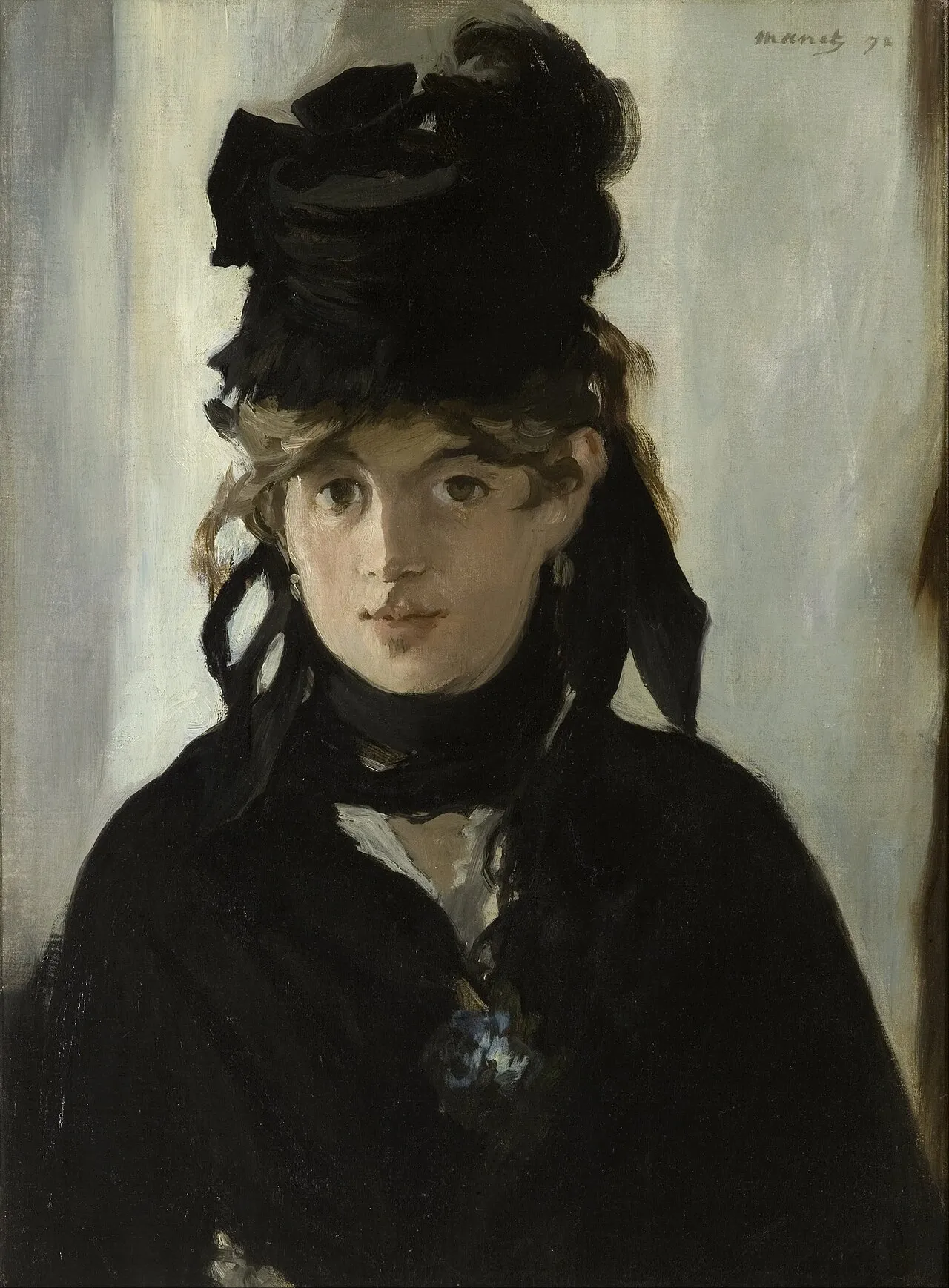
A leading French Impressionist painter of the nineteenth century, Berthe Morisot…
A battle to shatter the framework of "femininity" imposed by society. It embodies the painter's quiet energy, longing for freedom amidst constraint and confronting the world with a single brush.
✦ Highlights (technique & color)
キャンバス全体を覆う、独特の「ジグザグの筆触」が見どころです。細部を極限まで省略し、女性の衣服の質感と周囲の草木や光、水面を同一の短いストロークの網の目で統合しています。被写体とその周囲の大気を一体化させるこの先進的なアプローチは、絵画の表面全体にエネルギーと光のきらめきを与え、当時の批評家から「未完成」と批判されるほど革新的でした。
✦ The setting of this painting
舞台はパリ西部の「ブローニュの森」。1850年代にナポレオン3世らの指揮で、曲がりくねった小道や人工湖を配した自然に近い景観へと再開発されました。19世紀後半のパリにおいて、ブルジョワジーにとって最も流行した社交とレジャーの場であり、モリゾ自身も近接する高級住宅地パッシーに住んでいたため、生涯にわたり好んで制作の舞台に選びました。
✦ Historical context
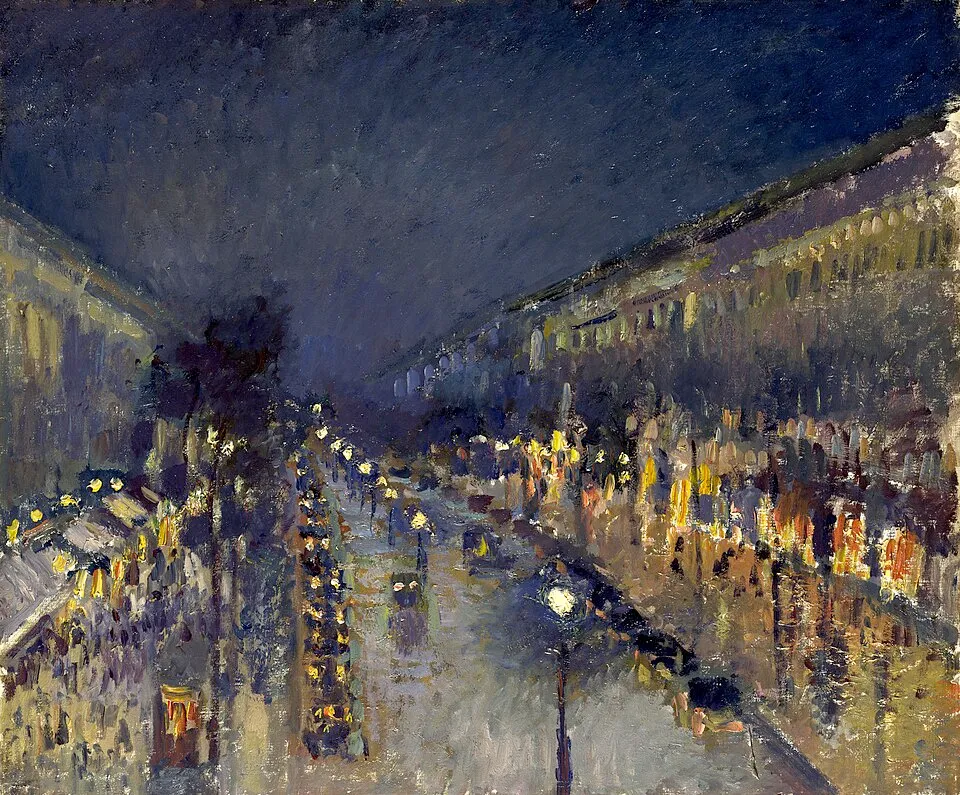
1870年代末から1880年にかけては、印象派グループが自立した展覧会を重ね、様式的な過渡期を迎えていた時代です。当時のフランスでは階級とジェンダーの規範が厳しく、ブルジョワ女性の行動範囲は家庭内や特定の公共空間に制限されていました。男性画家が都市の夜の街路などを描いたのに対し、女性画家は社会的な制約の中で主題を選ぶ必要がありました。
Two women lean close together before a backdrop of lush, verdant trees.
The woman in the blue dress sits on a chair, while the one in white leans forward, perhaps gazing down at the flowers in her hands.
This is the Bois de Boulogne, nestled on the western edge of Paris.
Painted in the late 1870s, this work is one of the masterpieces of the Impressionist Berthe Morisot.
At first glance, it appears to be an elegant snapshot capturing wealthy women on a peaceful, leisurely day.
A graceful record of everyday life, depicted through a gentle perspective often perceived as distinctly feminine.
Standing before the canvas, many would surely share such an impression.
Yet in truth, this is far more than a merely graceful, "feminine" landscape.
In an era when women were not even permitted to walk the city streets alone, this park was the battleground she chose for her art.
Born in 1841, Berthe Morisot began copying masterworks at the Louvre in 1858 alongside her sister, Edma.
However, nineteenth-century French society imposed strict conventions upon women.
They were denied access to formal academic art education.
Indeed, even to study and sketch in museums, they always required a chaperone.
By the late 1870s, as a central figure of the Impressionist movement, Morisot completed this work.
It was shown under the title The Garden at the Fifth Impressionist Exhibition in 1880.
Her male contemporaries strode freely through cabarets, cafés, and nocturnal streets, capturing the vibrant pulse of modern urban life.
Morisot, however, had no such freedom.
Her choice of subjects was restricted to domestic interiors or parks she could visit only with a suitable escort.
About 251 more words
Unlock this story's ending, and every article on MusicStory
- 42
Stories1–2 new every week
An archive of paintings paired with great music, made for a weekend night and a cup of coffee
- 282
Paintings with commentarygrowing daily
From simply looking to truly reading — the brushwork and the obsession of the masters
- 10
Music Librarygrowing daily
Know it first, and what reaches your ear changes — background music becomes art you keep for life
My Notes, unlimited
Every reading adds to a digital art notebook that is yours alone
Already have an account? Log in
Your Note
Write down what this painting made you feel in your art notebook.
Please sign up to write notes.
Sign up for freeRecommended Artworks
_Claude_Monet_(W_P_76).webp)
Sources & references
More artists






If you find an error in this content, please let us know here
This site is protected by reCAPTCHA, and the Google Privacy Policy and Terms of Service apply.