
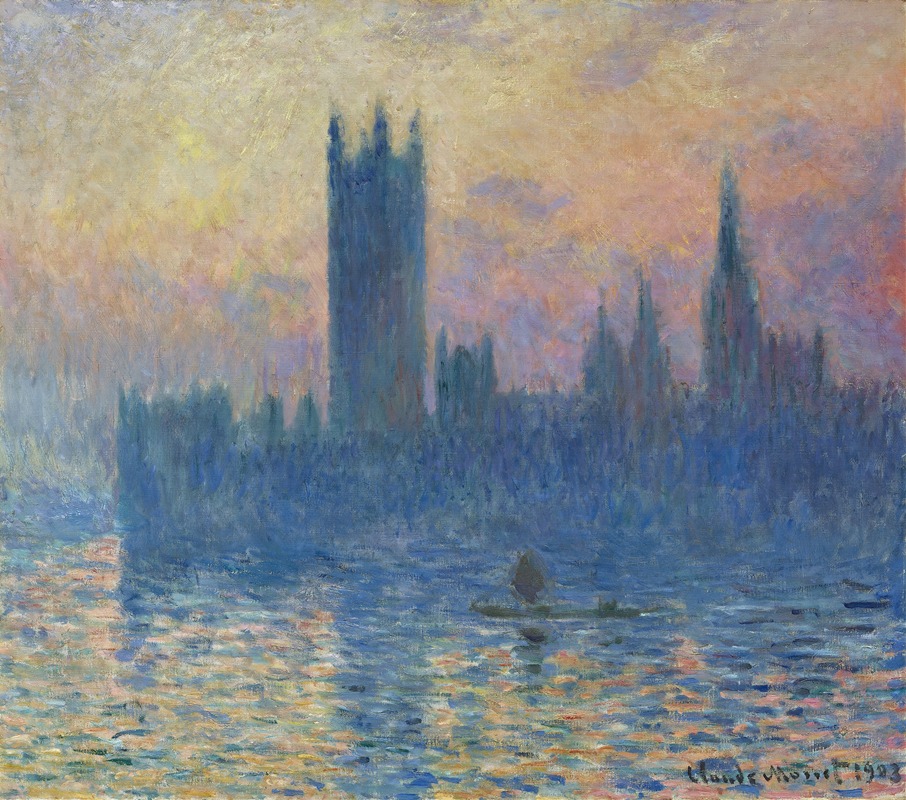
The Houses of Parliament, Sunset
1903
- Dimensions
- 81.2 × 92.8 cm
- Medium
- Oil on linen
- Collection
- The Art Institute of Chicago
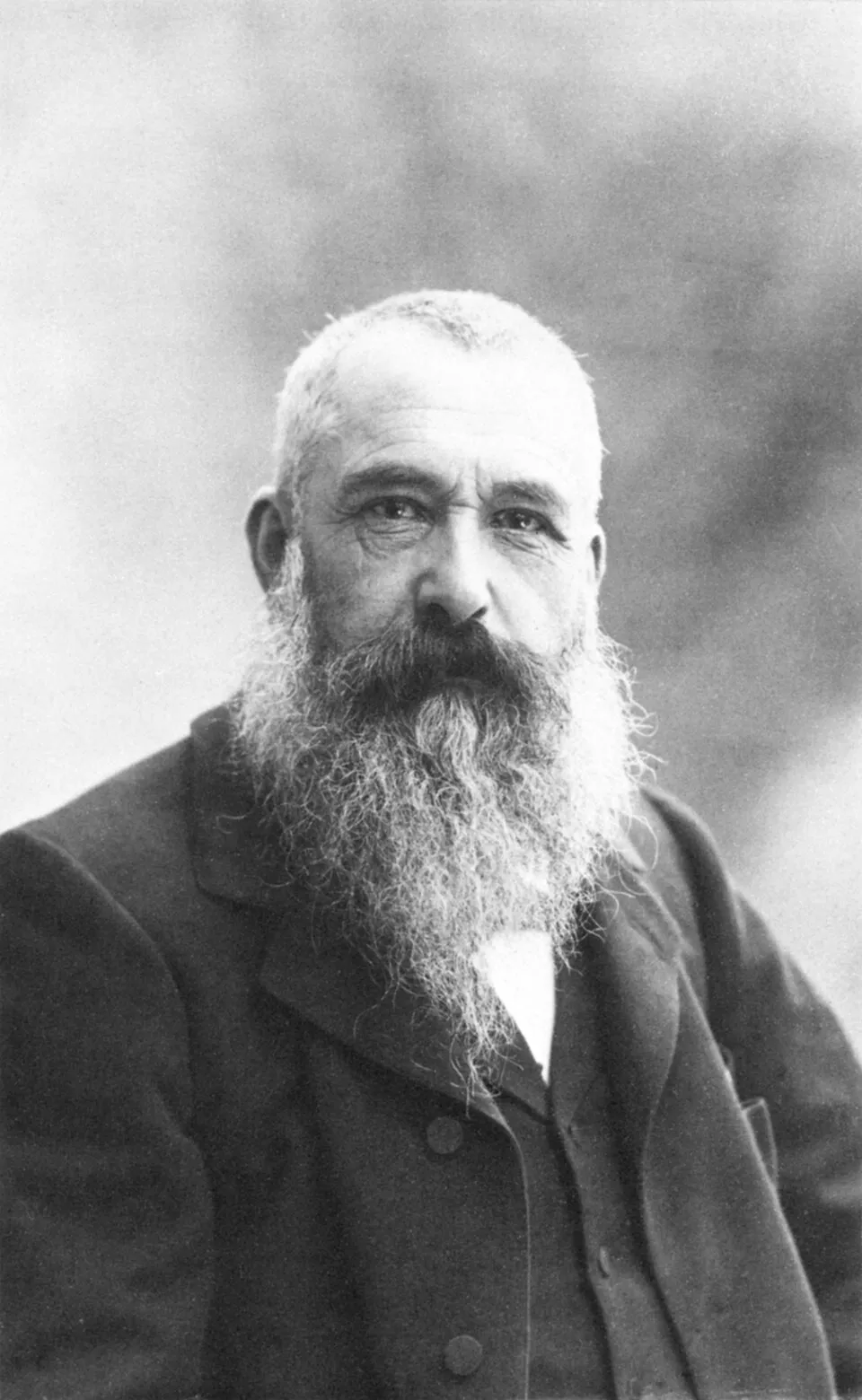
Celebrated as a founding figure of Impressionism, he is one of France’s most ren…
✦ Highlights (technique & color)
Monet made extensive use of "red lake," a pigment sensitive to light. While the red tones in the center of the canvas have faded over time, the vibrant colors of 1903 remain preserved along the edges where the frame shielded them from sunlight. In addition, X-ray examinations revealed two overlapping signatures in the lower right corner. This evidence shows that after initially signing the canvas on site, Monet heavily reworked the painting in his studio, obscuring the original signature and prompting him to sign it again before the paint had dried.
✦ The setting of this painting
The setting is a second-floor terrace of St Thomas' Hospital, situated on the south bank of the River Thames in London. From this vantage point looking diagonally across the water, the painting captures the silhouette of the Gothic Revival Palace of Westminster (the Houses of Parliament) rising on the opposite shore. At the height of the Industrial Revolution, coal-fueled industrial smog mingled with river fog, blanketing London in severe air pollution. Monet was captivated by the mysterious diffusion of light created by this smog.
✦ Historical context
From the late 19th to the early 20th century, London stood at the pinnacle of modernization driven by the Industrial Revolution. While the spread of railways sparked a boom in urban tourism, the heavy smog generated by burning vast amounts of coal became a pressing social issue. The public abhorred this polluted air, yet Monet stripped away the signs of modern city life and commercial river traffic, sublimating the atmosphere into an apocalyptic, mystical natural drama and a pure visual experience.
In the fading light of dusk, the hazy silhouette of the Palace of Westminster rises across the River Thames.
A lone rowboat floats upon the water.
An air of profound stillness drifts all around.
Claude Monet, the master of Impressionism.
He is celebrated as a painter who took his canvases outdoors to capture the fleeting shifts of natural light, seizing the atmosphere of the moment with rapid, spontaneous brushstrokes.
This painting, too, might appear to be a vivid snapshot of a single London sunset, conjured from river mist and smog along the banks of the Thames.
Yet in truth, this work was not completed beneath London skies.
On the contrary, Monet brought what was supposedly a finished piece back to his studio in France, obsessively reworking it over the course of three long years.
During the winters between 1899 and 1901,
Monet visited London. One of his primary bases was the second-floor terrace of St Thomas' Hospital on the south bank of the Thames.
At the time, London was at the height of the Industrial Revolution. Dense industrial smog from massive coal fires mingled with the river fog, creating a dramatic atmospheric veil. Where ordinary citizens saw foul, polluted air, Monet saw a mysterious, sublime drama of nature.
He would line up as many as nineteen canvases along the terrace at once.
Then, shifting rapidly from one canvas to another as the sunlight and fog constantly changed, he worked at a frenzied pace to record the fleeting atmospheric states.
Before the paint on the water's surface had even dried, he signed his name, "Claude Monet," in the lower right corner.
It was meant to be a declaration that he had truly captured the scene.
About 291 more words
Sign up free and enter Your Museum
Read the stories behind great paintings and music for free, in Your Museum
Your Note
Write down what this painting made you feel in your art notebook.
Please sign up to write notes.
Sign up for freeRecommended Artworks
Sources & references
More artists
If you find an error in this content, please let us know here
This site is protected by reCAPTCHA, and the Google Privacy Policy and Terms of Service apply.