
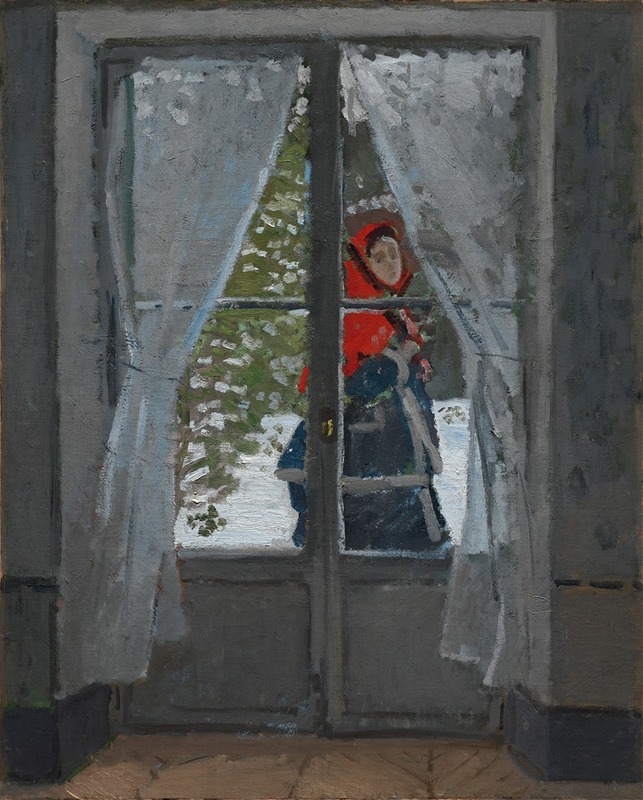
The Red Kerchief (c. 1868–73)
- Collection
- The Cleveland Museum of Art
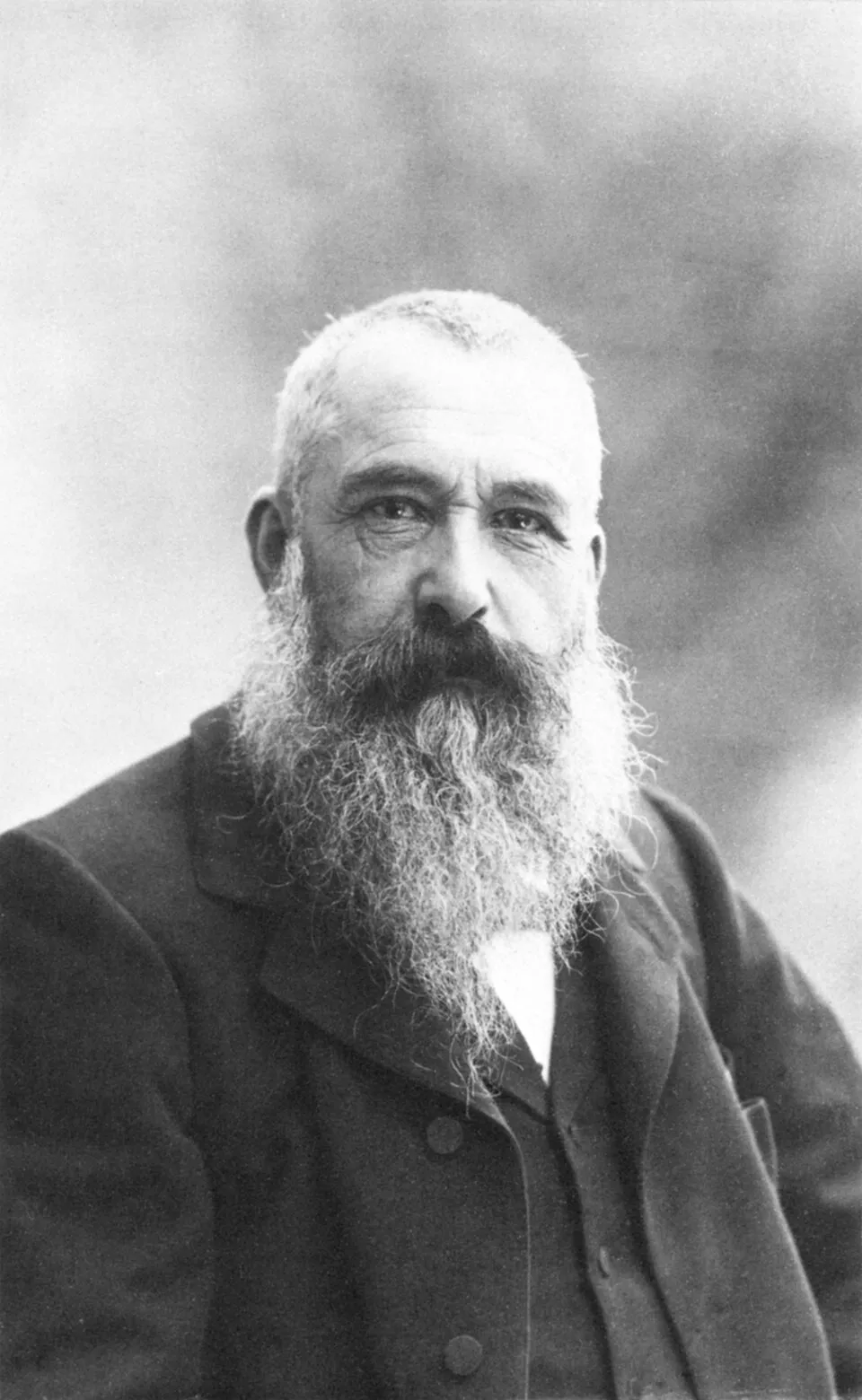
Celebrated as a founding figure of Impressionism, he is one of France’s most ren…
✦ Highlights (technique & color)
The work employs a technique of applying quick dabs of paint. The striking contrast between the white of the snow and the vibrant red of the cape is a major highlight.
✦ The setting of this painting
A snowscape seen through a window. In the crisp, cold light, the artist's wife, Camille, stands outside wrapped in a red cape.
✦ Historical context
Late 1860s to early 1870s. This represents a transitional period in which Monet moved away from traditional methods, shifting toward a pure visual experience centered on the perception of light.
Outside the window, a blanket of snow stretches across the landscape.
In the cold air, a woman in a red cape stands.
She is Camille, the painter's beloved wife.
For Monet, his family was an object of deep affection.
Yet, at the same time, they played a crucial role.
They were muses for his most rigorous visual experiments.
At that time, Monet was pursuing light as a physical phenomenon.
He sought logical strategies to reconstruct light on canvas.
The intimate relationship with his family held special significance for him.
It was a safe experimental ground where he could try new techniques without fear of failure.
Look at her face.
Her expression is not clearly depicted.
This is due to an innovative technique called 'dab,' where paint is applied in quick, thick strokes.
What Monet sought to capture was not his wife's emotions.
It was the reflection of light, woven by the white of the snow and the red of the cape.
When painting portraits of external patrons,
Monet depicted his models while preserving their dignity and social roles.
However, his brushwork when painting Camille was different.
He achieved astonishing freedom, even deconstructing her face into mere blocks of paint.
There was an immersion in pure visual experimentation.
To objectively view a loved one as merely a 'reflector of light.'
There is a cool, detached gaze from the painter.
Yet, at the same time, a fervent passion also existed.
The desire to eternally capture his beloved wife and the light of that moment.
About 57 more words
Read stories of masterpieces for free
Your Note
Write down what this painting made you feel in your art notebook.
Please sign up to write notes.
Sign up for freeRecommended Artworks
Sources & references
More artists

If you find an error in this content, please let us know here
This site is protected by reCAPTCHA, and the Google Privacy Policy and Terms of Service apply.