
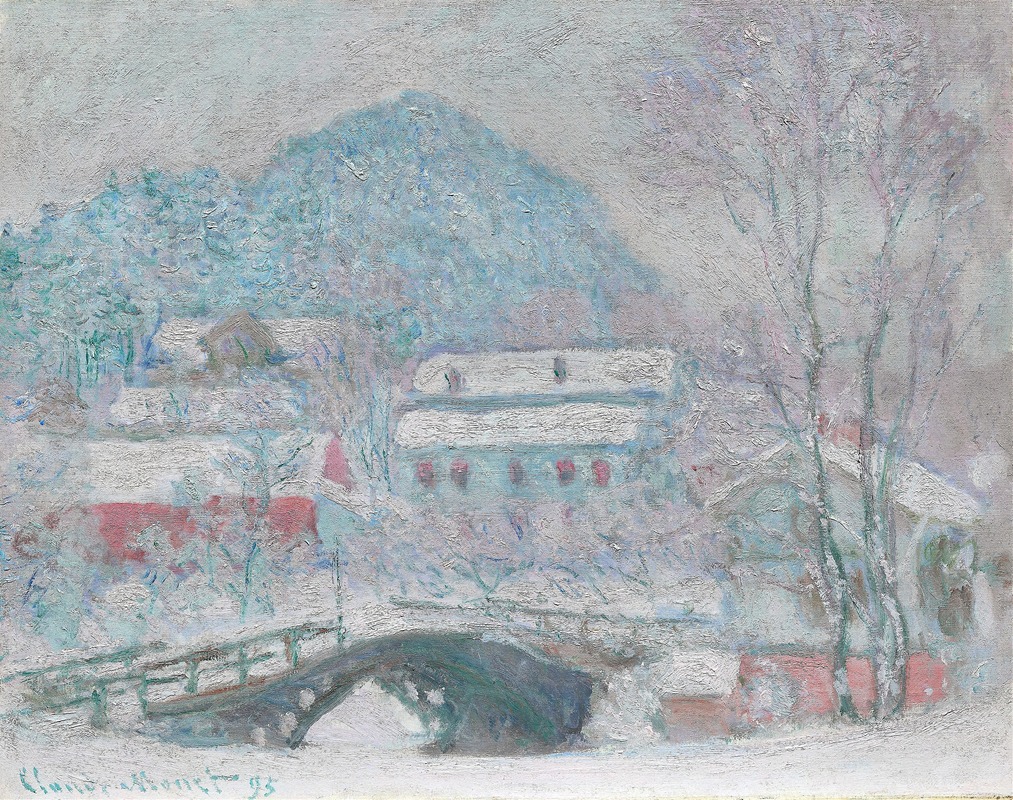
Sandvika, Norway
1895
- Dimensions
- 73.4 × 92.5 cm
- Medium
- Oil on canvas
- Collection
- The Art Institute of Chicago
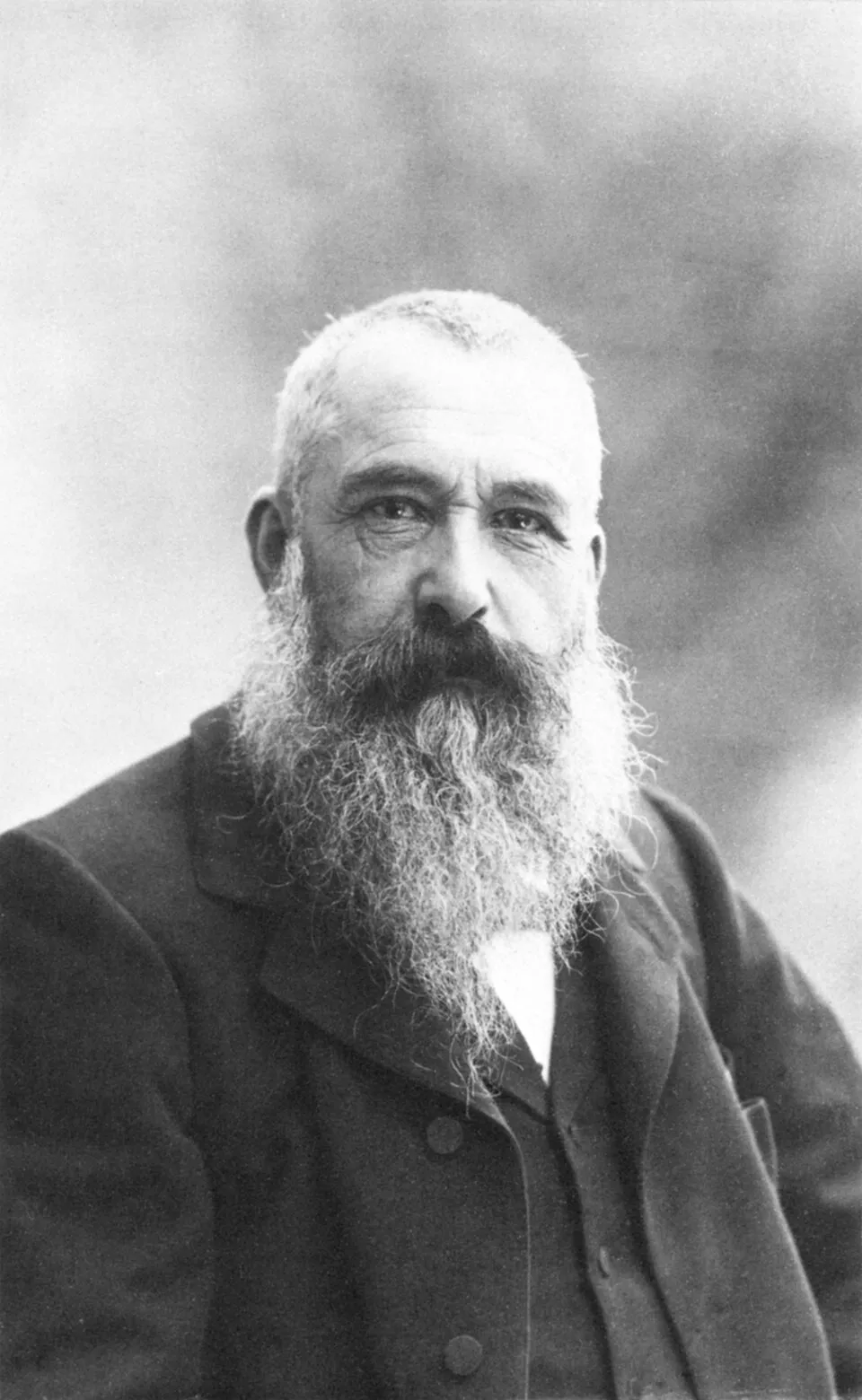
Celebrated as a founding figure of Impressionism, he is one of France’s most ren…
✦ Highlights (technique & color)
To depict the snow, thick applications of pure lead white were used as a base, over which delicate strokes of cobalt blue, rose, and pale yellow were layered, creating the optical vibration of sunlight scattering across the snowbanks. By applying paint wet-on-wet, he captured the tactile, three-dimensional mass of the snow.
✦ The setting of this painting
This painting depicts the village of Sandvika, located near the Norwegian capital of Oslo. At the center spans the cast-iron Løkke Bridge, erected in 1829, alongside red wooden houses nestled in the snow. Towering in the background is the sharp, rocky ridge of Mount Kolsås, a local landmark.
✦ Historical context
In 1895, at the age of 54, Monet traveled to Norway in search of fresh landscapes. Norway was then in the early stages of industrialization, and the Løkke Bridge was an emblematic structure of that era. Staying for about two months in frigid conditions, Monet took on the grueling challenge of painting en plein air while traveling by sleigh.
A scene of a snow-covered village.
It depicts red wooden houses and an arched bridge.
Behind them, a rugged mountain rises steep and tall.
It might look like a serene and beautiful winter scene.
A quintessentially Impressionist piece capturing the shimmer of light.
Yet in truth, traces of a blanket remain on the surface of this painting.
Recent research by the Art Institute of Chicago revealed a surprising fact.
Fibers, like those of a blanket, had been pressed against the paint before it dried.
January 28, 1895.
The 54-year-old Claude Monet departed from Giverny, France.
A long, arduous journey transferring across multiple trains and ferries.
His destination was Norway, a Nordic country.
On February 1, he arrived in Christiania.
What awaited him in the city—present-day Oslo—was a record-breaking cold wave.
A world of ice as far as the eye could see.
Even the surface of the fjords was completely frozen over.
Monet, who wished to capture reflections on the water, fell into deep despair.
What saved him was his stepson living locally.
Jacques Hoschedé.
The son of his wife Alice from her previous marriage, he arranged a sleigh for his stepfather.
And he accompanied him on a multi-day journey into the snowy expanse.
The sights from atop the sleigh.
Frozen waterfalls.
Vast snowfields.
Mount Kolsås glowing red in the setting sun.
Monet was captivated by its overwhelming beauty.
He based himself at a guesthouse in the village of Sandvika.
From there began nearly two months of grueling plein-air painting.
Fierce blizzards in temperatures tens of degrees below zero.
With his beard freezing over, Monet kept moving his brush from atop the sleigh.
The canvases were of the highest quality, ordered in advance from an art supply shop in Paris.
He had anticipated that procuring them locally would be difficult.
Onto them, he relentlessly worked to capture the brilliance of the snow.
Yet in the freezing cold outdoors, the paint would not dry quickly.
About 216 more words
Read stories of masterpieces for free
Your Note
Write down what this painting made you feel in your art notebook.
Please sign up to write notes.
Sign up for freeRecommended Artworks
Sources & references
More artists
If you find an error in this content, please let us know here
This site is protected by reCAPTCHA, and the Google Privacy Policy and Terms of Service apply.