
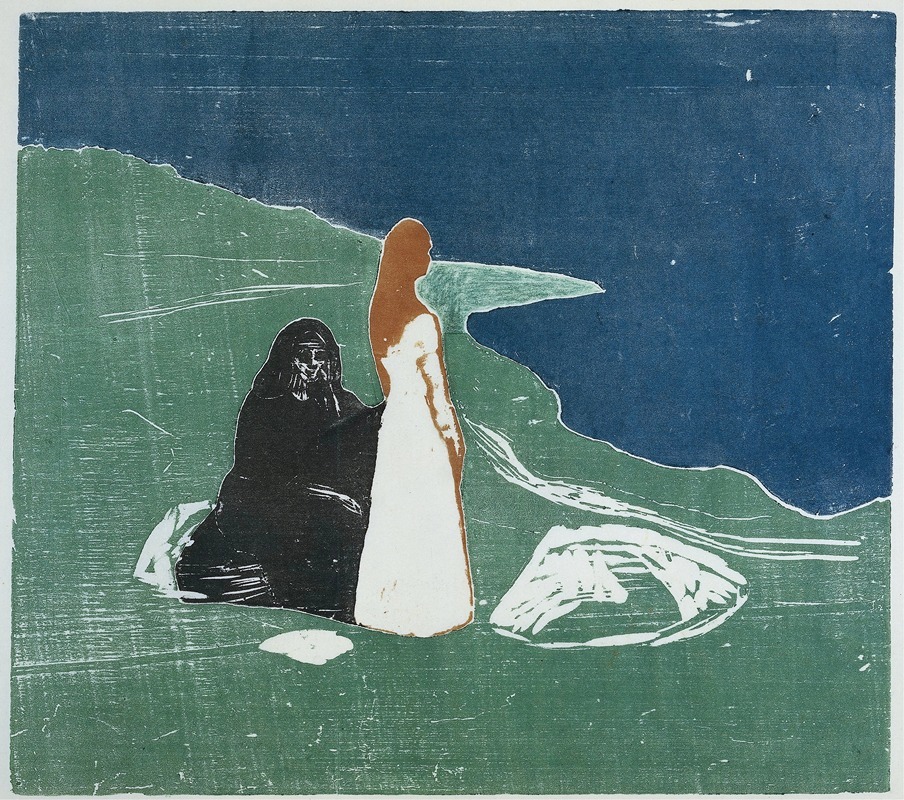
Two Women on the Shore
1898
- Dimensions
- 455 × 510 mm
- Medium
- Color woodcut (occasionally combined with linocut)
- Collection
- National Museum (Oslo), among others

A celebrated Norwegian painter active from the late nineteenth century to the fi…
✦ Highlights (technique & color)
Employing the jigsaw woodcut technique alongside elements of linocut, the coarse wood grain imparts an unsettling turbulence to the waves and sky in the background. In contrast, the women's garments are rendered in the smooth, matte planes of color characteristic of linocut, masterfully creating a textural dissonance between life and death, the material and the spiritual.
✦ The setting of this painting
The setting is the coast of Åsgårdstrand, a gentle shoreline scattered with rounded boulders of various sizes. Here, the rocks and the water symbolize the natural weathering brought by the passage of time, while also serving as an unsparing mirror that reflects the fate of the juxtaposed women—the inexorable decline of aging and death.
✦ Historical context
In the late 1890s, the literary world fiercely critiqued the social standing of women and the hypocrisy inherent in traditional family structures. Male bohemians harbored conflicting emotions: an ardent longing for women, intertwined with a profound dread of the inevitable aging and mortality they embodied.
There are two women on the shore.
One, dressed in white, faces the sea, while the other is clad in black.
The scene is set on the coast of Åsgårdstrand.
It is a gentle landscape, strewn with round boulders of various sizes.
In 1898.
Munch began to roughly carve the woodblock with his own hands.
Later, in 1906, he completed it as a multi-color woodcut in his Berlin studio.
In the late 1890s, he was preoccupied with expressing the fear and despair brought by human love.
Through the physical and spiritual transformations of women.
A theme he explored throughout his life.
It was the three stages of woman: the saint, the prostitute, and the old woman as a symbol of death.
The literary world of the time harshly denounced the hypocrisy inherent in the family system.
Men harbored longing for women.
At the same time, they also harbored an absolute fear of old age and death.
Munch visualized these conflicting emotions.
A young woman, clad in pure white, bright as if reflecting the light of the midnight sun itself, gazes at the sea with a yearning for the future.
And beside her, an old woman enveloped in darkness.
About 139 more words
Unlock this story's ending, and every article on MusicStory
- 42
Stories1–2 new every week
An archive of paintings paired with great music, made for a weekend night and a cup of coffee
- 282
Paintings with commentarygrowing daily
From simply looking to truly reading — the brushwork and the obsession of the masters
- 10
Music Librarygrowing daily
Know it first, and what reaches your ear changes — background music becomes art you keep for life
My Notes, unlimited
Every reading adds to a digital art notebook that is yours alone
Already have an account? Log in
Your Note
Write down what this painting made you feel in your art notebook.
Please sign up to write notes.
Sign up for freeRecommended Artworks
Sources & references
More artists




If you find an error in this content, please let us know here
This site is protected by reCAPTCHA, and the Google Privacy Policy and Terms of Service apply.