
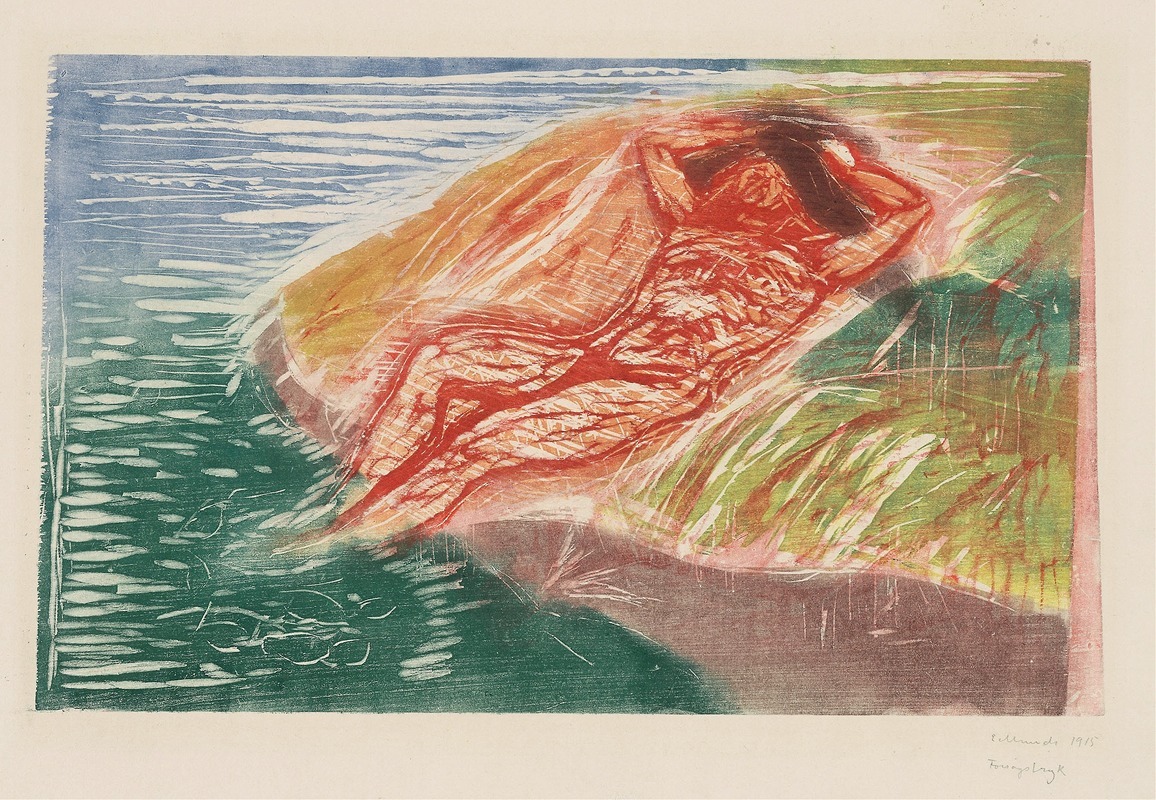
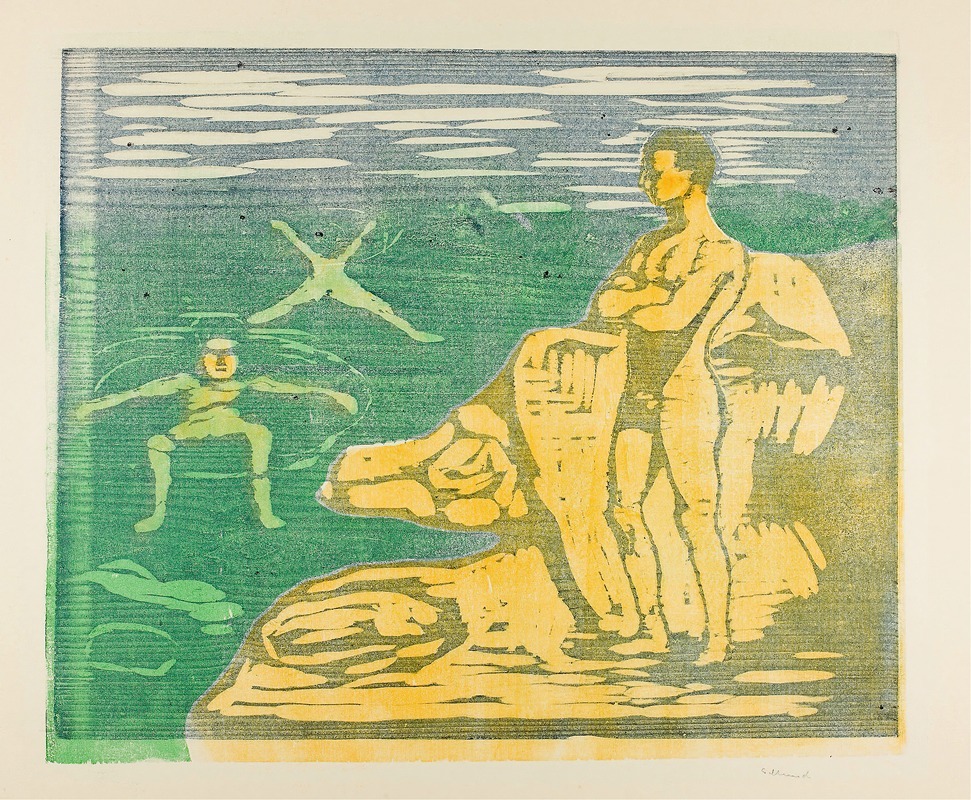
Sunbathing I
1915
- Dimensions
- 35.1 × 57.4 cm
- Medium
- Color woodcut on wove paper
- Collection
- Munch Museum (Oslo), The Art Institute of Chicago
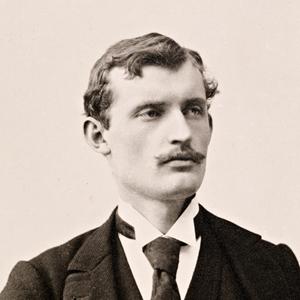
A celebrated Norwegian painter active from the late nineteenth century to the fi…
✦ Highlights (technique & color)
This remarkably intricate color woodcut was created using both sides of two woodblocks, utilizing four surfaces in total. As many as eight ink colors—including pink, orange, red, yellow, blue, and green—were layered in the printing process. The combination of bold gouge marks from rounded chisels and vibrant colors brilliantly captures the dynamic texture and radiant heat of the rock surface under the summer sun.
✦ The setting of this painting
The setting is the coastline of Hvitsten, a village situated on the eastern shore of the Oslo Fjord. It depicts the granite skerries, polished smooth by wind and waves, that lay directly before Nedre Ramme, an estate Munch purchased in 1910. These rounded rocks and the clear sea became an essential landscape symbolizing life's vital energy for Munch in his later years.
✦ Historical context
In early 20th-century Europe, Vitalism was rising in prominence as a reaction against the physical and mental exhaustion wrought by rapid industrialization. Sunbathing and naturism were widely encouraged to restore health through exposure to sunlight and seawater, marking an era of major social transition in which tanned skin evolved from a sign of manual labor into a status symbol of youth and vitality.
On the undulating rock surface.
A woman lies, bathed in the full light of the sun.
When you hear the name of the painter, Munch,
what comes to mind?
Most people probably imagine The Scream.
Anxiety.
Jealousy.
And the fear of death.
A painter who depicted a dark inner world.
That image might be very strong.
But in fact,
he had emerged from that darkness.
Into a world of dazzling sun and vibrant life.
In the late 1890s,
Munch suffered from severe neurasthenia and alcoholism.
Family illness.
The fear of hereditary madness.
His mind was on the verge of collapse.
However, in 1909,
Munch recovered from his long spiritual wandering.
He returned to his homeland, Norway.
The following year, he purchased a property in a village called Hvitsten.
That place, known as 'Nedre Ramme,'
had deep forests.
And a tranquil private beach.
In Europe at that time,
rapid industrialization had left urban dwellers suffering physically and mentally.
As a reaction, 'Lebensreform' (life reform) emerged.
Bathing in sunlight.
Immersing oneself in salty seawater.
Restoring human vitality through the power of nature.
Nudism and sunbathing became a major boom.
Munch, too, strongly resonated with this idea.
He himself would strip naked.
Set up his easel, and become one with nature.
His model was his maid, Ingeborg Kaurin.
She was Munch's greatest muse during this period.
About 157 more words
Read stories of masterpieces for free
Your Note
Write down what this painting made you feel in your art notebook.
Please sign up to write notes.
Sign up for freeRecommended Artworks
Sources & references
More artists
If you find an error in this content, please let us know here
This site is protected by reCAPTCHA, and the Google Privacy Policy and Terms of Service apply.