
The Sick Child I
1896
- Dimensions
- イメージ:42.2 × 57.0 cm / シート:50.6 × 66.4 cm
- Medium
- Color lithograph on paper
- Collection
- Munch Museum, MoMA, The Art Institute of Chicago, National Galleries of Scotland, and others
A celebrated Norwegian painter active from the late nineteenth century to the fi…
✦ Highlights (technique & color)
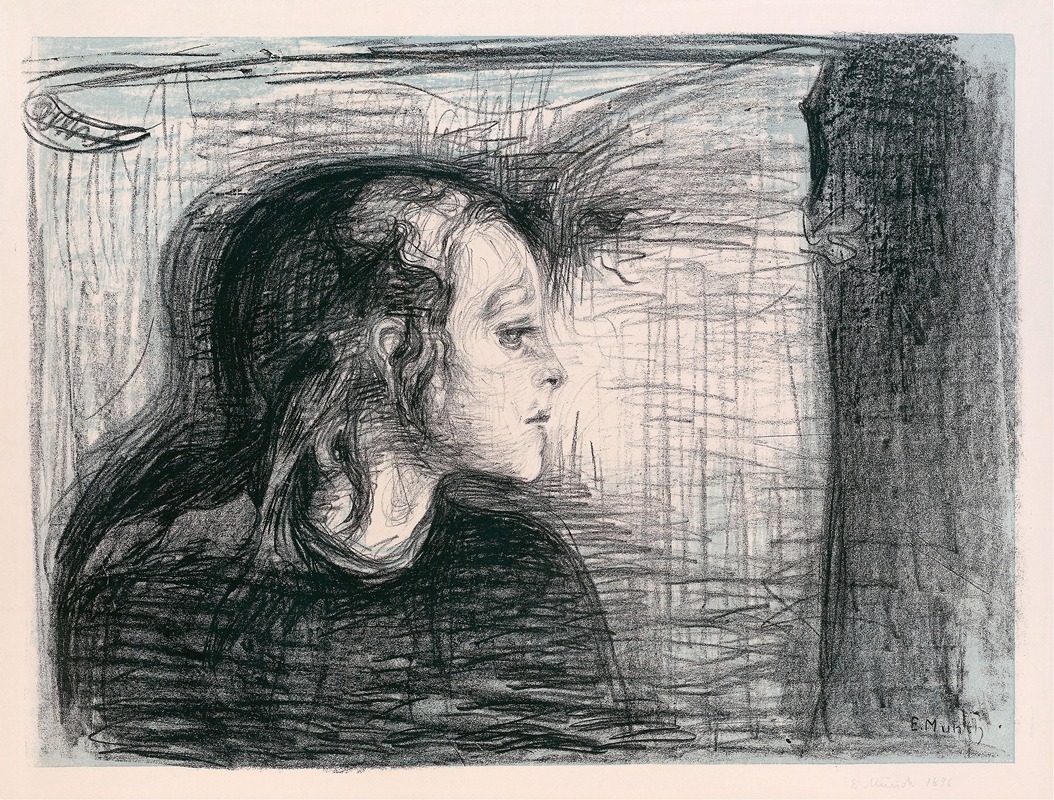
By boldly cropping the full figure of the aunt seen in the earlier oil painting, the composition brings the focus entirely to the profile of the young girl resting against the pure white pillow. The uninked, exposed paper to the right of her face evokes a sacred halo glowing around the maiden in the face of death.
✦ The setting of this painting
The setting is a sickroom in the Munch family home in Oslo. Lying in bed is Munch's sister, Johanne Sophie, who died of tuberculosis at the age of fifteen. Kneeling beside her, overcome with grief with her head bowed low, is her aunt Karen Bjølstad, holding her right hand.
✦ Historical context
In late 19th-century Europe, particularly in Scandinavia, tuberculosis was widespread and posed a grave social issue. In an era when effective medical treatments were virtually nonexistent, the deathbed of a child succumbing to the disease was a universal subject frequently explored by modern artists.
The profile of a young girl, resting her head on a large pillow, quietly emerges.
Beside her, the figure of a deeply bowed person clings like a dark shadow.
The subject depicted is Johanne Sophie, the sister of the painter Edvard Munch.
In 1877, she passed away from pulmonary tuberculosis at the tender age of 15.
The scene is the sickroom of the Munch family home in Oslo.
Beside the bed, his aunt, Karen Bjølstad, knelt in a dark dress.
Overwhelmed by grief, she bowed her head deeply, holding Sophie's right hand.
This deathbed scene became a poignant memory that would never fade for Munch throughout his life.
Approximately 20 years later, in 1896.
While staying in Paris, Munch undertook the challenge of reconstructing this memory as a print.
The setting was Auguste Clot's print workshop, renowned for its superior printing techniques in Paris.
During a test print, Paul Herrmann, a German painter accompanying Munch, witnessed an astonishing sight.
As the lithographic stones were arranged in the workshop, Munch suddenly closed his eyes tightly.
Then he pointed his index finger into the air.
As if conducting an invisible orchestra, he began to give loud instructions to Clot without ever opening his eyes.
Deliberately shutting out the objective reality perceived by his retina.
He directed the printing process solely by the intuition of his inner memory.
About 88 more words
Unlock this story's ending, and every article on MusicStory
- 42
Stories1–2 new every week
An archive of paintings paired with great music, made for a weekend night and a cup of coffee
- 282
Paintings with commentarygrowing daily
From simply looking to truly reading — the brushwork and the obsession of the masters
- 10
Music Librarygrowing daily
Know it first, and what reaches your ear changes — background music becomes art you keep for life
My Notes, unlimited
Every reading adds to a digital art notebook that is yours alone
Already have an account? Log in
Your Note
Write down what this painting made you feel in your art notebook.
Please sign up to write notes.
Sign up for freeRecommended Artworks
Sources & references
More artists

If you find an error in this content, please let us know here
This site is protected by reCAPTCHA, and the Google Privacy Policy and Terms of Service apply.