
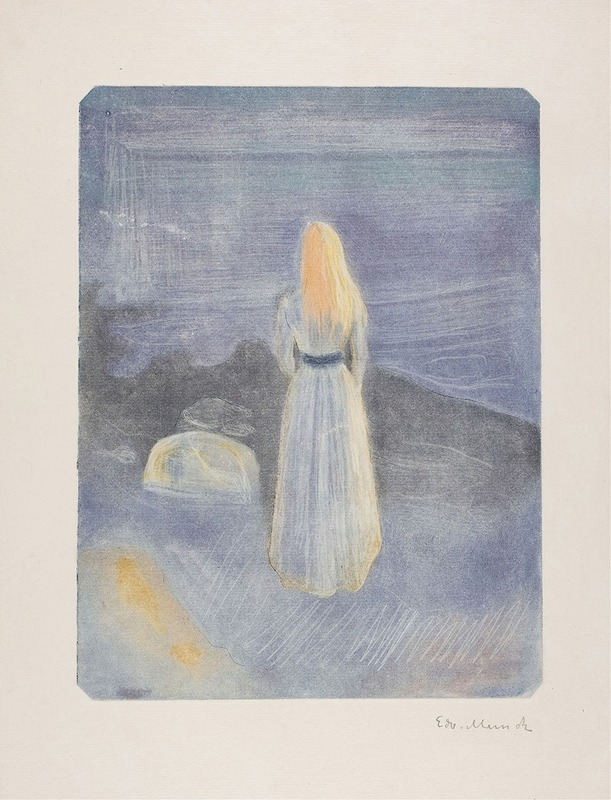
Young Woman on the Beach
1896
- Dimensions
- 図版:285 × 216 mm、用紙:450 × 307 mm
- Medium
- Intaglio (mezzotint and drypoint on sandblasted zinc plate), on wove or Japanese paper
- Collection
- Munch Museum (Oslo), Art Institute of Chicago, Fogg Museum (Harvard Art Museums), private collection
A celebrated Norwegian painter active from the late nineteenth century to the fi…
✦ Highlights (technique & color)
This intaglio print was made using a sandblasted zinc plate. The microscopic pits created by the impact of sand hold ink to produce soft, misty gradations, while sharp drypoint lines lend a crisp, firm definition to the contours of the figure's hair and garments.
✦ The setting of this painting
Set along the coastline of Åsgårdstrand, Norway, the scene depicts the ethereal white nights of summer, where a twilight glow lingers even at midnight. Characteristic elements include the dark sea meeting the shore and the rounded boulders scattered across the beach.
✦ Historical context
In 1896, Paris was at the peak of the printmaking revival. Through the efforts of Symbolist poets and publishers, printmaking was positioned at the forefront of the arts, inspiring Munch to engage with this sophisticated printing culture and innovate his own print techniques.
A hazy, blue seashore.
A woman in a white dress stands alone, her back to us.
Rounded boulders lie at her feet, and the gentle shoreline stretches endlessly.
In 1896, Edvard Munch was on an extended stay in Paris, France.
At that time, Paris was in the heyday of the printmaking revival movement, which regarded printmaking as the forefront of art.
Munch, who primarily painted in oils, was inspired by the advanced printing culture there and immersed himself in experimenting with printmaking techniques.
For this work, he chose an intaglio print using a zinc plate.
By applying sandblasting – that is, blowing sand onto the plate surface – he created countless tiny pores.
By holding ink in these pores, he produced soft, hazy, mist-like gradations.
Furthermore, he incised sharp lines using a technique called drypoint, giving a crisp contrast to the contours of the woman's clothing and hair.
The setting depicted is the coastline of Åsgårdstrand, Norway.
It is a summer midnight sun landscape, where the sun does not fully set even late at night.
Sigbjørn Obstfelder, a poet and close friend of Munch, reviewed his paintings in an art magazine that same year, stating:
“He sees the world in undulating lines. For him, the coastline, winding endlessly along the sea, is the very exploration of an inner self that fades away.”
About 78 more words
Unlock this story's ending, and every article on MusicStory
- 42
Stories1–2 new every week
An archive of paintings paired with great music, made for a weekend night and a cup of coffee
- 282
Paintings with commentarygrowing daily
From simply looking to truly reading — the brushwork and the obsession of the masters
- 10
Music Librarygrowing daily
Know it first, and what reaches your ear changes — background music becomes art you keep for life
My Notes, unlimited
Every reading adds to a digital art notebook that is yours alone
Already have an account? Log in
Your Note
Write down what this painting made you feel in your art notebook.
Please sign up to write notes.
Sign up for freeRecommended Artworks
.webp)
Sources & references
More artists


If you find an error in this content, please let us know here
This site is protected by reCAPTCHA, and the Google Privacy Policy and Terms of Service apply.