
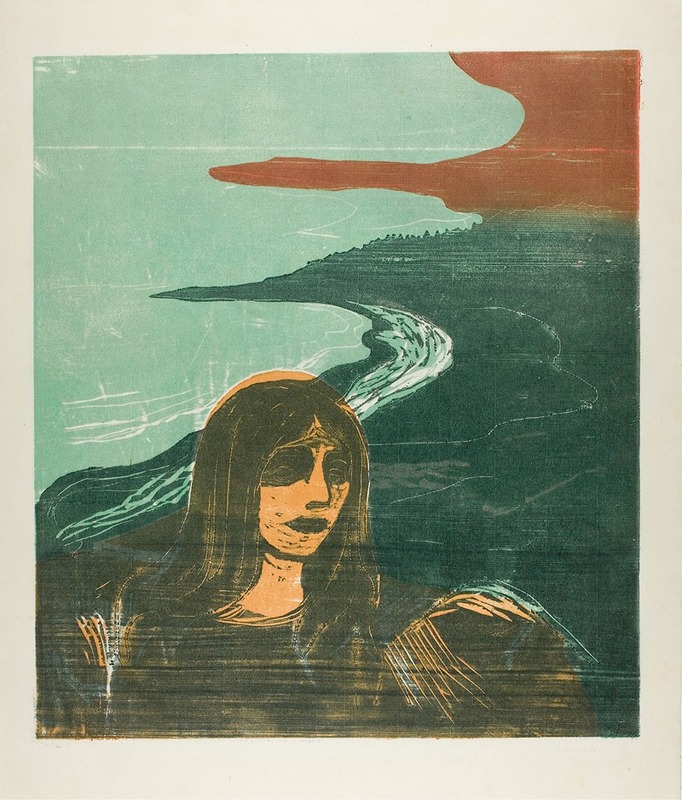
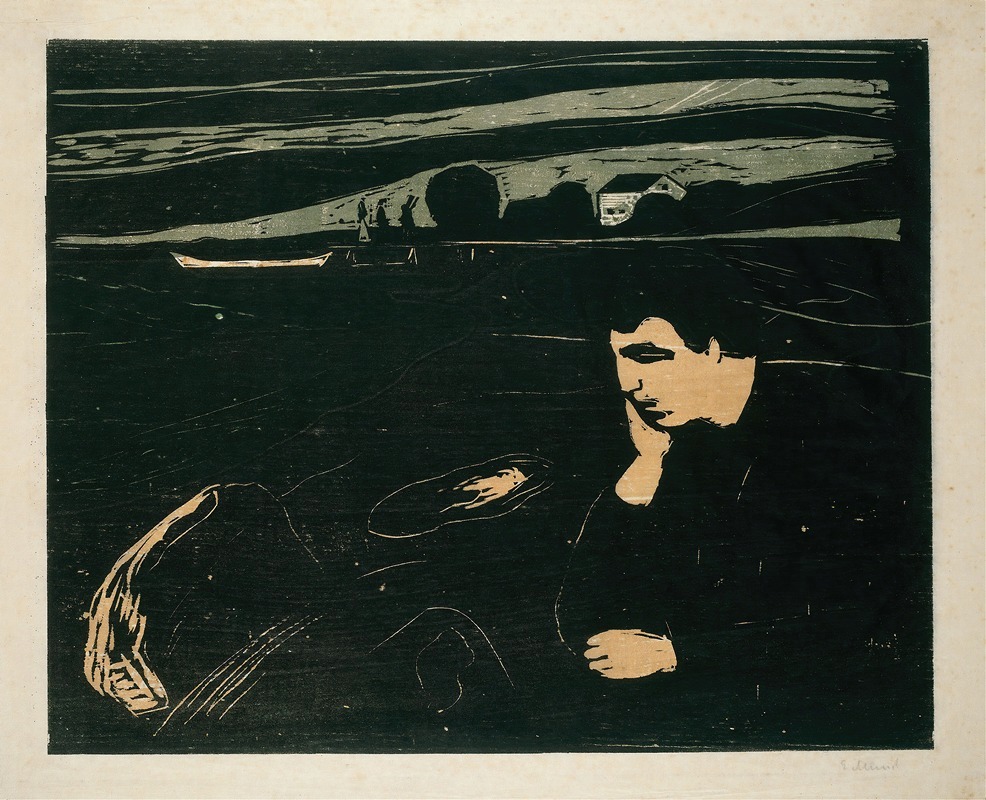
Woman’s Head against the Shore
1899
- Dimensions
- 465 × 410 mm
- Medium
- Woodcut
- Collection
- Munch Museum, Oslo
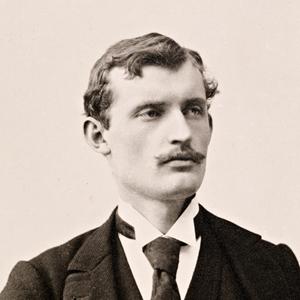
A celebrated Norwegian painter active from the late nineteenth century to the fi…
✦ Highlights (technique & color)
This piece employs the puzzle-block woodcut technique: two woodblocks were each cut into two pieces with a fretsaw, inked separately with different colors, and then reassembled like a jigsaw puzzle to be printed all at once. In addition, the prominent wood grain is deliberately emphasized to convey the raw, tactile texture of nature.
✦ The setting of this painting
This work depicts the coastline of Åsgårdstrand, a small coastal village situated on the eastern shore of the Oslofjord in southern Norway. Characterized by its gently undulating shoreline and rounded boulders, it was a vital sanctuary where Munch could escape the bustle of the city and project his inner emotions.
✦ Historical context
In the late 1890s, Western society saw a growing yearning for a return to nature and a heightened interest in the human psyche, largely as a reaction to rapid industrialization and urban life. Working between Paris and Berlin during this period, Munch sought to depict inner human struggles as universal themes.
Against an undulating coastline, a woman stands.
Her expression is somewhat vacant, casting a dark shadow.
In 1889, Edvard Munch visited this place for the first time with his family.
Åsgårdstrand, a small village in southern Norway.
The gently winding coastline and rounded boulders became the foundation of his inner landscape.
Two years later, in the summer of 1891.
Munch witnessed a tragedy in this seaside village.
His friend, Jappe Nilssen, fell in love with Oda Krohg, a married woman.
However, their love was never permitted.
The intense friction of love and hate brought about by the free love ideas of the time.
Jappe sank into the depths of despair.
Munch could only watch his friend suffer.
For he himself was also captivated by the inescapable themes of love and solitude.
In the late 1890s, Munch was actively working in Paris and Berlin.
The hustle and bustle of cities undergoing rapid industrialization.
As if escaping from it, he projected his inner anxieties onto the nature of this village.
The Åsgårdstrand coastline might have been a form of therapy for him.
About 71 more words
Read stories of masterpieces for free
Your Note
Write down what this painting made you feel in your art notebook.
Please sign up to write notes.
Sign up for freeRecommended Artworks
.webp)
Sources & references
More artists


If you find an error in this content, please let us know here
This site is protected by reCAPTCHA, and the Google Privacy Policy and Terms of Service apply.