
The Sea of Ice
1824
- Dimensions
- 96.7 × 126.9 cm
- Medium
- Oil on canvas
- Collection
- Hamburger Kunsthalle

Active from the late eighteenth to the early nineteenth century, this German pai…
A quiet resistance against a reactionary political order that suppressed freedom and a society that marginalized the artist. This indomitable spiritual manifesto conveys hopes shattered in desperate isolation, yet still soaring toward the heavens in towering monuments of ice.
✦ Highlights (technique & color)
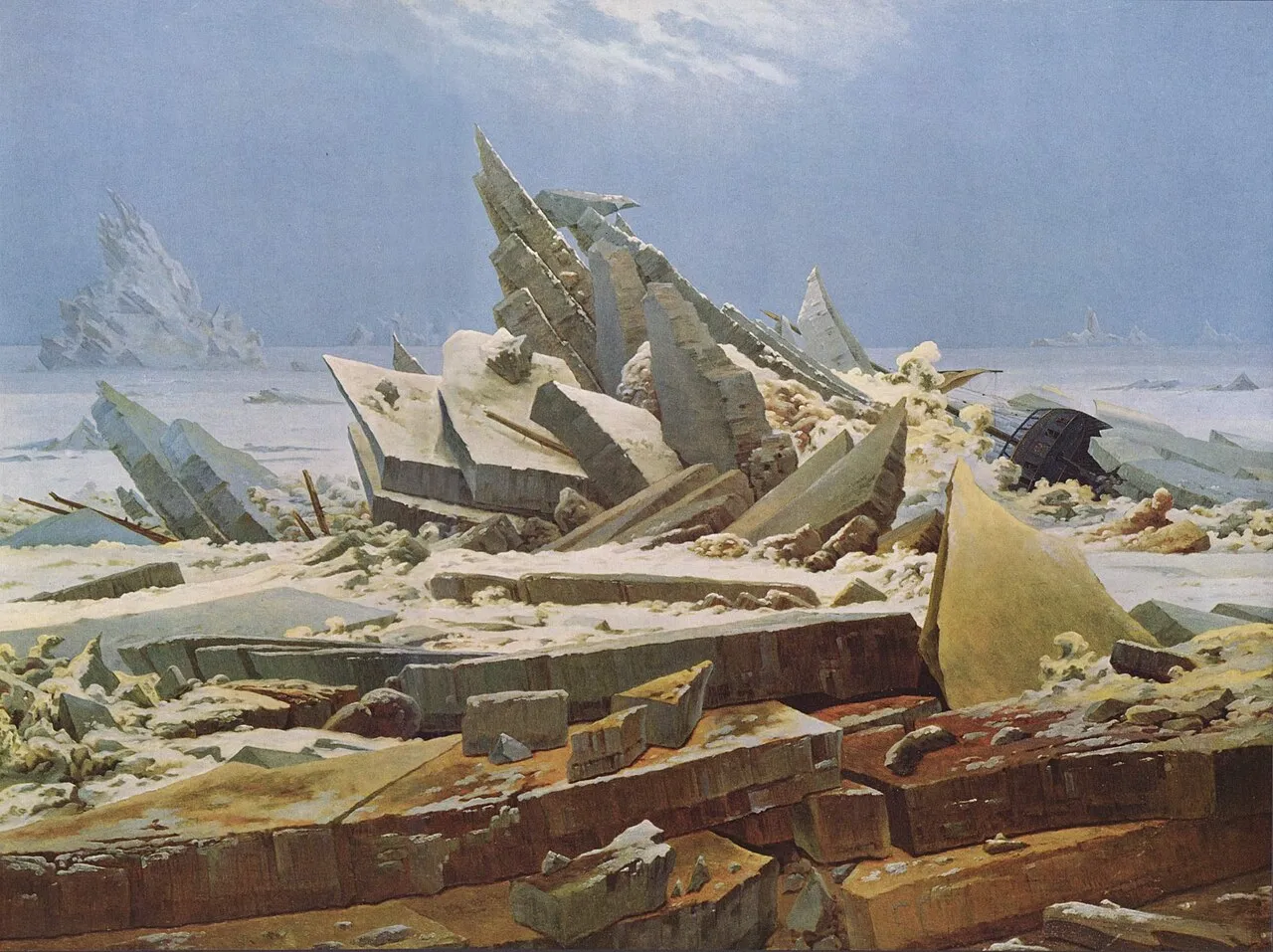
To evoke the extreme polar cold, the composition is dominated by chilly tones of blue, violet, and frigid white. In contrast, muddy yellows and dark browns are used for the wreckage of the wooden ship, underscoring the divide between man-made artifacts and untouched nature. Furthermore, while the sky in the background is rendered with subtle gradations of thinly layered, translucent paint, the edges of the ice floes in the foreground are worked in thick, opaque brushstrokes, accentuating their sharp and sculptural presence.
✦ The setting of this painting
The scene depicted in this work is not a study from life of the actual Arctic Ocean, but an idealized polar landscape synthesized through the artist's memory and imagination. The immediate inspiration for the ice formations was the Elbe River near Dresden, which froze solid during the severe cold wave of 1820–1821. Friedrich observed the massive ice floes piling up along the riverbank in person, and using those sketches, he constructed an unforgiving, pristine world of ice within his studio.
✦ Historical context
In the early nineteenth century, Arctic expeditions by the Royal Navy to discover the Northwest Passage were pursued as a national project and captured the public imagination. Politically, however, the establishment of the Congress of Vienna in 1815 ushered in strict censorship and intensified suppression of liberal ideas. Friedrich's depiction of a thwarted voyage and a frozen sea reflected this contemporary fascination with exploration, while also resonating eerily with the political deadlock of the era.
Monolithic, razor-sharp slabs of ice thrust violently toward the heavens.
Cold and heavy, their geometric forms evoke the solemn presence of a megalithic tomb.
Beneath them to the right lies a wooden ship, crushed and slowly sinking under the immense pressure of the ice.
To later generations, this painting became widely known as "The Wreck of Hope."
It is often described as a vivid documentary sketch of a tragic Arctic expedition, drawn from life.
Some even claim that the vessel's hull bears the inscribed name "Hope."
Explanations of this kind are frequently encountered online.
Yet in truth, the painter Caspar David Friedrich never set foot in the Arctic in his life.
He had never once laid eyes upon a polar iceberg.
The year was 1823.
The setting, Dresden.
At forty-nine, Friedrich found himself trapped in profound despair.
His wife, Caroline, fell gravely ill, and he sank into deep depression.
His anguish was laid bare in letters sent to his brother Adolf.
The following year, his long-cherished ambition to become a full professor at the Academy of Fine Arts was crushed.
Though appointed an associate professor, he was denied an adequate salary.
His liberal ideals, which dreamed of a unified Germany, were met with deep suspicion by the court.
Under the reactionary regime established in 1815, society was subjected to harsh censorship, plunging those who yearned for freedom into a prolonged spiritual freeze.
Isolation.
No one paid him any heed.
Stricken by financial hardship and cast aside by society,
he began this painting not on commission, but purely for himself.
For reference, he consulted publications and engravings documenting British polar expeditions.
The inspiration for the angular ice formations came from the drift ice on the nearby Elbe River.
A few winters earlier, a severe cold wave had frozen the river solid.
Friedrich had carried his art materials out to the bitter riverbanks, making sketch after sketch of the ice.
Recent scientific examinations using infrared reflectography have revealed an astonishing truth.
On the initial canvas, details of the ship's rigging and ropes were meticulously drawn.
Yet as the work progressed, Friedrich systematically painted over them with layer upon layer of pigment.
By his own hand, he deliberately erased the literal record of a specific maritime disaster.
His aim was to elevate a factual tragedy into something far more abstract and sublime.
About 201 more words
Read stories of masterpieces for free
Your Note
Write down what this painting made you feel in your art notebook.
Please sign up to write notes.
Sign up for freeRecommended Artworks



Sources & references
- Das Eismeer - Sammlung Online | Hamburger Kunsthalle
- Caspar David Friedrich Das Eismeer: Bidbeschreibung, Interpretation - ARTinWORDS
- Sammlung Online | Hamburger Kunsthalle
- Full text of "German Masters of the Nineteenth Century: Paintings and Drawings from the Federal Republic of Germany" - Internet Archive
- Caspar David Friedrich – Unendliche Landschaften | Kunst+Film
- Caspar David Friedrich - Sammlung Online | Hamburger Kunsthalle
- Alexander Kluge-Jahrbuch 9783847104209, 3847104209 - DOKUMEN.PUB
- Caspar David Friedrich Sold at Auction Prices - Invaluable.com
- Caspar David Friedrich (1774–1840) Das Eismeer, 1823/24 | Hamburger Kunsthalle
- Das Eismeer, Caspar David Friedrich Poster | Zazzle.at
- The Sea of Ice – 250 Jahre Caspar David Friedrich
- Das Eismeer von Caspar David Friedrich - KULTURA-EXTRA, das online-magazin
- Caspar David Friedrich - Wikipedia
- Caspar David Friedrich - AnthroWiki
- Caspar David Friedrich - WahooArt.com
More artists




If you find an error in this content, please let us know here
This site is protected by reCAPTCHA, and the Google Privacy Policy and Terms of Service apply.