
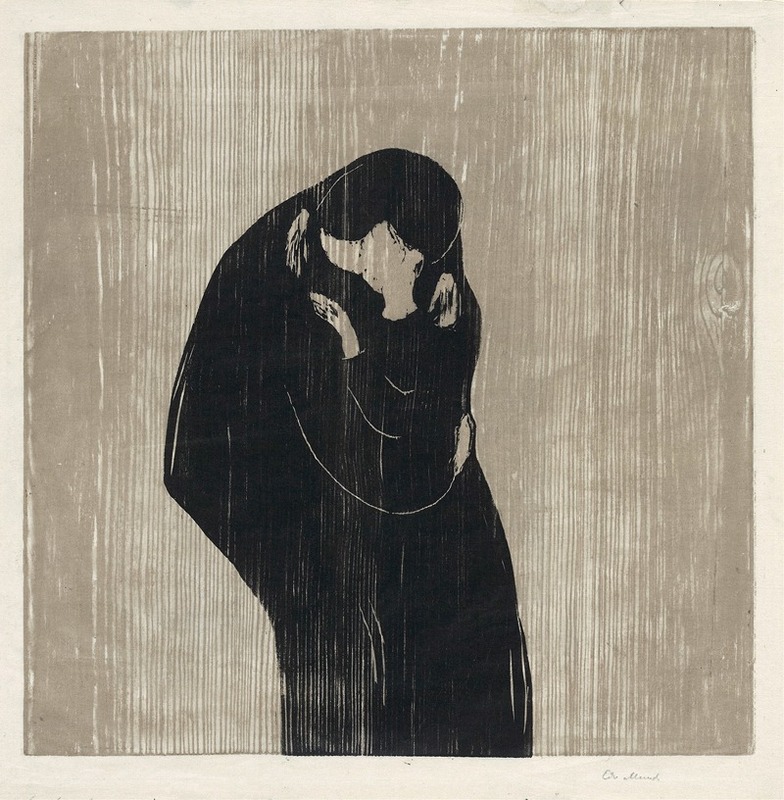
The Kiss IV
1902
- Dimensions
- イメージ:47.0 × 47.0 cm / シート:53.4 × 60.0 cm
- Medium
- Color woodcut on Japanese paper
- Collection
- Munch Museum (Oslo), among others
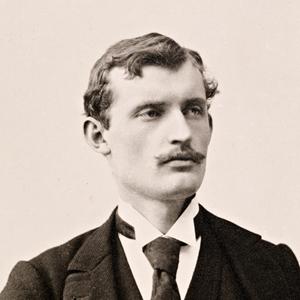
A celebrated Norwegian painter active from the late nineteenth century to the fi…
✦ Highlights (technique & color)
A key highlight is Munch's distinctive 'jigsaw puzzle' technique. Using a fretsaw, he cut a thick woodblock into two pieces—the figures and the background—applying black ink to the figures and gray ink to the background. For the background, he preserved the raw, natural grain of the pine. Reassembling the pieces like a puzzle, he printed them onto Japanese paper in a single pass of the press. This creates the remarkable effect of the figures and background maintaining distinct contours while achieving complete harmony through the underlying wood grain.
✦ The setting of this painting
In this work, any concrete everyday interior or view outside a window has been entirely banished. Devoid of elements that indicate a specific setting, the man and woman stand in the center of the composition like a monumental sculpture. The powerful vertical wood grain in the background creates a primordial space, suggesting that their union is not merely an occurrence in human society, but something directly bound to the fundamental will of the cosmos and nature itself.
✦ Historical context
Between 1891 and 1897, Munch repeatedly explored oil paintings of a couple embracing by a window. After turning this subject into an etching in 1895, his encounter with the woodcut medium catalyzed a sharp shift toward abstraction. Progressively reworking the woodblocks starting from The Kiss I in 1897, he ultimately arrived at this work, The Kiss IV, in 1902. Behind it lies a history of relentless technical experimentation in which he continually pushed the boundaries of printmaking.
Two figures embracing against a background of strong vertical wood grain.
No specific room details or outside scenery are depicted here.
The two stand monumentally in the center of the composition.
Edvard Munch dedicated many years to this motif.
Between 1891 and 1897, he repeatedly painted oil works of a man and woman embracing by a window.
In 1895, he rendered this composition as a copper engraving.
He did not stop.
His encounter with the medium of woodcut profoundly transformed his expression.
He created his first woodcut in 1897, followed by the next version the following year.
And finally, in 1902, he arrived at this work.
He separated the thick woodblock with a fretsaw.
The figures, and the background.
Their heads were scraped away with a rough chisel, as if torn.
Facial features such as eyes, nose, and mouth were completely obliterated.
Stripping away individual identity, he transformed the two embracing bodies into a single black silhouette.
For the background, he used the raw, unprocessed grain of pine or coniferous wood.
For the figures' block, he applied opaque black or dark gray ink.
For the background block, he applied gray ink.
He then reassembled them like a puzzle and printed them with a single impression.
While separating the figures and background, he harmonized them completely through the wood grain.
This was his invented 'jigsaw puzzle method'.
In the early 1900s, while living in Kvitsten, Norway, he left a pencil note on the back of one print.
'Edvard Munch, residing in Kvitsten, Norway. Title: The Embrace, woodcut from two blocks, price 200 dollars.'
A vivid record of his attempt to market his work directly to international collectors.
The initial plates for this print were made in the workshop of the Berlin craftsman Lassally.
And even after 1906, it continued to be printed on the finest Japanese paper imported from Japan.
About 45 more words
Unlock this story's ending, and every article on MusicStory
- 42
Stories1–2 new every week
An archive of paintings paired with great music, made for a weekend night and a cup of coffee
- 282
Paintings with commentarygrowing daily
From simply looking to truly reading — the brushwork and the obsession of the masters
- 10
Music Librarygrowing daily
Know it first, and what reaches your ear changes — background music becomes art you keep for life
My Notes, unlimited
Every reading adds to a digital art notebook that is yours alone
Already have an account? Log in
Your Note
Write down what this painting made you feel in your art notebook.
Please sign up to write notes.
Sign up for freeRecommended Artworks
.webp)
Sources & references
More artists


If you find an error in this content, please let us know here
This site is protected by reCAPTCHA, and the Google Privacy Policy and Terms of Service apply.