
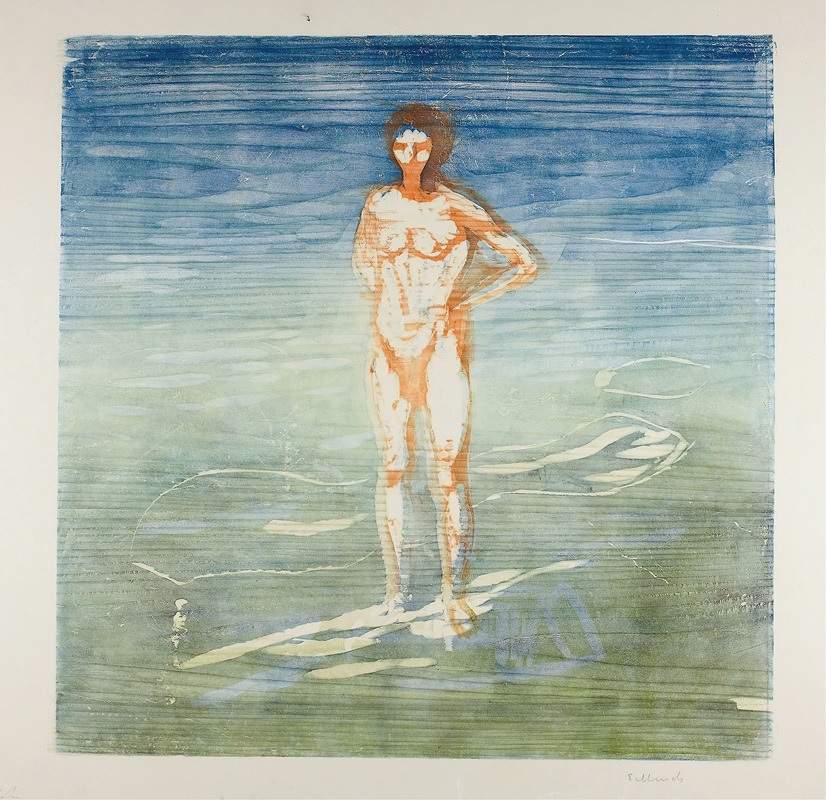
Man Bathing
1899
- Dimensions
- イメージ:44.4 × 44.4 cm / シート:48.7 × 66.2 cm
- Medium
- Color woodcut on wove or grey-ivory paper
- Collection
- Munch Museum, Oslo
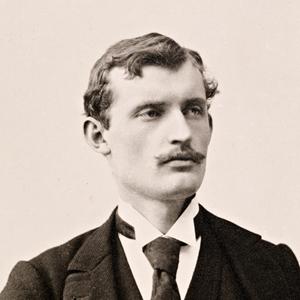
A celebrated Norwegian painter active from the late nineteenth century to the fi…
✦ Highlights (technique & color)
One of the consummate examples of the innovative 'puzzle woodcut' technique developed by Munch. He took a single hand-carved woodblock and physically sawed it into separate pieces—the man's body, the water, and the sky. He then inked each fragment with different colors (warm flesh tones for the body, cool blues and greens for the water), reassembled them like a jigsaw puzzle, and pulled the print in a single pass. As a result, while the figure and the water are distinctly separated, they remain seamlessly united through the continuous grain of the wood.
✦ The setting of this painting
The coast of Åsgårdstrand, a small fishing village along the Oslofjord about 100 kilometers south of Oslo. After his first visit in the summer of 1889, Munch spent every summer here, eventually purchasing a modest old house near the shore in 1898. The smooth, rounded granite rocks polished by glacial erosion and the gently rolling shoreline formed a symbolic setting for him, where vital energy and meditative stillness coexisted.
✦ Historical context
At the turn of the twentieth century, the Life Reform movement (Vitalism) gained momentum across Europe as a reaction against the perceived decadence of rapid urbanization and industrialization, advocating for natural healing, sunbathing, and open-air bathing in the nude. This philosophy sought to revitalize body and spirit through the pure forces of nature, far removed from urban corruption. Troubled by frail health and psychological trauma, Munch resonated with this movement, cultivating a deep yearning for physical vitality and enduring life energy.
A naked man stands facing forward, with his back to the water.
His hands are placed around his waist, and he gazes straight ahead.
His bright skin tone stands out in contrast to the blue and green striped background.
Edvard Munch is a painter best known for works like The Scream.
He is widely recognized for depicting somber themes such as anxiety, jealousy, and death.
The man in this painting, with his facial expression not clearly defined, might also appear somewhat solitary and lost in thought.
However, this work actually represents a bold shift in his direction, showing his attempt to break free from such a dark world and affirm vitality.
In the late 1890s, Munch was on the verge of a mental breakdown.
Chronic alcoholism and severe neurasthenia were deeply eroding his mind and body.
It wasn't just his own illness that tormented him.
In 1899, his beloved sister Laura's schizophrenia worsened.
She was forced to be admitted to a psychiatric hospital.
The oppressive family atmosphere, stemming from his father Christian Munch's fanatical faith.
Having grown up surrounded by the shadow of death since childhood, Munch was constantly exposed to the fear of hereditary illness running in his family.
He wondered if he too would someday completely lose his sanity.
He found himself at the bottom of a dark personal life, facing an inescapable fate of blood.
To escape this, Munch chose to confront his own body.
Around 1899, he stayed at his home in Åsgårdstrand and various sanatoriums.
He began to practice mental reconstruction, making outdoor sunbathing and cold water bathing part of his daily routine.
This resonated with the rise of vitalism that was sweeping across Europe at the time.
To move away from cities tainted by civilization and restore body and mind through the pure power of nature.
Munch sought to find hope for living in actions aimed at healing himself.
About 140 more words
Read stories of masterpieces for free
Your Note
Write down what this painting made you feel in your art notebook.
Please sign up to write notes.
Sign up for freeRecommended Artworks
.webp)
.webp)
Sources & references
More artists
If you find an error in this content, please let us know here
This site is protected by reCAPTCHA, and the Google Privacy Policy and Terms of Service apply.