
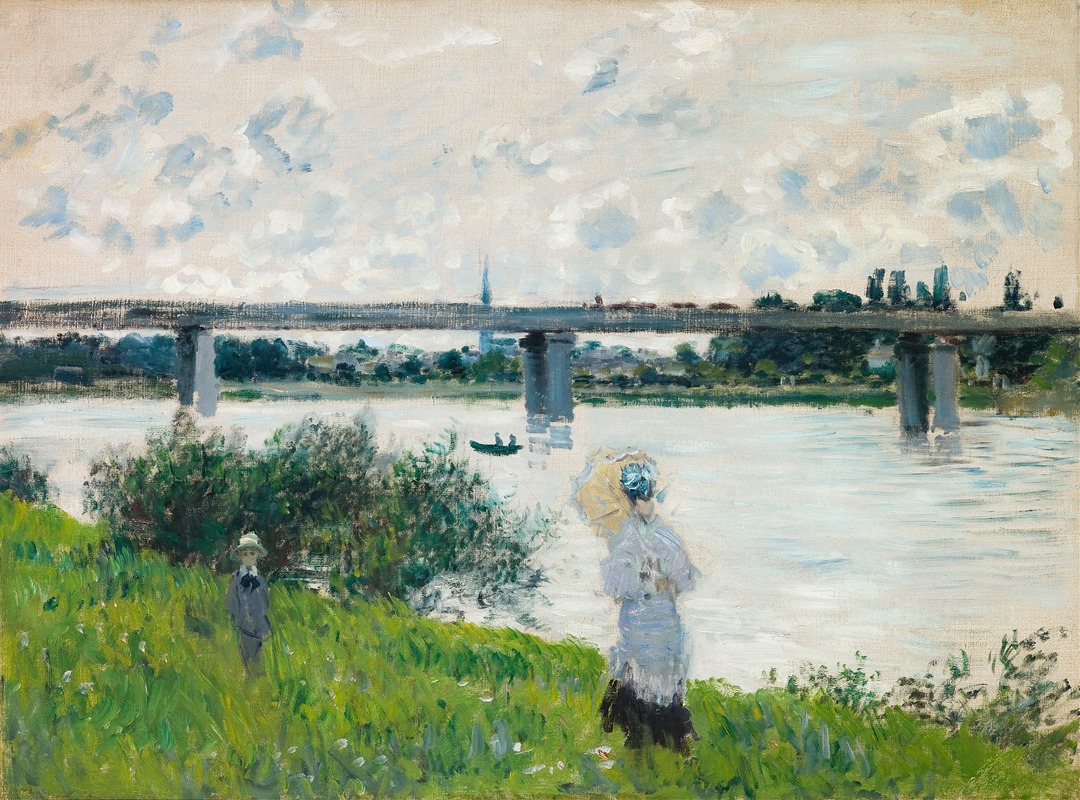
The Promenade with the Railroad Bridge, Argenteuil
1874
- Dimensions
- 53.7 × 72.1 cm
- Medium
- 油彩・カンヴァス
- Collection
- セントルイス美術館
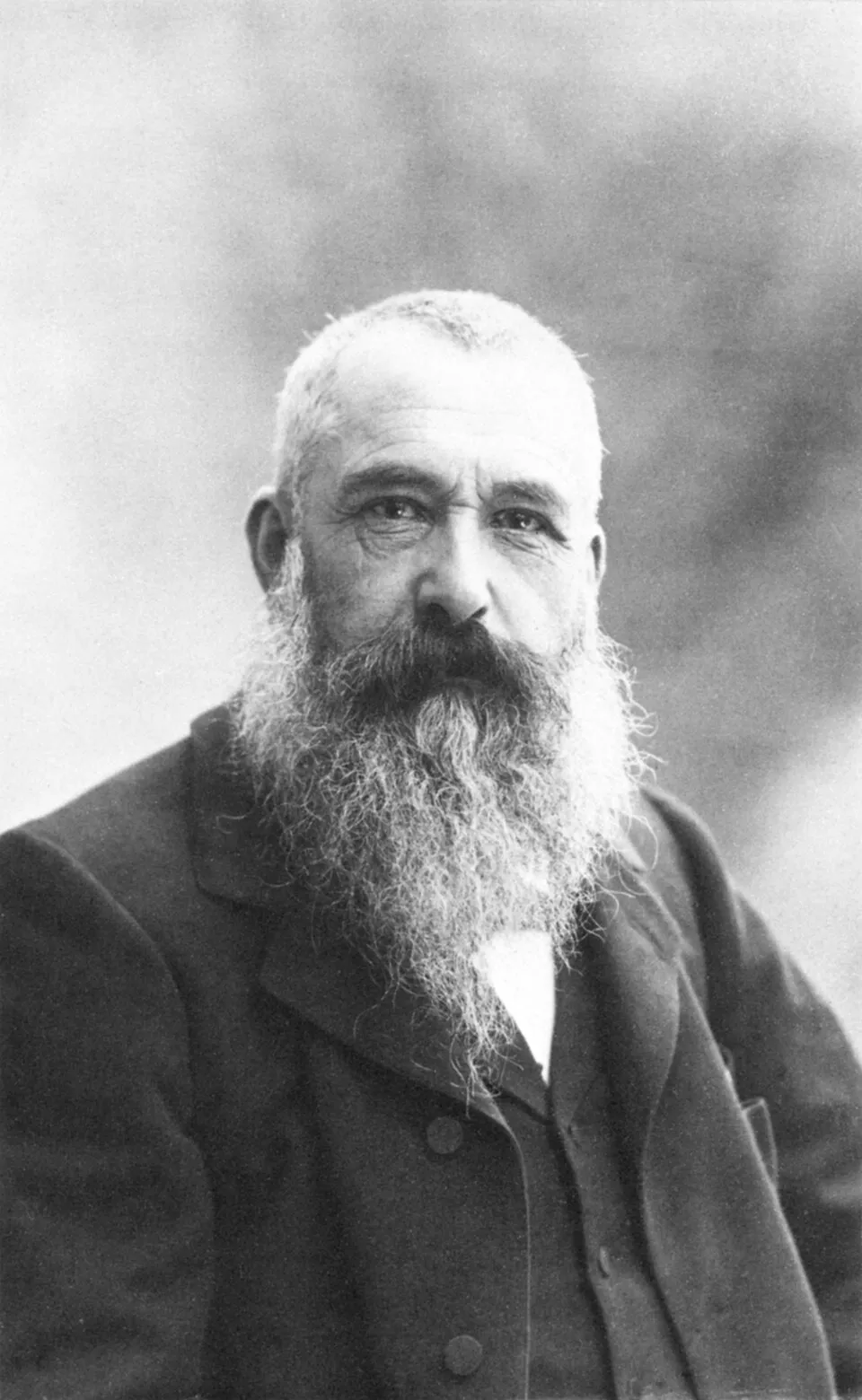
Celebrated as a founding figure of Impressionism, he is one of France’s most ren…
機械文明の象徴である鉄道橋と、自然の中で余暇を楽しむ家族の姿を同一画面上で調和させ、「現代生活の美」を美学的に昇華させること。
✦ Highlights (technique & color)
画面全体に淡い灰色の地塗りが意図的に透けて見えるように残されており、柔らかな大気感を生み出している。また、左手前のカミーユとジャンから、奥の鉄道橋、そしてたなびく蒸気煙へと視線を滑らかに誘導する構図が計算されている。
✦ The setting of this painting
パリの北西約11キロメートルに位置するセーヌ川沿いの街アルジャントゥイユ。対岸のプチ=ジェヌヴィリエ側から見たセーヌ川と、普仏戦争後に再建されたばかりの近代的な鉄道橋周辺の景観。
✦ Historical context
1874年、第1回印象派展が開催された年。鉄道網の発達により都市労働者やブルジョワ階級が郊外へ移動できるようになり、アルジャントゥイユはパリ市民の行楽地として急速に発展していた。
On the banks of the Seine, where an early summer breeze sweeps through, a woman holding a parasol and a young boy take a leisurely stroll. The hem of her pale dress sways in the wind, while the grasses and wildflowers beneath their feet glisten in the sunlight. Behind them, an immense iron bridge spans the blue water as a black steam locomotive rumbles across, trailing white smoke in its wake. Where the gentle rhythm of nature meets the powerful strides of modernization, this landscape stands as a quiet yet impassioned testament to an artist observing both his beloved family and the dawn of a new era.
A Family Stroll Painted by a Struggling Artist in the Birth Year of Impressionism
In the early summer of 1874, Claude Monet stood before his canvas in Argenteuil, a suburban town northwest of Paris. In the lower left foreground, his wife Camille, dressed in pale attire with a parasol, and their eldest son, Jean, are depicted enjoying a walk along the riverbank.
Just that spring, Monet and his circle of peers had held the First Impressionist Exhibition in Paris, where critics first hurled the label "Impressionists" at them. Monet was struggling financially at the time, as art dealer Paul Durand-Ruel faced financial difficulties, making it hard to sell paintings. Yet Monet's creative drive was at its peak, and he worked tirelessly outdoors in Argenteuil. Rather than a commission for a client or dealer, this depiction of a family walk was painted of his own volition in pursuit of his artistic ambitions. The passion for exploring a new pictorial language and the serene moments spent with his family quietly converge upon this single canvas.
Not an Idyllic Countryside, but State-of-the-Art Infrastructure
What Monet chose as the backdrop for his family was far more than an idyllic natural landscape. Crossing the river and spanning the canvas is a modern cast-iron railroad bridge. This bridge was cutting-edge infrastructure, newly rebuilt after having been destroyed during the Franco-Prussian War of 1870–1871. A steam locomotive, rendered in dark silhouette, speeds across the bridge, billowing trails of white smoke.
It was once commonly believed that Monet disliked the products of civilization and moved to Argenteuil purely in search of untouched nature. In reality, he settled there fully aware that the town was a modern suburb directly connected to Paris, just about a fifteen-minute train ride from the Gare Saint-Lazare. Far from turning a blind eye to the reality of rapid suburban urbanization, Monet actively welcomed the iron bridge and trains into his canvases as vibrant elements of modern life.
Why Were the Factories Left Out?
While Monet sought to capture modern landscapes faithfully, he did not simply transcribe everything that met his gaze onto the canvas. In reality, the area immediately adjacent to the Argenteuil railroad bridge was dotted with numerous factories, warehouses, and coal-unloading docks. Yet Monet deliberately cropped these utilitarian industrial facilities out of the frame.
Through this deliberate choice, Monet managed to convey the power of modern infrastructure while preserving an atmosphere of an elegant riverside path where citizens could comfortably enjoy a stroll. Rather than uncritically documenting reality as it was, Monet reconstructed the landscape through his own artistic vision, striving to achieve an aesthetic harmony between mechanical civilization and natural beauty within a single frame. As a practitioner of what poet Charles Baudelaire termed the "painter of modern life," Monet consciously selected the imagery that defined the new age.
A Shift in the Final Canvas of the Series of Five
Between 1873 and 1874, Monet created a total of five canvases centered on the railroad bridge at Argenteuil. In the earlier works from 1873, he positioned himself close to the bridge, emphasizing its imposing architectural structure. In subsequent pieces, his interest shifted toward exploring reflections on the water and atmospheric effects.
In this final work, Monet stepped back significantly, shifting his vantage point toward the promenade along the riverbank. By placing the stroll of his wife Camille and their son Jean in the foreground, he brought the series to its culmination. The horizontal line of the bridge dividing the composition intersects with the diagonal sweep of the promenade extending from the lower left into the distance, generating both depth and structural stability. The cold, mechanical iron bridge and the tender figures of his family—two seemingly contrasting elements—merge in exquisite harmony amidst the light and breeze of the Seine, crystallizing into a unified landscape.
About 498 more words
Read the rest of this commentary —
and step into a secret gallery
opened just for you
An "art letter" delivered to you every Saturday morning
Works, music and words chosen for your sensibility, from your artist-type result and the paintings you love
A library of masterpieces and music you can enjoy "in your own words", not just look at
A "digital art notebook" (unlimited) where your impressions build into your own taste
Unlimited likes and notes
¥980 / month¥0 today
¥980/month (tax incl.) from day 8. Cancel anytime.
Already have an account? Log in
Your Note
Write down what this painting made you feel in your art notebook.
Please sign up to write notes.
Sign up for freeRecommended Artworks
Sources & references
More artists

If you find an error in this content, please let us know here
This site is protected by reCAPTCHA, and the Google Privacy Policy and Terms of Service apply.