
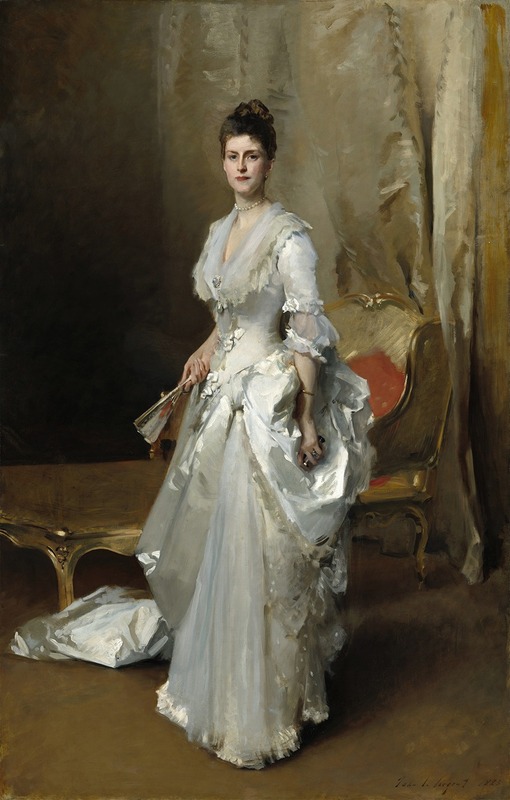
Margaret Stuyvesant Rutherfurd White (Mrs. Henry White)
1883
- Dimensions
- 225.1 × 143.8 cm
- Medium
- Oil on canvas
- Collection
- National Gallery of Art (Washington, D.C.)
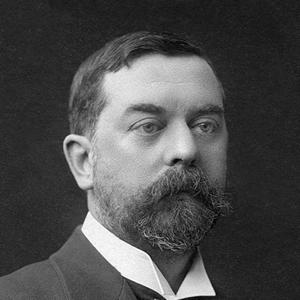
Born in Italy to American parents, he spent his early years in Paris before esta…
✦ Highlights (technique & color)
The varying textures of white—satin, lace, and tulle—are masterfully distinguished. The satin radiates a cool, bluish white, while the tulle shifts from warm beige to pure white. Sargent brilliantly captures how the gown appears to catch the light and glow, reflecting the ambiance of an era when evening soirees were illuminated primarily by gas lamps and candlelight.
✦ The setting of this painting
Work on the portrait began in Paris, continued with sittings in Nice in the South of France, and was completed back at the artist's Paris studio. In the background, a gilt-accented daybed and heavy drapery harmonize with the white of the dress, creating a refined setting reminiscent of an elegant Parisian salon.
✦ Historical context
In the early 1880s, Sargent was seeking to establish himself in high Parisian society. The sitter's husband served as the first secretary of the American legation in Paris, and the couple were prominent figures in transatlantic diplomatic and social circles. This work was one of Sargent's earliest and most significant commissions from American high society.
A woman in a white dress gazes quietly at us.
In her right hand, a fan; in her left, black opera glasses.
She seems to be on her way to a glamorous evening party.
Her name was Margaret White.
Her nickname was Daisy.
In 1882, at the age of 29, she was deeply impressed by John Singer Sargent's work at a Parisian salon.
She then commissioned him to paint her portrait.
Her husband, Henry White, was the first First Secretary at the American Legation in Paris.
The couple were true aristocrats, at the heart of European and American high society.
For Sargent, who was trying to establish his reputation in Paris, this was an absolutely crucial commission he couldn't afford to miss.
The painting began in late 1882 in Paris.
However, after only a few sessions,
Daisy departed for Nice in the South of France.
Normally, one would wait for her return.
But Sargent was different.
He carried the enormous canvas, over two meters tall, and followed her all the way to Nice.
He continued working there and then returned to his Paris studio to complete the painting.
About 146 more words
Read stories of masterpieces for free
Your Note
Write down what this painting made you feel in your art notebook.
Please sign up to write notes.
Sign up for freeRecommended Artworks

Sources & references
More artists




If you find an error in this content, please let us know here
This site is protected by reCAPTCHA, and the Google Privacy Policy and Terms of Service apply.