
Zdeňka Černý: The Greatest Bohemian Violoncellist
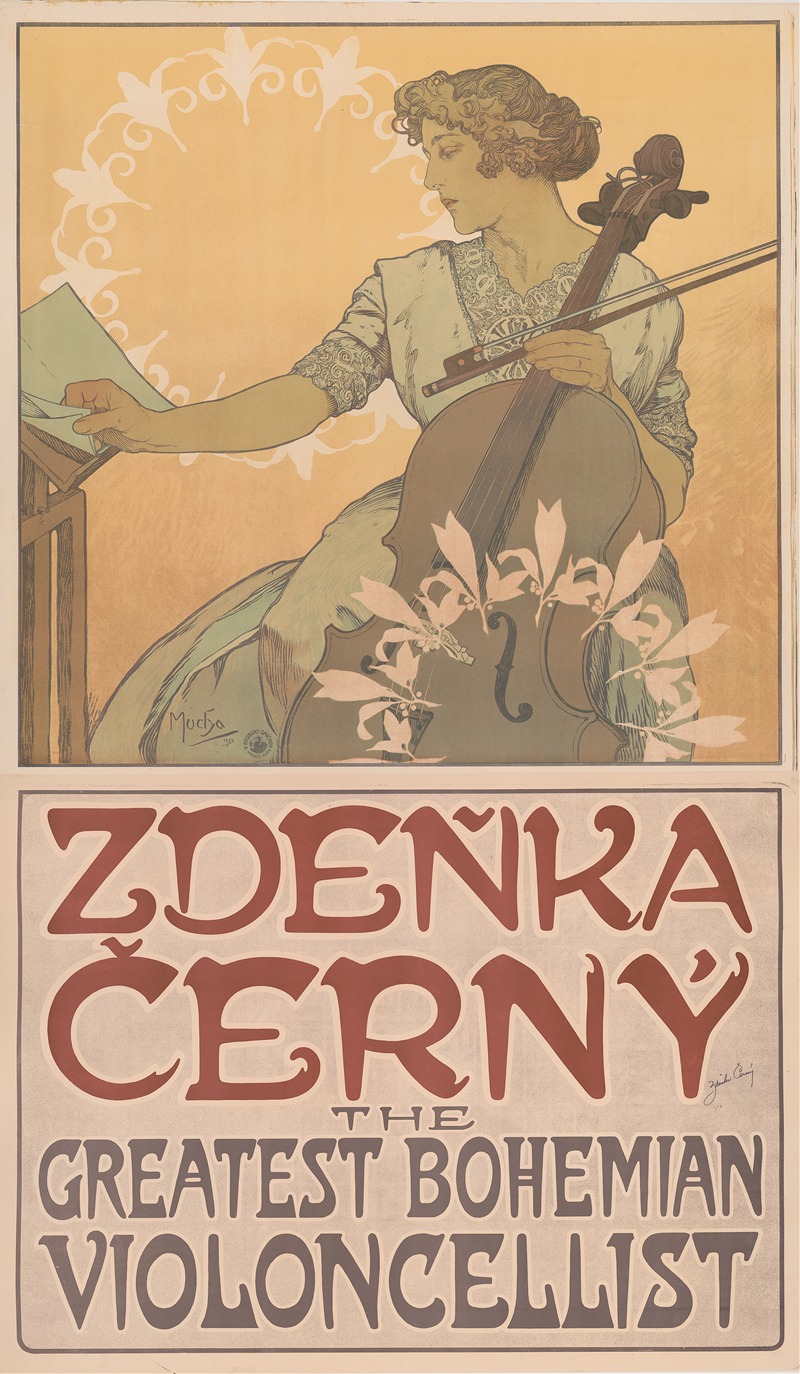
- Dimensions
- 189 x 110 cm
- Medium
- Color lithograph on paper
- Collection
- Mucha Museum, Prague
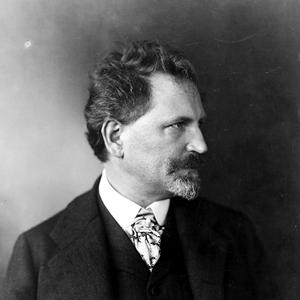
Alfons Maria Mucha, known internationally as Alphonse Mucha, was a Czech painter…
✦ Highlights (technique & color)
Although based on reference photographs, Mucha idealized Zdenka's features, lightened the tone of her hair, and delicately refined the pose of her hand turning the sheet music, imbuing her with the spiritual presence of a sacred "Muse of Music." The color scheme is distinguished by a warm, ethereal light that envelops her white-clad figure.
✦ The setting of this painting
While there is no specific real-world setting, the intricate folk-style medallions floating in the background evoke the indigenous musicality and spirituality of Slavic Bohemia, a passion of Mucha's. Two circular motifs—lilies symbolizing purity and laurels celebrating musical triumph—frame the composition, filling the space with a warm, sacred light reminiscent of the Bohemian landscape.
✦ Historical context
Created in 1913, this poster was intended to promote Zdenka's first major European concert tour, planned for 1914 to 1915. However, the outbreak of World War I in 1914 led to the tour's complete cancellation. Furthermore, following her marriage in 1916, she was forbidden from playing the cello, leaving this poster a testament to a tour that never came to be.
A young girl in a white dress cradles a large cello.
Quietly, she reaches her hand toward the sheet music.
In the background are lilies symbolizing purity and a wreath of laurels celebrating triumph.
A warm, sacred light fills the entire composition, evoking the land of Bohemia.
At first glance, it appears to be a poster celebrating the brilliant future of a young musician.
Indeed, it was created for her very first major European tour.
Yet in truth, this tour never came to pass.
Nor did she ever play the cello on stage again.
The story begins in Chicago in 1906.
At the time, the painter Alphonse Mucha was lodging at the home of a professor from the Chicago Conservatory of Music.
His name was Albert Vojtěch Černý.
There, Mucha met the professor's second daughter, seven-year-old Zdeňka.
Deeply moved by her extraordinary musical gift, the artist made a promise:
“When you become a first-rate musician, I will paint your portrait for a poster.”
The year was 1913.
Now sixteen, Zdeňka had blossomed into a true virtuoso of the cello.
The painter fulfilled his promise.
Though based on a real photograph, her features were idealized.
Her hair was rendered in brighter, luminous tones.
Subtle adjustments were also made to the gesture of her hand turning the score.
In this way, she was immortalized as a sacred muse of music.
A European tour was slated for 1914 through 1915.
This beautiful poster was printed to promote the concerts.
The doors to a dazzling future were on the verge of opening.
Then came 1914.
World War I erupted.
As the flames of war engulfed the world, the planned tour was entirely cancelled.
In 1916, another event sealed her fate.
Her marriage.
Her husband strictly forbade Zdeňka from continuing her career as a cellist.
Worse still, he would not even permit her to teach music to younger students.
A prodigy stripped of her cello.
She went on to live a remarkably long life, reaching 102 years of age.
Yet after the day of her wedding, she never played the cello again.
About 170 more words
Sign up free and enter Your Museum
Read the stories behind great paintings and music for free, in Your Museum
Your Note
Write down what this painting made you feel in your art notebook.
Please sign up to write notes.
Sign up for freeRecommended Artworks
Sources & references
More artists
If you find an error in this content, please let us know here
This site is protected by reCAPTCHA, and the Google Privacy Policy and Terms of Service apply.