
Eleanora O’Donnell Iselin (Mrs. Adrian Iselin)
1888
- Dimensions
- 153.7 × 93.0 cm
- Medium
- Oil on canvas
- Collection
- National Gallery of Art, Washington, D.C.

Born in Italy to American parents, he spent his early years in Paris before esta…
✦ Highlights (technique & color)
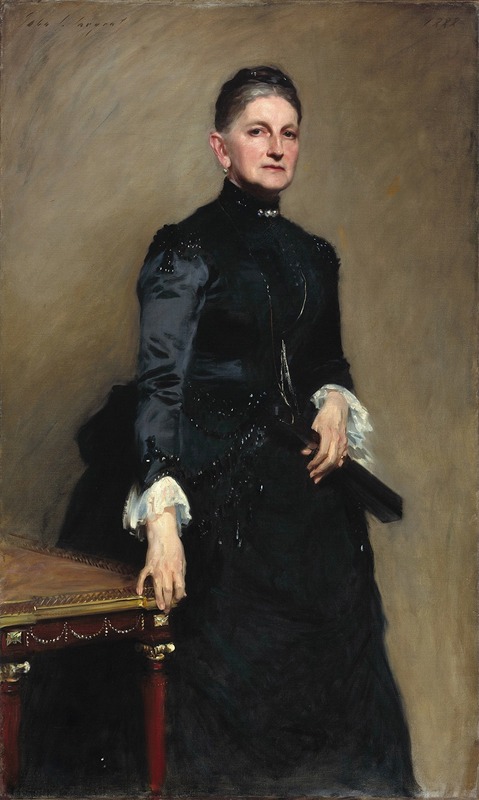
In a vertical, nearly full-length composition, Sargent displays his precise yet economical brushwork. The drapery of the black gown and the lustrous texture of the beads are captured with cool elegance through delicate highlights and smoothly blended strokes. Amid the sea of black, the pearls and gold jewelry radiate a solitary brilliance.
✦ The setting of this painting
The drawing room of the Iselin residence in New York City. The background is treated with striking simplicity, depicted as an unadorned wall in a warm caramel brown. This plain setting serves as a theatrical backdrop that accentuates Mrs. Iselin's formidable presence and dignity.
✦ Historical context
1888, during America's Gilded Age. After losing clients due to a scandal in Paris, Sargent achieved tremendous success during his professional painting tour of the United States. Amid the rise of the nouveau riche, this portrait of Mrs. Iselin, a leading lady of New York high society, symbolizes the status and sophistication of the era's upper class.
An elderly lady stands against a warm caramel-brown wall.
She wears a high-collared, tight black dress adorned with glossy black beads.
Her gray hair, parted in the middle, is gathered under a black lace cap.
In her left hand, she holds a tightly closed black fan.
And her gaze, piercing and intensely severe, seems to fixate on the viewer.
Her name is Eleanora O’Donnell Iselin.
Born into a distinguished Baltimore family and married to a wealthy banker in 1845, she reigned as the undisputed first lady of New York society.
Her impeccable black attire and dignified posture.
It certainly appears to be an official portrait, meticulously calculated by a woman of power and status from the upper class to immortalize her standing for posterity.
However, the truth is, at the moment this painting was created, she harbored strong dissatisfaction and bewilderment.
And the black dress she is wearing was not a special costume prepared for the portrait.
Spring 1888, New York.
The painter John Singer Sargent was visiting the Iselin family's drawing-room.
Sargent, who had lost his clientele in France after a work exhibited in Paris in 1884 caused a major scandal.
Despite relocating his base of operations and facing harsh criticism, his working trip to America proved to be a great success.
The wealthy elite of New York and Boston welcomed his modern touch, and Sargent was once again poised to reach the pinnacle of portraiture.
Mrs. Iselin, who welcomed him, was full of enthusiasm.
She entered the room with her maid carrying a mountain of luxurious ball gowns.
“Which dress should I wear for the portrait?”
For her, as a leader of society, a portrait was the ultimate stage to display her wealth and sophistication.
Naturally, she must have firmly believed that the most splendid dress would be chosen.
However, what came from Sargent's mouth was an unexpected request.
He immediately insisted that she pose in the strict black everyday dress she was wearing at the time.
The first lady, whose luxurious dresses were rejected and who was to be painted in her everyday attire.
Her dissatisfaction and bewilderment at this sudden demand created this displeased and severe expression.
A quiet yet intense psychological conflict arose between the painter and the sitter.
Sargent sought to capture not her adorned exterior, but the overwhelming dominance and dignity within her, drawing it out from her unadorned self.
About 145 more words
Read stories of masterpieces for free

Your Note
Write down what this painting made you feel in your art notebook.
Please sign up to write notes.
Sign up for freeRecommended Artworks





.webp)
Sources & references
More artists








If you find an error in this content, please let us know here
This site is protected by reCAPTCHA, and the Google Privacy Policy and Terms of Service apply.