
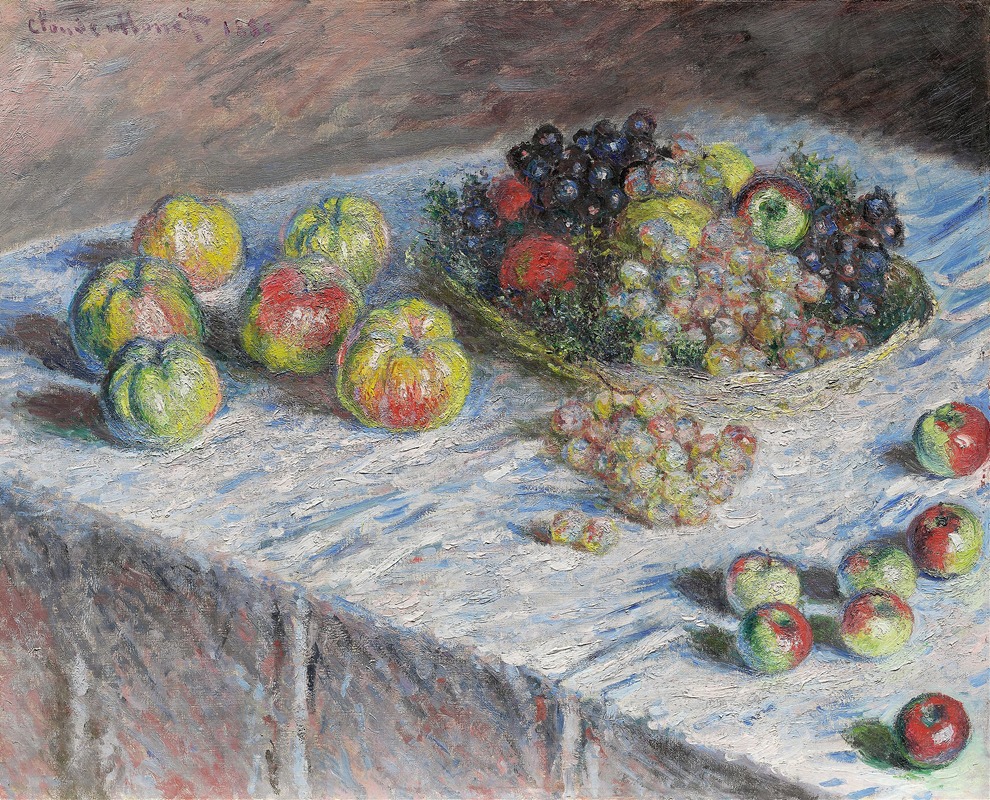
Apples and Grapes
1880
- Dimensions
- 65.0 × 81.0 cm
- Medium
- Oil on linen canvas
- Collection
- The Art Institute of Chicago
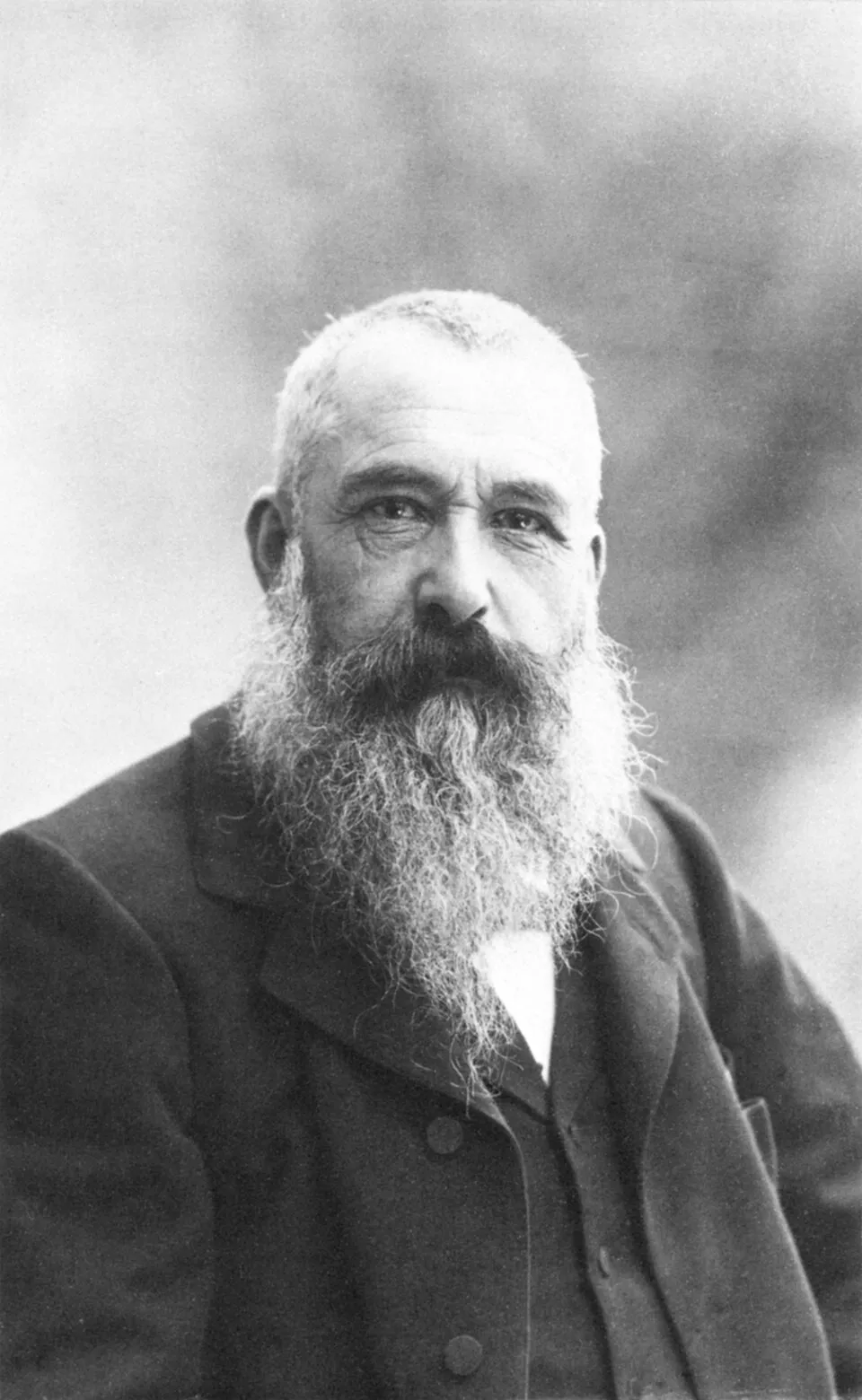
Celebrated as a founding figure of Impressionism, he is one of France’s most ren…
✦ Highlights (technique & color)
The composition, with the tabletop tilted steeply toward the viewer and the background depth flattened, reveals an affinity with the still lifes of Cézanne. The white tablecloth is rendered with fine, horizontal brushstrokes of blue, violet, and gray, closely echoing Monet's depiction of refracted light on water. In addition, he made skillful use of incising—scraping away the edges of wet paint with a pointed tool to expose the cream-colored ground beneath—to sharpen the contours of the fruit.
✦ The setting of this painting
The setting is the attic studio of Monet's home in Vétheuil, a quiet rural village along the Seine about 60 kilometers northwest of Paris. In the autumn of 1879, relentless heavy rains made painting outdoors physically impossible. Monet was therefore forced indoors, arranging local autumn harvests—apples and grapes—in a shallow wicker basket on a white tablecloth to compose this still life.
✦ Historical context
The years 1879 to 1880 marked the most harrowing emotional and financial trials of Monet's life. In September 1879, his beloved wife Camille died at the age of thirty-two. Furthermore, he became the sole breadwinner for his two sons, as well as Alice Hoschedé—the wife of his bankrupt patron—and her six children. With landscapes struggling to sell, Monet was strategically compelled to produce still lifes, which were popular on the art market and readily sought after by collectors.
A shallow wicker basket rests upon a white tablecloth.
Inside, an abundant autumn harvest of grapes and apples is heaped high.
A few more apples lie scattered casually around it.
The tabletop tilts dramatically toward the viewer.
The background wall and the depth of the room are scarcely visible.
Claude Monet is widely remembered as a landscape painter who pursued outdoor light and atmosphere.
Why, then, did this master of Impressionism confine himself indoors?
Why did he paint such classical still lifes?
In fact, from the autumn of 1879 into the following year, when this piece was created,
circumstances prevented him from painting en plein air.
One reason was the relentless, heavy rain that battered the village of Vétheuil.
The other was a profound sense of loss that shook him to his core.
On September 5, 1879,
his beloved wife Camille, who had modeled for so many of his works, passed away.
She was only 32.
Overcome with grief, Monet may have found it simply too painful
to gaze upon the outdoor landscapes where traces of Camille still lingered.
Retreating to his attic studio to paint still lifes
served as a self-protective shelter against his sorrow.
He had to sell paintings to survive.
Following Camille's death, Monet had two sons to support.
Moreover, he had to provide for the family of his patron, who had gone effectively bankrupt:
Ernest Hoschedé's wife, Alice, and her six children.
Monet found himself the sole provider for a household of nearly ten people.
Yet the landscapes he submitted to the Fourth Impressionist Exhibition in 1879 were met with cold indifference by critics.
Monet thus chose the subject matter that sold best in the art market.
He was compelled to strategically produce still lifes that collectors found accessible.
Alice's daughter Marthe, who would later become his stepdaughter,
wrote in her notebook in late November 1879:
"Monet is working very hard on some charming still lifes."
In December 1879,
amid the biting winter wind,
Monet borrowed 50 francs for travel expenses from the Vétheuil postmaster.
Carrying several completed still lifes, he made his way to Paris by foot and train through deep snow.
There, the art dealer Georges Petit purchased one of his still lifes for 500 francs,
allowing Monet to narrowly overcome his financial crisis.
About 168 more words
Sign up free and enter Your Museum
Read the stories behind great paintings and music for free, in Your Museum
Your Note
Write down what this painting made you feel in your art notebook.
Please sign up to write notes.
Sign up for freeRecommended Artworks
Sources & references
More artists
If you find an error in this content, please let us know here
This site is protected by reCAPTCHA, and the Google Privacy Policy and Terms of Service apply.