
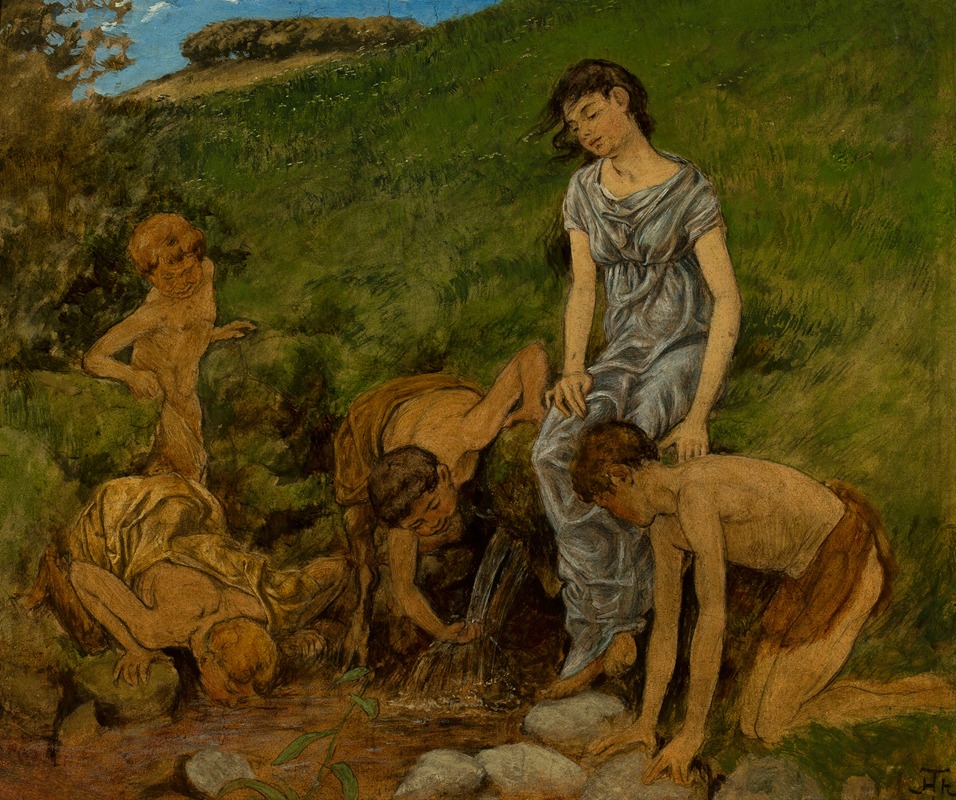
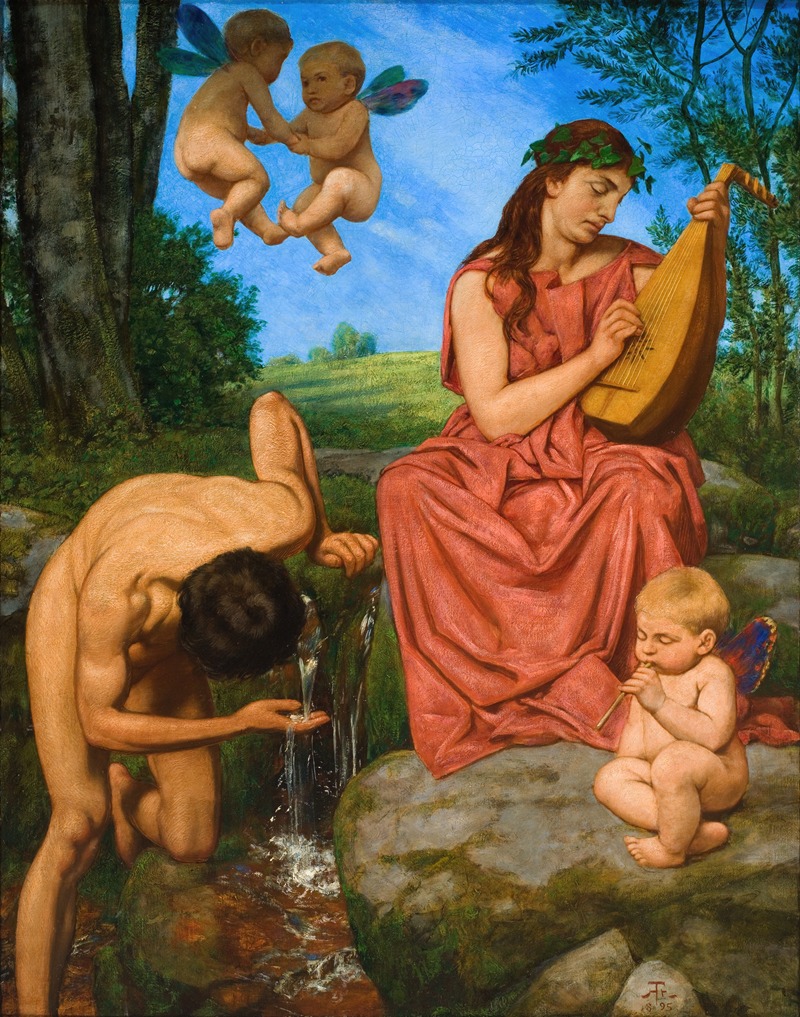
At the spring well
- Dimensions
- 縦 56.5 cm × 横 67.5 cm
- Medium
- Oil on cardboard
- Collection
- National Museum in Warsaw
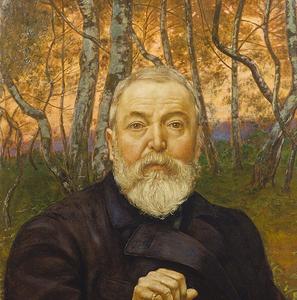
Hans Thoma was a German painter. He was born on 2 October 1839 in Bernau, Grand…
✦ Highlights (technique & color)
Using cardboard as a support, the artist achieves a rustic tranquility through meticulous contours and flatly applied areas of color. The deep moss greens and brown shadows form a vivid contrast with the shimmering water and the bright tones of the children's clothing.
✦ The setting of this painting
This landscape was inspired by the mountain streams and the "little brown brook" in Bernau, Hans Thoma's native region in the Black Forest. Set deep within lush woods dappled with sunlight, it depicts a tranquil natural spring and a rustic well.
✦ Historical context
In the early 20th century, the German Empire was undergoing rapid industrialization and urbanization. In response, the Heimatkunst movement—advocating a return to nature and expressing nostalgia for lost rural traditions—reached its height, and this work reflects that very zeitgeist.
Deep within a dense forest, dappled sunlight falls upon a quiet spring. Children bend low, playing in the clear, pristine water.
In the German Empire of the early twentieth century, a swift wave of industrialization and urbanization swept across the country. Amidst this upheaval, the Heimatkunst—or regional art movement—emerged, calling for a return to nature. In 1899, Hans Thoma was appointed director of the Kunsthalle Karlsruhe, revered as the movement’s spiritual pillar. Throughout his life, he returned again and again to the landscapes of his native Bernau: mountain streams and quiet, "little brown brooks."
The home where he grew up had a deep shingled roof and weathered wooden walls that had aged into rich, time-honored hues. Beside it lay a small enclosed flowerbed and a spring-fed well, forever brimming with water. It was around this very well that Thoma shared cherished memories with his mother, whom he revered as "unchanging goodness." Using handmade wooden models, his loving mother taught him astronomy—explaining the orbital motions of the Earth and the Moon—in lessons that ultimately forged his view of the cosmos and the natural world.
About 151 more words

Sign up free and enter Your Museum
Read the stories behind great paintings and music for free, in Your Museum
Your Note
Write down what this painting made you feel in your art notebook.
Please sign up to write notes.
Sign up for freeRecommended Artworks
Sources & references
More artists
If you find an error in this content, please let us know here
This site is protected by reCAPTCHA, and the Google Privacy Policy and Terms of Service apply.