
Senecio
1922
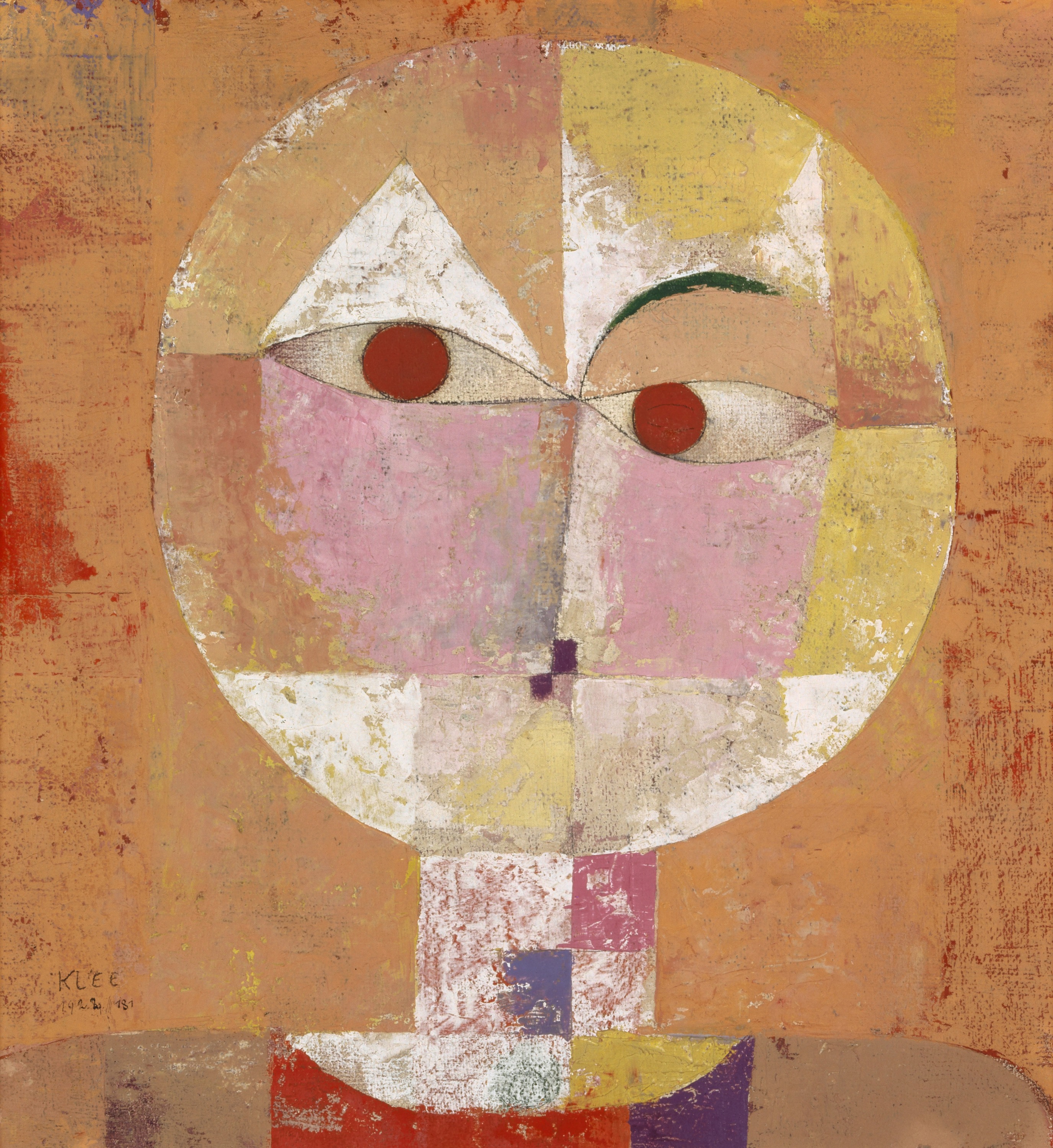
Image: Wikimedia Commons / Public Domain
- Dimensions
- 40.3 × 37.4 cm
- Medium
- Oil on chalk ground on gauze, mounted on cardboard
- Collection
- Kunstmuseum Basel
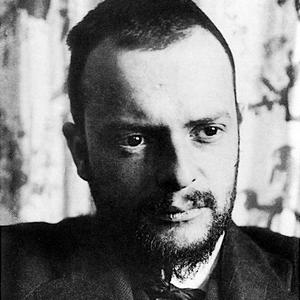
A Swiss-born painter of the early twentieth century who brought a rigorously str…
To deconstruct the conventional notion of portraiture as the likeness of a specific individual, using the dynamics of lines and planes to express the multifaceted nature of the human psyche and the transition between youth and age.
✦ Highlights (technique & color)
The complex, multi-layered construction—gauze mounted on cardboard, coated with a chalk ground, and painted in oil—creates a matte texture reminiscent of a fresco. Observing the asymmetrical arrangement of the eyes and eyebrows reveals an optical device whereby the figure's expression transforms endlessly depending on the viewer's gaze.
✦ The setting of this painting
Rather than a real geographical landscape, this is Paul Klee's theoretical exploration of spatial composition, developed within the Bauhaus as a crucible of artistic experimentation. It is a purely abstract space constructed entirely within the painter's mind.
✦ Historical context
1922. A period of social and technological innovation in the Weimar Republic as it sought recovery from the devastation of the First World War. At the Bauhaus, artists aimed to synthesize rational, geometric formal language with industrial technology.
In a quiet studio in Weimar, Germany. Amid the soft light filtering through the window, Paul Klee was engaged in an unspoken dialogue with the canvas before him. He was gazing at a large, near-circular face that dominated the composition. It was not a portrait of anyone in particular. Neither gender nor age could be discerned from this face, which looked back at Klee with a touch of the comical, yet tinged with a profound melancholy.
A Face of No One, Gazing Back at Everyone
1922. Europe, having endured the unprecedented devastation of the First World War, was striving to take its first steps into a new era despite its deep wounds. While teaching at the Bauhaus—the school of design that sought to unite art and craft—Klee was constantly questioning the essence of what it meant to be human.
At the Bauhaus in those days, rational, dispassionate geometric forms devoid of emotion and mechanical designs were coming into favor. Yet Klee's heart resisted surrendering entirely to this trend. The war had mercilessly exposed human frailty and folly. That was precisely why he yearned to capture on canvas human warmth and the fluctuations of the soul—qualities that cold theories could never fully resolve.
Onto a firm cardboard ground he affixed coarse gauze, carefully layering a chalk ground over it, as if gently bandaging and tending to wounded human skin. He then arranged warm colors—pinks, lavenders, ochres, and vermilions—like a mosaic.
For Klee, who had played the violin with near-professional skill since childhood, applying paint was akin to striking musical chords. Adjacent colors resonated with one another, and a quiet melody began to take shape across the entire surface.
Emerging from this sea of color was a round face partitioned by geometric lines. Yet it was far from a mere diagram. With every stroke of Klee's brush, it took on an enigmatic vitality.
About 522 more words
- ・A wondrous optical illusion born of asymmetric eyes
- ・The true meaning hidden behind the title 'Senecio'
- ・Klee's gaze, embracing human imperfection
Read the rest of this commentary —
and step into a secret gallery
opened just for you
An "art letter" delivered to you every Saturday morning
Works, music and words chosen for your sensibility, from your artist-type result and the paintings you love
A library of masterpieces and music you can enjoy "in your own words", not just look at
A "digital art notebook" (unlimited) where your impressions build into your own taste
Unlimited likes and notes
¥980 / month¥0 today
¥980/month (tax incl.) from day 8. Cancel anytime.
Already have an account? Log in
Your Note
Write down what this painting made you feel in your art notebook.
Please sign up to write notes.
Sign up for freeRecommended Artworks
Sources & references
More artists
If you find an error in this content, please let us know here
This site is protected by reCAPTCHA, and the Google Privacy Policy and Terms of Service apply.