
 日本語 (JA)
 English (EN)
- Dimensions
- 34.9 × 43.8 cm
- Medium
- 油彩・カンヴァス
- Collection
- メトロポリタン美術館
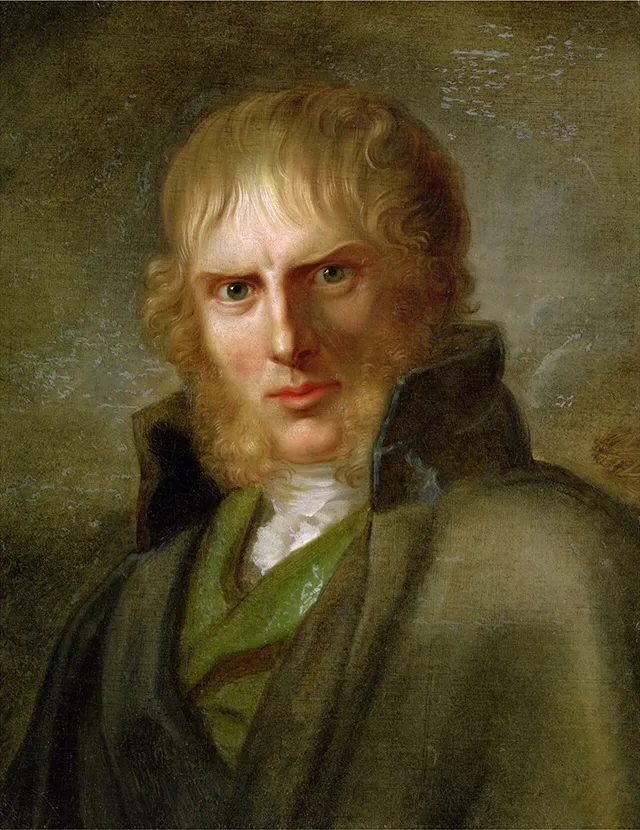
Active from the late eighteenth to the early nineteenth century, this German pai…
政治的弾圧や個人的な不遇という困難な現実の中でも、決して奪われることのない精神の自由と、無限の宇宙へと思いを馳せる人間の尊厳を静かに主張したかった。
✦ Highlights (technique & color)
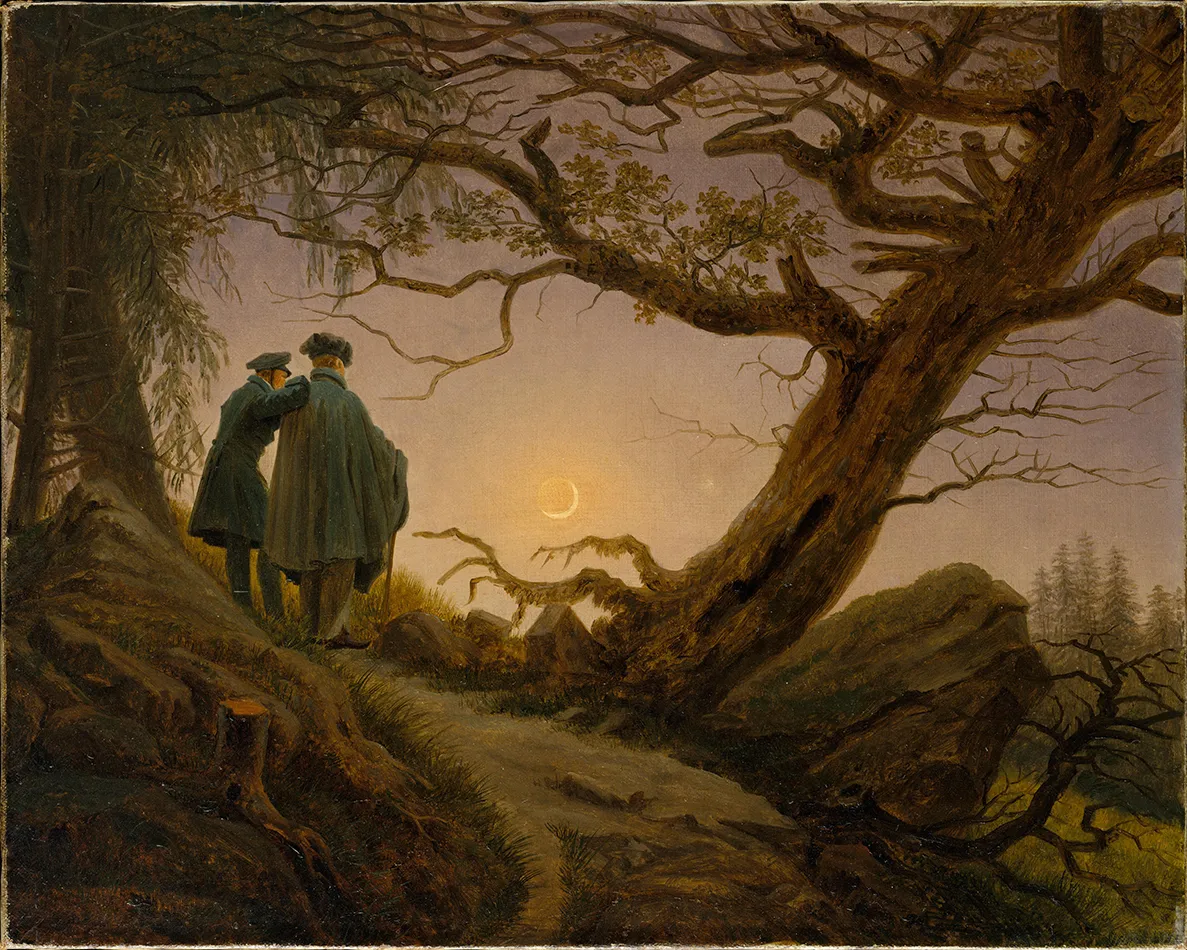
画面下部には巨岩や倒れた古オークの木が描かれ、そこから中景を飛ばして上部の輝く天空へと視線が導かれます。幾重にも塗り重ねられた極薄の油彩塗膜が、薄暮の空の微妙な微光や月光の透明感を生み出しています。
✦ The setting of this painting
実在する単一の場所ではなく、ハルツ山地やリューゲン島などで描いたスケッチをアトリエで再構成した「合成風景」。晩秋から初冬の、太陽が沈んだ直後の黄昏から夜へと移行する時間帯の山道。
✦ Historical context
ナポレオン追放後のウィーン体制下、1819年の「カールスバート決議」により言論・出版の検閲が強化され、自由主義的な学生組合や旧ドイツ装束の着用が禁止されるなど、強硬な復古主義と反動政治が敷かれていた時代。
As the sun sets and the deep stillness of twilight envelops the surroundings, two men pause along a rugged mountain path. Before their gaze, the evening star and a slender waxing crescent moon, faintly outlined in blue-gray, glow quietly in the sky. The man on the right leans upon a walking stick, standing upright, while the younger man on the left gently rests a hand on his shoulder in a quiet gesture of companionship. With their backs turned to us, they gaze in silence at the infinite heavens.
Caspar David Friedrich, the leading German painter of the nineteenth century, faced this small canvas in the quiet of his studio. His heart was stirred by lost hopes, political oppression, and personal sorrow. Yet the hand guiding his brush never wavered. Within this painting, he sought to enshrine the freedom and dignity of the human spirit—treasures that no harsh reality could ever take away.
What Are the Two Men Contemplating the Moon Doing?
Looking at the two figures gazing up at the moon in the dim forest, one might wonder if they are absorbed in astronomical observation. Indeed, a popular theory once held that the pair depicted here were engaged in scientific study. Yet their hands hold neither telescope nor surveying instruments. What they are doing is not scientific observation, but something far deeper—an act that touches the depths of the soul.
In the Romantic era in which Friedrich lived, gazing upon the moon and nocturnal landscapes held a significance far beyond the mere observation of nature. It was a religious and spiritual experience, a quiet communion between the individual soul and the vastness of God's creation, prompting deep reflection on the relationship between an infinite cosmos and finite humanity. In the cool night air, through nature, the two men speak of divinity, life, and death—or perhaps share these thoughts without needing words at all.
Friedrich did not create this serene spiritual landscape through intuition and passion alone. According to studies by art historian Werner Busch and others, the vertical and horizontal axes of the composition, the positions of the moon and the evening star, and the point where the leaning oak tree intersects the scene are all arranged with mathematical precision according to the golden ratio. Friedrich used geometric calculation to construct upon the canvas a revelation: that within the asymmetrical, wild scenery of nature lies a hidden, divine order. His rational, meticulous design lends this painting its unshakeable tranquility and sense of eternity.
A Quiet Rebellion in Forbidden Attire
A closer look at the garments worn by the two figures reveals Friedrich's resolute defiance against the social conditions of his time. The caped cloak and black velvet beret worn by the man on the right, and the frock coat worn by the young man on the left, comprise the traditional attire known as the "Old German costume."
In post-Napoleonic Germany, voices demanding freedom and unity grew stronger, but the authorities sought to suppress them by force. Under the Carlsbad Decrees of 1819, censorship of speech and the press was tightened, and liberal student fraternities were outlawed. The very act of wearing this "Old German costume," once a symbol of patriotism and solidarity, was strictly banned by law, branded as the dangerous activity of political dissidents.
Friedrich, who harbored deep sympathies for liberal ideals, refused to bend to authoritarian oppression. Evading the watchful eye of the censors, he continued to clothe the figures in his paintings in this forbidden attire. It was a quiet yet resolute message of protest in an age when one could not speak out loud.
It is said that one day, pointing out the two figures to his friend Johann Christian Dahl during a visit to his studio, Friedrich remarked with a touch of irony, "They are engaging in demagogic activities." Under the harsh grip of a police state, Friedrich kept the flame of an unyielding spirit of rebellion burning within the private sanctuary of his canvas.
Years of Hardship and a Gift to His Physician
In the late 1820s, when this work was painted, Friedrich's life was clouded by deep shadows. Though he had once been celebrated as a leading figure of his era, he now found himself in a difficult period of physical and emotional hardship.
In 1820, the murder of his close friend, the painter Gerhard von Kügelgen, left a deep wound in his heart. Furthermore, in 1824, he was passed over for the anticipated promotion to professor of landscape painting at the Dresden Academy. Public taste in art was also shifting; his mystical, symbolic landscapes came to be regarded as outmoded, and sales of his work fell sharply. Amid economic distress, his own health gradually began to show signs of decline.
Painted amid loneliness, illness, and financial strain, this work was not created on commission for a specific patron or client. Born of Friedrich's own inner exploration, the painting remained in his possession for some time after its completion.
Ultimately, the painting was never sold through an art dealer; instead, it passed into the hands of his physician, Dr. Otto Friedrich Rosenberg. Lacking cash income, Friedrich gave this work in kind as payment for medical care to the doctor who sustained his life. This fact reveals how financially destitute he was at the time, while also quietly testifying to the close bond of trust that existed between the artist and his physician.
A Silence of 160 Years and the Auction of the Century
After entering the hands of Dr. Rosenberg, this small masterpiece disappeared completely from the public art world. Following Friedrich's death, his name was rapidly forgotten, and the painting was passed down as an heirloom through generations of the Rosenberg family.
Never displayed in exhibitions nor reproduced in art monographs, the painting kept its quiet vigil on the walls of a private residence for more than 160 years. During that time, the world weathered two world wars, and artistic trends shifted dramatically, yet the two men contemplating the moon continued to watch over the family's history without change.
Then, in 1999, breaking its long silence, the painting suddenly appeared at an auction held at Christie's in London. With Friedrich's international reappraisal on the rise, the emergence of this legendary masterpiece sent ripples through the art world. Following fierce bidding, the painting was sold for the astonishing sum of approximately 1.27 million dollars.
The work subsequently entered the collection of the Metropolitan Museum of Art in New York. After more than 160 years, the personal gift that Friedrich had handed to his physician in gratitude began to shine once more, now as a treasure of humanity admired by people from across the globe.
About 619 more words
Read the rest of this commentary —
and step into a secret gallery
opened just for you
An "art letter" delivered to you every Saturday morning
Works, music and words chosen for your sensibility, from your artist-type result and the paintings you love
A library of masterpieces and music you can enjoy "in your own words", not just look at
A "digital art notebook" (unlimited) where your impressions build into your own taste
Unlimited likes and notes
¥980 / month¥0 today
¥980/month (tax incl.) from day 8. Cancel anytime.
Already have an account? Log in
Stories featuring this painting
Your Note
Write down what this painting made you feel in your art notebook.
Please sign up to write notes.
Sign up for freeRecommended Artworks
Sources & references
More art movements
Pre-Baroque
1 artworks
Victorian era
10 artworks
Impressionism
48 artworks
Late Pre-Raphaelite
10 artworks
Baroque
2 artworks
American Impressionism
5 artworks
Realism
4 artworks
Pre-Raphaelite
3 artworks
Barbizon School
5 artworks
Academic art
5 artworks
Luminism
3 artworks
Rococo
2 artworks
Symbolism
22 artworks
Neo-Impressionism
3 artworks
Ukiyo-e
1 artworks
Japonism
4 artworks
Edo period
1 artworks
Fauvism
1 artworks
Naturalism
9 artworks
Russian Realism
1 artworks
Post-Impressionism
13 artworks
Genre painting
9 artworks
Neoclassicism
3 artworks
ウィーン分離派
7 artworks
自然主義
1 artworks
ナショナル・ロマンティシズム
1 artworks
未来派
1 artworks
More artists
If you find an error in this content, please let us know here
This site is protected by reCAPTCHA, and the Google Privacy Policy and Terms of Service apply.