
Fugue in Red
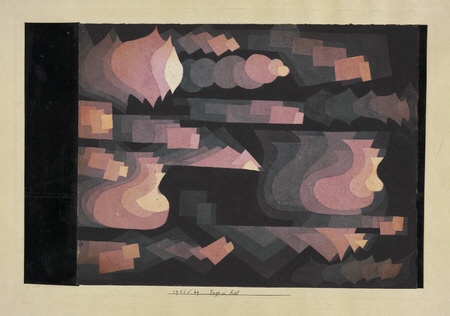
- Dimensions
- 24.4 × 31.5 cm
- Medium
- Watercolor and pencil on paper, mounted on cardboard
- Collection
- Private collection, Switzerland (on permanent loan to the Zentrum Paul Klee)
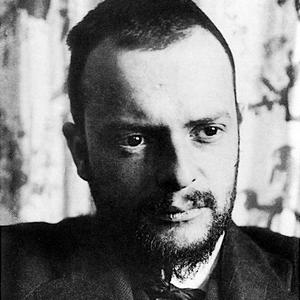
A Swiss-born painter of the early twentieth century who brought a rigorously str…
An experiment in introducing time and polyphony into painting, an art of space. Created to demonstrate form theory to Bauhaus students, this piece stands as the crystallization of theoretical inquiry, etching his musical thinking and meticulous calculation into the layered structure of watercolors.
✦ Highlights (technique & color)
After making a delicate preparatory pencil drawing on paper, Klee employed a technique of layering extremely thin, highly transparent watercolor washes. Utilizing the complementary contrast of indigo red and green, he engaged in an advanced backwards calculation—beginning with the lightest ground, reserving shapes as he painted, and ultimately grounding the background in black. The overlapping translucent layers resonate together, akin to musical counterpoint.
✦ The setting of this painting
This work does not depict an actual geographical location, but rather an autonomous, abstract pictorial space constructed purely through the artist's theoretical contemplation. Its true setting may be seen as the theoretical abstract space that Klee generated during his lectures on form at the Bauhaus in Weimar, Germany, in May 1921.
✦ Historical context
Following the defeat in the First World War, a movement seeking the integration of art and a new society flourished under the Weimar Republic. At the Bauhaus, education was conducted to unite various disciplines such as architecture, painting, and music. Drawing on Bach's counterpoint and contemporary musical theory, Klee pioneered "polyphonic painting," introducing the passage of time into the spatial art of painting.
Against a pitch-black background, shapes shift from red to green.
Geometric motifs like vases, circles, and rectangles.
Overlapping one another, they drift horizontally across the space.
Vivid forms seem to emerge from the darkness.
Given its title, "Fugue in Red," it is sometimes spoken of in this way:
that in the lingering excitement of listening to Bach, it was painted in a single breath upon a black canvas;
an intuitive work born of letting the brush follow raw emotion.
Yet in reality, the truth was quite different.
The order in which it was painted was the exact opposite of what meets the eye.
1921.
Weimar, Germany.
Paul Klee was appointed as a master at the newly founded Bauhaus.
Recognition as an avant-garde painter, alongside a stable income.
It was the dawn of a brilliant career.
Yet reality was far from easy.
Building a new educational program.
Developing lecture curricula.
Enormous labor and endless expenses.
In letters from that time, Klee vented his frustrations about money.
He even jokingly referred to these relentless struggles as a "pedal point of a fugue."
Amidst such demanding days.
In early May, Klee began painting a model piece to show his students.
How to depict "time" within the spatial realm of painting.
That was his challenge.
He took Bach's counterpoint as his model.
A structure where multiple voices move independently while weaving together a single piece of music.
This was what he sought to realize on canvas.
Recent scientific analyses have revealed the astonishing process behind this painting.
We perceive the work as moving from the dark left to the bright right, from the background toward the foreground—
as if bright colors had been layered onto a black ground.
It was the exact reverse.
Klee began by applying the lightest, pale red onto the pristine white paper.
Then, leaving overlapping shapes in reserve like white silhouettes, he built up progressively deeper shades of red.
Next, he applied layers of green watercolor in the same manner.
Thin, transparent glazes, layer upon delicate layer.
The last color he reached for was black.
He washed black paint across the surface, enveloping the entire background.
This was no spontaneous, single-stroke creation.
Starting from the brightest light and calculating backward into darkness,
it was an exquisitely meticulous, thoroughly calculated experiment.
About 127 more words
Read stories of masterpieces for free
Your Note
Write down what this painting made you feel in your art notebook.
Please sign up to write notes.
Sign up for freeRecommended Artworks
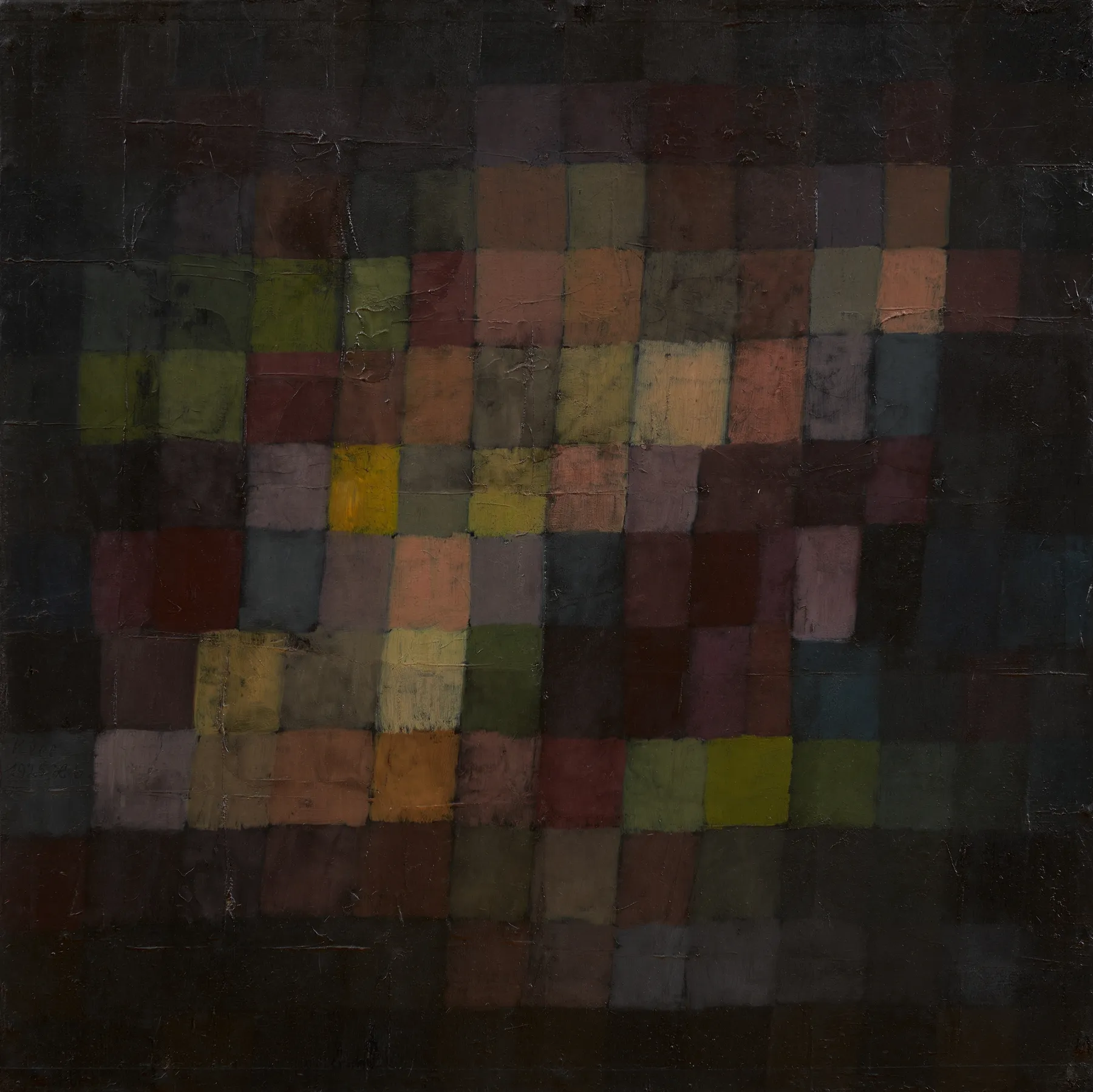
![Untitled [Rescue boat]](https://musicstory-assets-682855971161-ap-northeast-1-an.s3.ap-northeast-1.amazonaws.com/artworks/paintings/untitled-rescue-boat.jpg)
Sources & references
More artists
If you find an error in this content, please let us know here
This site is protected by reCAPTCHA, and the Google Privacy Policy and Terms of Service apply.