
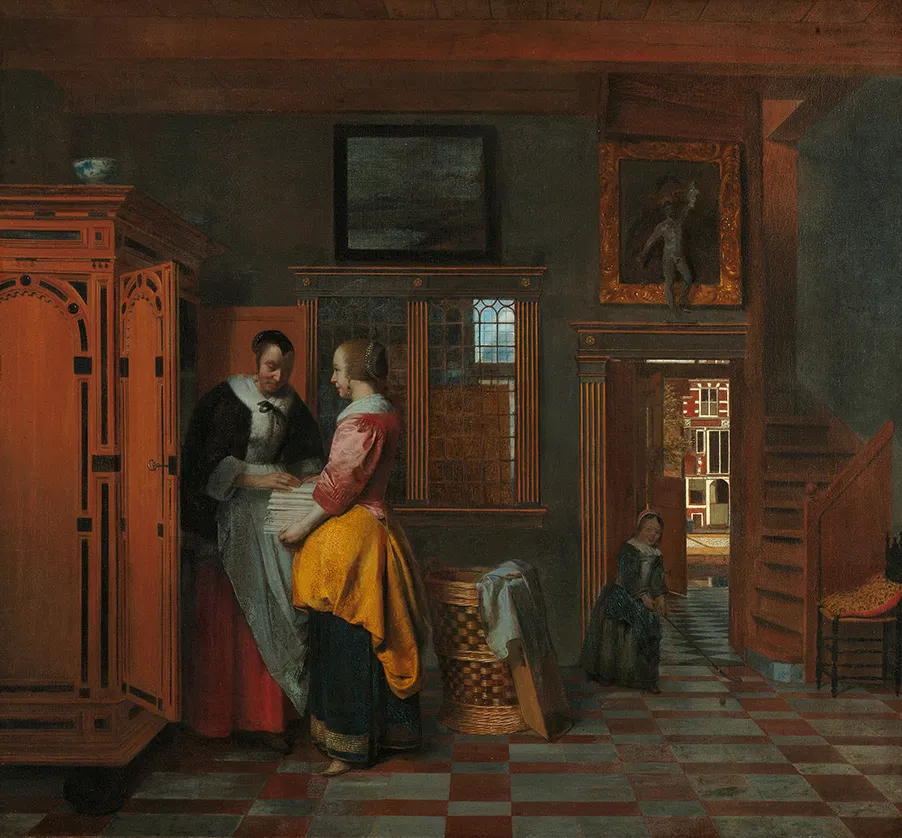
Interior with Women beside a Linen Cupboard
1663
- Dimensions
- 70 × 75.5 cm
- Medium
- Oil on canvas
- Collection
- Rijksmuseum, Amsterdam (on permanent loan from the City of Amsterdam)
✦ Highlights (technique & color)
The painting’s crowning achievement is its multi-layered spatial composition, known as a doorkijkje (view-through). The scene is structured into three distinct zones of varying illumination: the shadowy front room in the foreground, the sunlit doorway, and the bright canal houses beyond. Guided by the diagonal grid of the floor tiles, meticulous linear perspective draws the viewer inward, rendering the depth and three-dimensionality of the interior with extraordinary mastery.
✦ The setting of this painting
The setting is the voorhuis (front room) of an affluent seventeenth-century townhouse in Amsterdam. Serving as a multifunctional threshold between the street outside and the private quarters within, this sunlit space was a hub of daily domestic life, where household chores were done and children played. Beyond the open doorway, canal-side houses bask in radiant sunlight. Rather than an exact depiction of an actual room, however, this interior is an idealized, imaginative composite of architectural elements crafted by the artist.
✦ Historical context
Having secured independence from Spain in 1648, the Dutch Republic was at the height of its Golden Age, fueled by maritime trade. In the Calvinist social ethos of the time, the home was viewed as the bedrock of both nation and morality. Keeping the house immaculate and scrupulously managing valuable linens went far beyond mere domestic upkeep; it was celebrated as an embodiment of religious and spiritual virtue.
A heavy oak linen cupboard stands open as two women carefully fold and stack sheets.
In the bright entranceway beyond, a young girl with a stick is engrossed in a game of colf.
Around 1660.
Pieter de Hooch left his familiar home of Delft
and moved to the great city of Amsterdam.
Amsterdam was then at the height of its Golden Age,
thriving through global maritime trade and finance.
Along the grand canals stood the magnificent mansions of affluent merchants.
De Hooch embraced the sophisticated domestic culture of this cosmopolitan metropolis.
Adapting to the tastes of the rising urban bourgeoisie, he transformed his style,
painting interiors far more stately and lavish than those of his Delft period.
1663.
The year this piece was created marked the pinnacle of his career,
a time when his mastery of spatial rendering and play of light reached its ultimate maturity.
Sustained by steady demand from the upper-middle class,
he created his works in an atmosphere of financial stability.
What he constructed on canvas was not an exact sketch of an existing residence.
Staircases, windows, and marble-patterned floor tiles—
he carefully deconstructed and reassembled these architectural elements into an imagined space,
giving form to the immaculate, orderly domestic ideal cherished by Dutch citizens of the time.
- This work is part of “6 works for you” for The Meticulous Artisan → See
About 98 more words
Unlock this story's ending, and every article on MusicStory
- 42
Stories1–2 new every week
An archive of paintings paired with great music, made for a weekend night and a cup of coffee
- 319
Paintings with commentarygrowing daily
From simply looking to truly reading — the brushwork and the obsession of the masters
- 10
Music Librarygrowing daily
Know it first, and what reaches your ear changes — background music becomes art you keep for life
My Notes, unlimited
Every reading adds to a digital art notebook that is yours alone
Already have an account? Log in
Your Note
Write down what this painting made you feel in your art notebook.
Please sign up to write notes.
Sign up for freeRecommended Artworks
.webp)

Sources & references
More artists







If you find an error in this content, please let us know here
This site is protected by reCAPTCHA, and the Google Privacy Policy and Terms of Service apply.