
 日本語 (JA)
 English (EN)
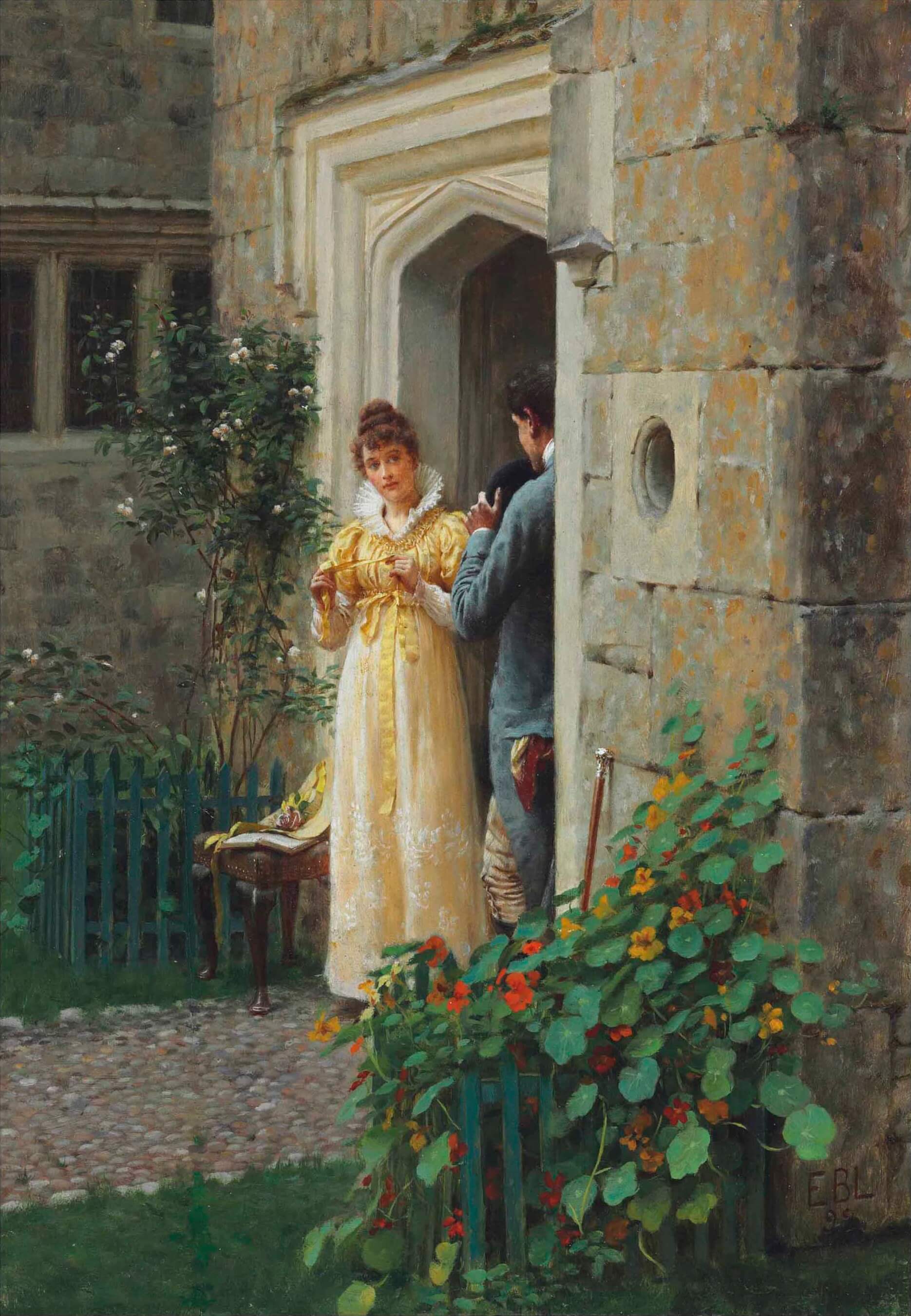
- Dimensions
- 35.6 × 25.4 cm
- Medium
- Oil on panel
- Collection
- Private collection
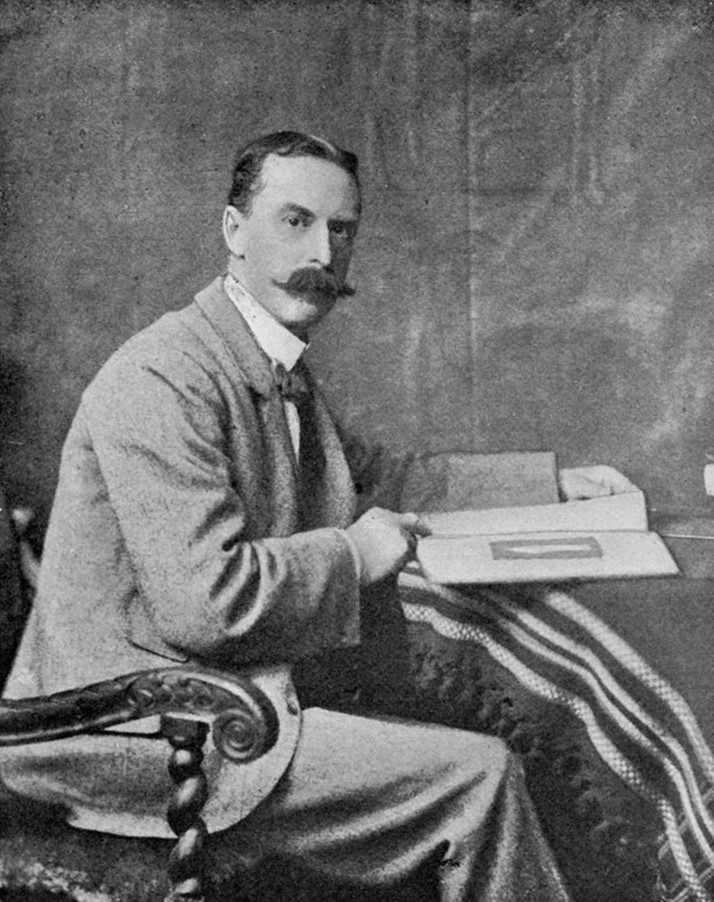
Active in London during the late Victorian and Edwardian eras, he was an artist…
An unwavering commitment to an intricate, romantic narrative world that stood firm against the tide of modern art. It embodies the pride of a solitary outsider who, though excluded from the Academy, captured intimate personal emotion with breathtaking technical mastery.
✦ Highlights (technique & color)
Executed on a smooth wooden panel rather than canvas. Through the traditional technique of layering thin, translucent glazes of oil paint, the artist meticulously rendered the soft sheen of the fabrics and the grainy texture of the stone arch, leaving no visible brushstrokes.
✦ The setting of this painting
The entrance approach to an estate evoking the Regency era of the late 18th to early 19th century. Rather than a direct study of an existing building, it is an idealized, imaginary setting synthesized in the studio from architectural elements—such as arches, doorways, and garden shrubbery—sketched by the artist in Norfolk and elsewhere.
✦ Historical context
Early 1890s Britain, a time when the advanced industrialization and urbanization of the late Victorian era reached its peak. In reaction to rapid modernization, public nostalgia for the graceful pastoral life of the Middle Ages and the Regency era was at its height.
In the shadow of a massive stone archway, a young man and woman exchange quiet words. In the soft light of early summer, the woman in a golden dress casts her gaze downward, her fingers repeatedly winding and twisting a ribbon from her dress. The man standing before her clutches his hat firmly, seemingly entreating her with earnest words. In the London of 1892, the painter Edmund Blair Leighton worked quietly at this small panel in his studio. What he sought to capture was neither a momentous event that reshaped history nor the grand drama of mythology, but an unspoken, intimate moment of affection between two ordinary souls.
The Faceless Suitor and the Winding Ribbon
Leighton made a daring decision when planning the composition of this painting: he deliberately concealed the suitor's face and the left side of his upper body within the frame's edge and the deep shadow of the arch. Typically, in narrative painting, the facial expressions of the figures are among the most vital elements. Yet by deliberately choosing not to depict the man's face, the artist carefully calculated the composition so that the viewer's gaze would naturally settle upon the woman's expression at the center of the canvas, and on her hands.
Art historian Cara Rosa notes that the delicate gesture of the woman twisting the ribbon visually symbolizes her hesitation and emotional conflict upon receiving the suit. Nowhere are the man's exact words of entreaty revealed, nor did the artist ever leave a record of what was said. By entrusting the specific dialogue to the viewer's imagination, Leighton may well have intended to complete the painting in the mind of the beholder. It is precisely because the man's face is hidden that we can intuitively share the woman's bewilderment and tension, resonating deeply with the delicate stirring of her heart.
Who Is Looking On?
Leighton introduced yet another device between this intimate scene and the viewer. In the foreground, he placed a low wooden or iron fence alongside foliage of lush green leaves. This fence and shrubbery create a distinct physical barrier between the space occupied by the figures within the painting and that of ourselves outside it.
Art historian Cara Rosa remarks that this composition places the viewer in the role of an outside observer peering into an extraordinarily intimate and private moment. We experience a psychological tension, almost as if crouched behind a hedge, holding our breath as we watch their secret exchange. Leighton fashioned the viewer not merely into a passive onlooker, but into an "outsider" who has stumbled upon this confidential scene. And perhaps the painter himself, moving his brush within his studio, was likewise an onlooker gently accompanying the subtle emotional currents of these fictional lovers.
An Ideal Stage Crafted in the Studio
The romantic setting depicted in this painting was not a direct sketch of an actual location. The stone arch, the heavy wooden door, and the flagstone pavement beneath their feet share an identical structure with another work Leighton produced the following year, Two Strings to Her Bow.
During the summer months, the artist would stay in rural areas such as Norfolk, diligently sketching ancient local architecture and gardens. Upon returning to his studio at his home in Bedford Park, London, he would assemble these architectural details—the stonework of an arch, the iron hardware of a door—much like a stage set. Rather than transcribing reality verbatim, Leighton created an idealized, fictional space. It was the perfect stage for romance, steeped in the graceful atmosphere of the Regency era of the late eighteenth and early nineteenth centuries, a time for which the public of his day harbored great nostalgia. Within the seclusion of his studio, Leighton acted as director, placing these nameless lovers upon this beautifully arranged stage.
The Strategy of an Artist Outside the Elite
In the 1890s, when he created this painting, Leighton had reached a period of stability in his artistic career. Yet his position within the British art world of the time was somewhat unique. Although he exhibited at the Royal Academy for more than forty years, he was never elected as a full member or an associate. Keeping his distance from academic factional politics, he never joined the authoritative circle of the elite.
Yet his absence from Academy membership did not mean he lacked success. On the contrary, he enjoyed immense popularity among the public and in the art market. The Request was not executed on commission from a specific patron. In Britain at the time, there was a soaring demand for high-quality, small-scale genre paintings to adorn the salons and drawing rooms of private residences. Leighton read these market currents astutely, choosing a compact panel measuring 35.6 by 25.4 centimeters to create this work on his own initiative. Rather than seeking the approval of institutional authorities, he aimed to bring narratives that enriched the heart into people's daily lives—a shrewd and sincere strategy chosen by an artist who forged his own path outside the elite establishment.
About 471 more words
Read the rest of this commentary —
and step into a secret gallery
opened just for you
An "art letter" delivered to you every Saturday morning
Works, music and words chosen for your sensibility, from your artist-type result and the paintings you love
A library of masterpieces and music you can enjoy "in your own words", not just look at
A "digital art notebook" (unlimited) where your impressions build into your own taste
Unlimited likes and notes
¥980 / month¥0 today
¥980/month (tax incl.) from day 8. Cancel anytime.
Already have an account? Log in
Stories featuring this painting
Your Note
Write down what this painting made you feel in your art notebook.
Please sign up to write notes.
Sign up for freeRecommended Artworks
Sources & references
More art movements
Pre-Baroque
1 artworks
Victorian era
10 artworks
Impressionism
48 artworks
Late Pre-Raphaelite
10 artworks
Baroque
2 artworks
American Impressionism
5 artworks
Realism
4 artworks
Pre-Raphaelite
3 artworks
Barbizon School
5 artworks
Academic art
5 artworks
Luminism
3 artworks
Rococo
2 artworks
Symbolism
22 artworks
Neo-Impressionism
3 artworks

Ukiyo-e
1 artworks
Japonism
4 artworks
Edo period
1 artworks
Fauvism
1 artworks
Naturalism
9 artworks
Russian Realism
1 artworks
Post-Impressionism
13 artworks
Genre painting
9 artworks
Neoclassicism
3 artworks
ウィーン分離派
7 artworks
自然主義
1 artworks
ナショナル・ロマンティシズム
1 artworks
未来派
1 artworks
More artists
If you find an error in this content, please let us know here
This site is protected by reCAPTCHA, and the Google Privacy Policy and Terms of Service apply.