
Les hasards heureux de l'escarpolette (The Happy Accidents of the Swing)
1768
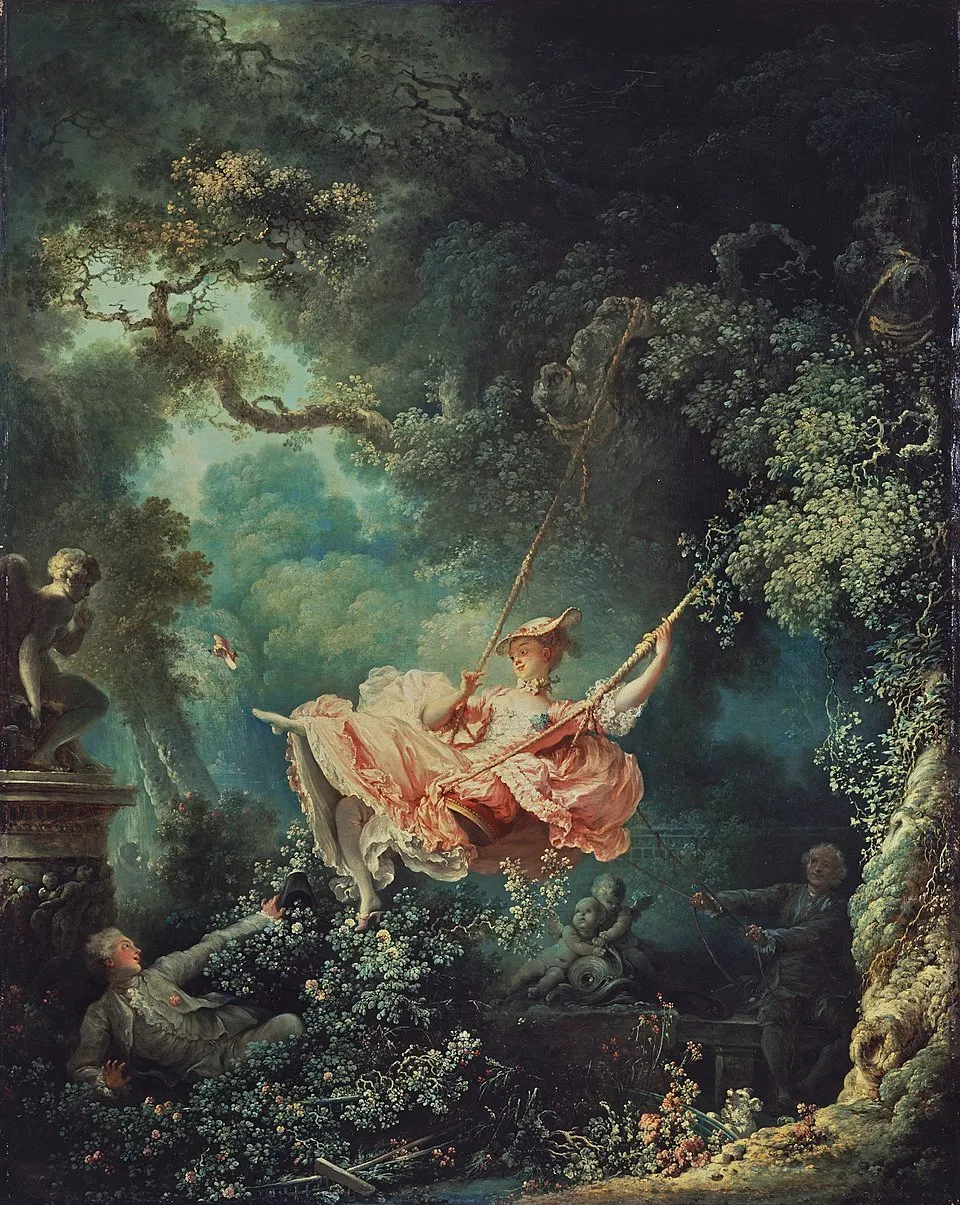
- Dimensions
- 81.0 cm × 64.2 cm
- Medium
- Oil on canvas
- Collection
- The Wallace Collection (London)
18世紀のフランス美術を代表するロココ期の巨匠。南仏のグラースに生まれ、パリでジャン・シメオン・シャルダンやフランソワ・ブーシェといった著名な画家たちのもとで修…
✦ Highlights (technique & color)
The piece is distinguished by its vivid colors—brought back to life through restoration—and its meticulously calculated composition. Madder lake and vermilion are used lavishly in the woman's dress, blending with lead-white highlights to flawlessly capture the shimmering luster of silk. Fragonard employed a technique of "calculated chaos," where thick, swift, and rough impasto brushstrokes visible up close dissolve into an atmospheric play of shimmering light when viewed from a distance. By focusing an intense beam of light solely on the woman, he created the enchanting effect that her dress is glowing from within.
✦ The setting of this painting
The setting depicted is not a faithful rendering of an actual garden, but rather an "idealized private garden" conceived by the artist. In mid-18th-century France, untamed gardens framed by dense foliage and rose arches were favored by aristocrats as secluded stages for amorous intrigue. Fragonard's memories of overgrown vegetation and ancient statuary from his studies in Italy are woven into this lush, teeming landscape.
✦ Historical context
Painted in the late 1760s under the Ancien Régime during the twilight years of Louis XV's reign, this work emerged in a courtly society steeped in "libertinism"—an ethos that embraced infidelity and clandestine romance as playful diversions. While the Royal Academy championed solemn history painting as the artistic ideal, the aristocracy and the rising affluent class sought sensual paintings tailored for private pleasure, marking an era where two distinct artistic values coexisted in creative tension.
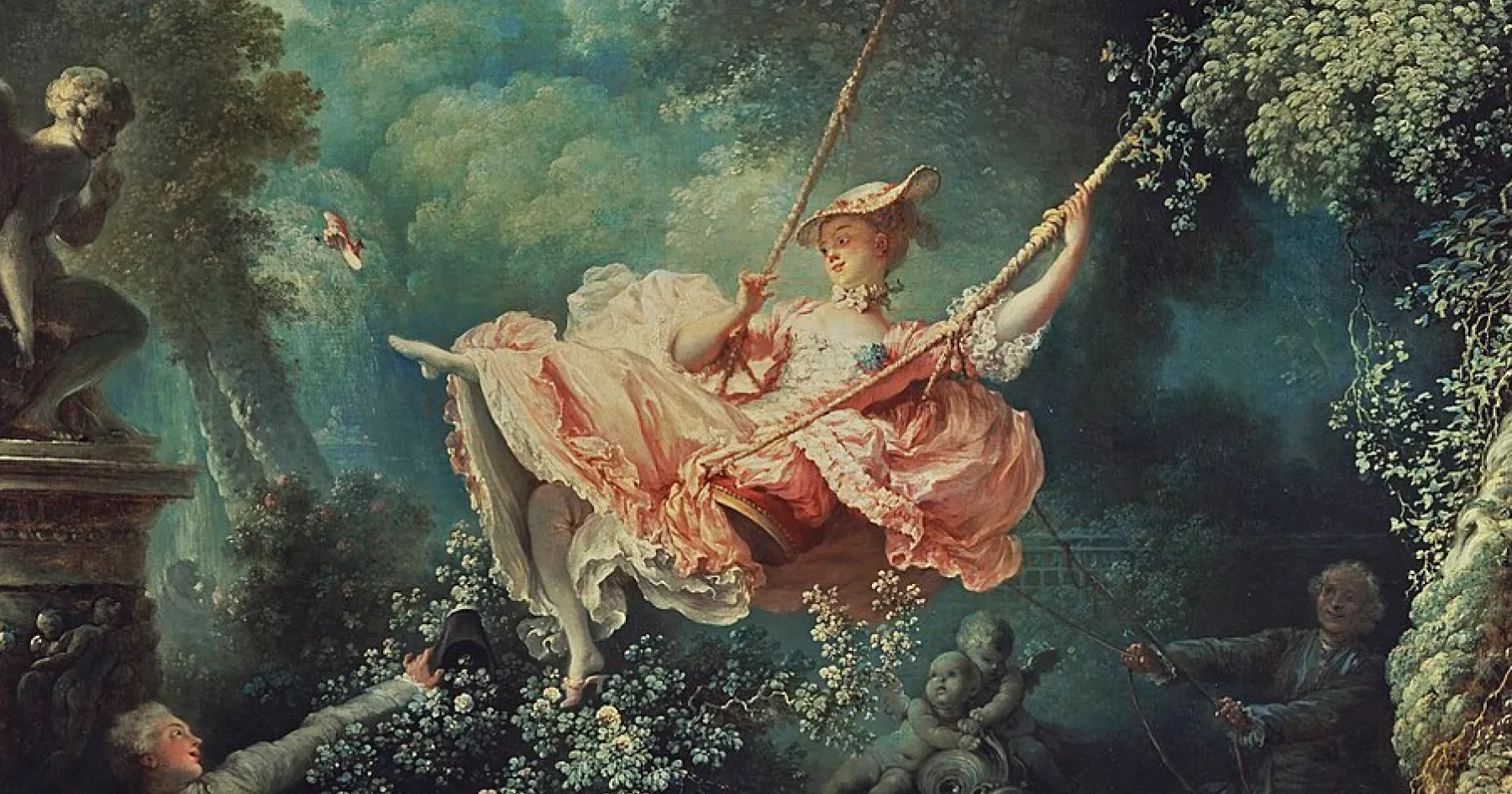
Sunlight filters through the dense canopy of trees. A young woman in a pink silk dress soars through the air on a swing. Slipping from her left foot, a small shoe flies through the air. In the bushes below to the left, a young man lies hidden—in the perfect position to look up under her skirt. In the shadows to the lower right, an older man smiles as he pulls the ropes of the swing.
This work, an icon of 18th-century French Rococo art, was long said to have been born from the mischievous, almost frivolous request of a court aristocrat. For centuries, the narrative held that the man pulling the swing in the dark was a bishop, representing a satirical demand to make a clergyman complicit in an immoral tryst. It was also widely accepted that the patron who commissioned it was the 54-year-old Baron de Saint-Julien.
Yet in recent years, research and scientific analysis have overturned these long-held theories one after another. In 2021, the Wallace Collection undertook the painting’s first conservation treatment in nearly a century, stripping away a thick layer of yellowed varnish. Scientific analysis revealed that the older man on the lower right was not dressed in black clerical robes at all, but in vibrant blue secular attire. A bishop was never painted there in the first place.
Behind this masterpiece was a defining, high-stakes choice by the painter Jean-Honoré Fragonard. In 1765, Fragonard achieved grand acclaim from the Royal Academy for a monumental history painting, which was even purchased by King Louis XV. He had secured a brilliant career as an official history painter—a position of prestige that anyone would envy. However, reality was not so forgiving. Payments from the royal treasury were frequently delayed, and he resented being tied down by heavy, labor-intensive history paintings.
It was around the autumn of 1767 when a courtier brought forward a bizarre request, as recorded by the playwright Charles Collé. The commission was first offered to the history painter Gabriel-François Doyen: "Place my mistress on a swing, and have a bishop push her." "Hide me in the bushes so I can look up at her legs." Doyen refused, taking the request as an insult to his dignity as a history painter. And so, the commission was passed on to Fragonard.
While the patron was long believed to be the 54-year-old Baron de Saint-Julien, recent scholarship has shifted this view. Because the suitor depicted in the painting is a young man in his twenties, it is now considered far more likely that the buyer was his 18-year-old son or another young court aristocrat.
Fragonard accepted this scandalous commission. Producing a private piece for a wealthy patron offered immediate, handsome compensation—even if it meant straying from the Academy’s official path. Yet he didn't simply do as he was told. Depicting a clergyman aiding an illicit affair posed a real risk of censorship. And so, he subtly replaced the bishop with the man in blue.
About 178 more words
Unlock this story's ending, and every article on MusicStory
- 42
Stories1–2 new every week
An archive of paintings paired with great music, made for a weekend night and a cup of coffee
- 282
Paintings with commentarygrowing daily
From simply looking to truly reading — the brushwork and the obsession of the masters
- 10
Music Librarygrowing daily
Know it first, and what reaches your ear changes — background music becomes art you keep for life
My Notes, unlimited
Every reading adds to a digital art notebook that is yours alone
Already have an account? Log in
Stories featuring this painting
Your Note
Write down what this painting made you feel in your art notebook.
Please sign up to write notes.
Sign up for freeRecommended Artworks
.webp)
_Claude_Monet_-_Muse%CC%81e_des_Beaux-Arts_de_Lyon_(W821)+(1).webp)
Sources & references
- The Swing (Fragonard) - Wikipedia
- Fragonard's masterpiece The Swing goes back on display after conservation - The Wallace Collection
- Fragonard's The Swing has been restored—and it's saucier than ever - The Art Newspaper
- The Bishop and the Petticoat: How Fragonard's The Swing Began as an Aristocratic Prank - Meron
- The swing, 1782 by Nicolas de Launay, after Jean-Honoré Fragonard :: | Art Gallery of NSW
- Les hasards heureux de l'escarpolette (The Swing) - The Wallace Collection
- Les Hasards heureux de l'escarpolette - Wikipédia
More artists



If you find an error in this content, please let us know here
This site is protected by reCAPTCHA, and the Google Privacy Policy and Terms of Service apply.