
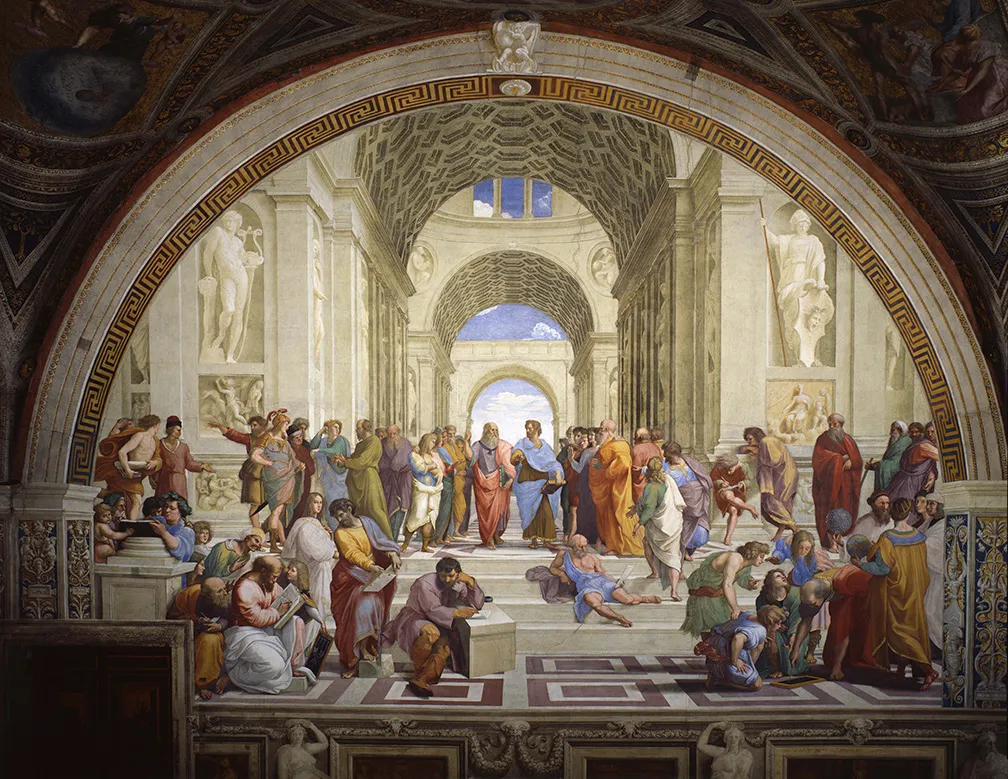
The School of Athens
1511
- Dimensions
- 約500 × 770 cm
- Medium
- Fresco (buon fresco)
- Collection
- Vatican Museums
A profound awe before overwhelming talent, and a fierce impulse to disrupt his own flawless harmony. The raw, burning obsession of a young painter who scraped away a nearly completed wall to hurriedly paint in his homage to a solitary genius.
✦ Highlights (technique & color)
The mural was created using the buon fresco technique, in which water-based pigments are applied directly onto wet plaster. Raphael made extensive use of incision, pressing the contours of his preparatory cartoons into the plaster to transfer the design. By placing the perspective's vanishing point precisely between Plato and Aristotle at the center, he achieved a masterful composition that effortlessly guides the viewer's eye to these twin giants of classical thought.
✦ The setting of this painting
This work is located in the Stanza della Segnatura within the Papal Palace. At the time, the room served as Pope Julius II's private library, with bookshelves holding volumes on philosophy and natural science set beneath the murals. The grand architecture depicted here is not an actual building, but an imaginary space inspired by the designs for the new St. Peter's Basilica, which was under construction at the time.
✦ Historical context
In the early 16th century, Pope Julius II pursued an ambitious vision to revive Rome as the spiritual and cultural capital of Europe. Grounded in Renaissance humanism, which viewed ancient Greek pagan wisdom as a noble precursor to Christian truth, this fresco embodies the era's ideal of harmony between reason and faith.
A grand architectural space framed by soaring arches.
Within it, more than fifty ancient philosophers, scientists, and thinkers have gathered, engaged in debate and deep contemplation.
Walking at the very center are Plato, pointing toward the heavens, and Aristotle, gesturing toward the earth with an open palm.
In the lower left, Pythagoras writes down formulas, while in the lower right, Euclid bends down to work with a compass.
Painted by the Renaissance master Raphael in his twenties, it is one of the greatest masterpieces of Western art.
This painting has long been celebrated as a symbol of perfect harmony.
The figures arranged across the left and right sides brilliantly represent theoretical philosophy and empirical science.
The vanishing point of the perspective is placed precisely between the two central figures, naturally guiding the viewer's eye into the distance.
An ideal world, calculated down to the smallest detail from the very beginning and constructed without the slightest flaw.
Or so it might seem.
Yet in truth, this seemingly flawless composition contains one figure who was forced in at the last moment.
In the foreground, on the central steps.
A man leans his elbow against a block of marble, brooding in solitude as he writes.
This is the ancient philosopher Heraclitus.
In the full-scale cartoon preserved in Milan,
this man is nowhere to be found.
He was never part of the original design, but was hastily added just before the fresco was completed.
Late in 1508.
The twenty-five-year-old Raphael, recommended by an architect from his hometown, arrived in Rome at the summons of Pope Julius II.
The Pope was so taken with his talent that he granted him an extraordinary commission: frescoing the walls of the papal library.
Raphael rose to the occasion, leading a large workshop and making steady, confident progress.
Work began in the autumn of 1509, and by mid-1511, this grand fresco was nearing completion.
A young prodigy, now the toast of the Roman art world.
Yet in August 1511, he was utterly shaken.
Right next door in the Sistine Chapel, a new work was unveiled.
It was the colossal ceiling painted by Michelangelo.
Its overwhelming physical expression and sculptural power were undeniable.
Confronted with it, Raphael was struck to his core.
- This work is part of “6 works for you” for The Perfectionist Architect → See
About 179 more words
Unlock this story's ending, and every article on MusicStory
- 42
Stories1–2 new every week
An archive of paintings paired with great music, made for a weekend night and a cup of coffee
- 319
Paintings with commentarygrowing daily
From simply looking to truly reading — the brushwork and the obsession of the masters
- 10
Music Librarygrowing daily
Know it first, and what reaches your ear changes — background music becomes art you keep for life
My Notes, unlimited
Every reading adds to a digital art notebook that is yours alone
Already have an account? Log in
Your Note
Write down what this painting made you feel in your art notebook.
Please sign up to write notes.
Sign up for freeRecommended Artworks
Sources & references
More artists
If you find an error in this content, please let us know here
This site is protected by reCAPTCHA, and the Google Privacy Policy and Terms of Service apply.