
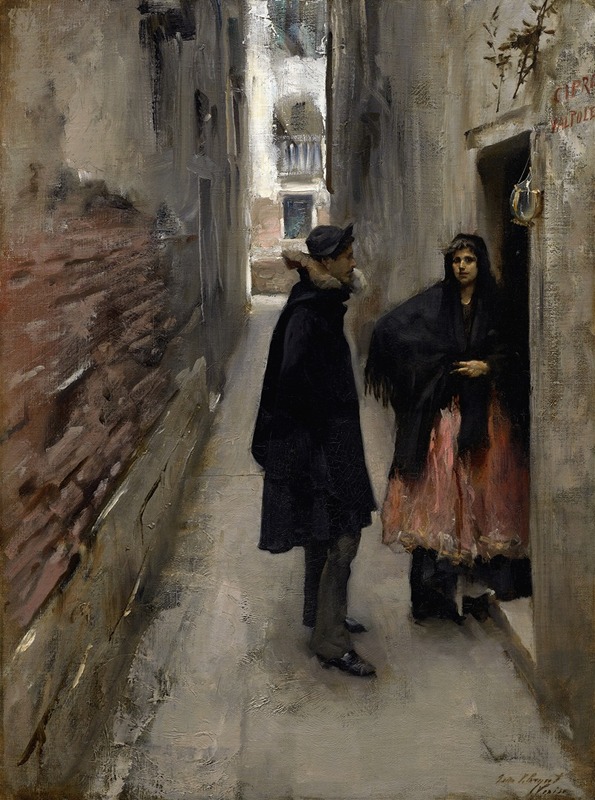
A Street In Venice (c. 1880–82)
- Dimensions
- 75.1 × 52.4 cm
- Medium
- Oil on canvas
- Collection
- Clark Art Institute

Born in Italy to American parents, he spent his early years in Paris before esta…
✦ Highlights (technique & color)
While the composition is dominated by a near-monochromatic palette of browns, inky blacks, and grays, strategic touches of red—such as the comb in the woman's hair—breathe warmth and vitality into the scene. Additionally, the tight, photographic cropping that abruptly cuts off parts of the figures creates a cinematic sense of an immediate, fleeting moment.
✦ The setting of this painting
The scene is set in an extremely narrow alley framed by flaking, weathered plaster walls. In the far distance at the dead end, intense sunlight dramatically illuminates the pavement. The woman in the center is about to cross the threshold of a wine shop. Eschewing typical tourist landmarks, the painting captures the shadowy everyday realm of ordinary people.
✦ Historical context
Created during the artist's stay in Venice between 1880 and 1882, the work strongly reflects the influence of Italian painter Giovanni Boldini, then active in Venice, as well as the street photography of Carlo Naya. It adopts a modern approach, spontaneously capturing the dynamism of daily life.
A remarkably narrow alleyway, flanked by old, peeling stucco walls.
A woman in a black shawl steps over the threshold of a wine cellar, glaring sharply in our direction.
When one hears of Venetian landscape paintings, most people envision glamorous scenes.
The beautiful Grand Canal.
Magnificent palaces and elegant gondolas gliding by.
Critics in Paris at the time also expected such a romanticized image of a tourist city.
Furthermore, in the art market, when Sargent's 'A Street in Venice' is mentioned, many people recall the horizontal painting housed at the National Gallery of Art in Washington.
That one is a masterpiece depicting a woman walking away briskly and a man staring at her unabashedly.
But in fact, two paintings with the same title exist in parallel.
And what Sargent depicted on this vertical canvas was the 'shadow' of real people's daily lives, far removed from tourist attractions.
From 1880 to 1882, the young Sargent stayed in Venice.
He resolutely refused to paint typical tourist spots.
Instead, he turned his attention to eerie backstreets, like a cracked labyrinth.
In 1883.
Sargent exhibited a series of street scenes at the first exhibition of the 'Société Internationale de Peintres et Sculpteurs' held at the prestigious Galerie Georges Petit in Paris.
However, what awaited him was harsh criticism.
The paintings are commonplace and boring.
The backstreets are too dark.
The disheveled, grimy local women completely destroy the image of the elegant beauties of yesteryear.
Conservative critics vehemently rejected the realistic portrayal of Venice he presented.
What they sought was Italy as a comforting fantasy.
However, Sargent, with a realistic approach, depicted the 'shadow' of the daily lives of the real people living there, and a single sharp ray of light piercing through it.
Later, in 1926, this painting came into the possession of Robert Sterling Clark.
And to this day, it is carefully preserved in the museum bearing his name.
About 176 more words
Read stories of masterpieces for free
Your Note
Write down what this painting made you feel in your art notebook.
Please sign up to write notes.
Sign up for freeRecommended Artworks





.webp)
Sources & references
More artists








If you find an error in this content, please let us know here
This site is protected by reCAPTCHA, and the Google Privacy Policy and Terms of Service apply.