A visual artist who dismantled Renaissance perspective to pioneer Cubism and invented collage by applying disparate materials to canvas, transforming painting from an illusion of the external world into an autonomous object.
LifeLife and works
Born in Málaga in southern Spain in 1881, Pablo Picasso received systematic training in drawing and oil painting from his father, an art teacher. In his mid-teens, he passed the advanced entrance examination for the Barcelona School of Fine Arts in just a single week. In 1897, his monumental social-realist canvas Science and Charity, depicting a bedridden patient attended by a doctor, earned an honorable mention at the National Exhibition of Fine Arts in Madrid. His early work reflected both an interest in medical reality and a rigorous adherence to academic convention.
Following his first visit to Paris in 1900, Picasso's style shifted in response to his surroundings. The suicide of his close friend Carles Casagemas in Paris in 1901 brought a profound change to his art. Enduring severe hardship, he entered his Blue Period, rendering subjects of death and destitution in monochromatic shades of blue. In 1904, he took up residence at the Bateau-Lavoir, an artists' tenement in Montmartre, and began living with Fernande Olivier, marking a transition to the Rose Period, which featured circus performers and acrobats in warm, luminous tones.
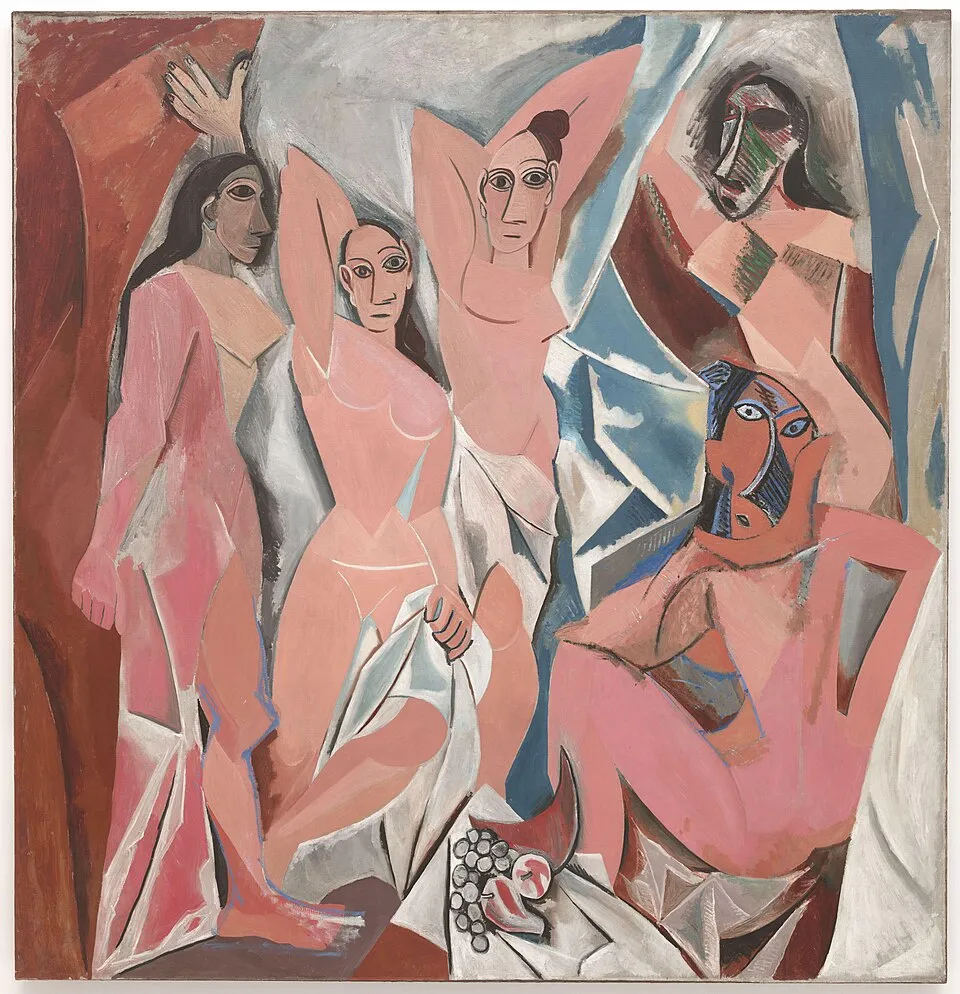
In 1907, he created Les Demoiselles d'Avignon, a depiction of a Barcelona brothel. Incorporating the formal structures of ancient Iberian sculpture and African masks, he dismantled the single-point perspective that had underpinned Western painting since the Renaissance. Soon after, he collaborated with Georges Braque to develop Analytic Cubism, breaking down forms into small geometric facets. The two worked so closely that their canvases became virtually indistinguishable without their signatures, establishing a method for reconstituting visual information upon a single plane.
In 1912, with Still Life with Chair Caning, he introduced the technique of pasting a piece of oilcloth printed with a caning pattern onto the lower portion of the canvas and framing the composition with a length of rope. By incorporating real materials directly into the pictorial space, this collage technique presented painting not as a fictional projection of the visible world, but as a tangible material reality. Around the same time, signing an exclusive contract with the art dealer Daniel-Henry Kahnweiler rescued him from poverty and established a stable channel for bringing his work to market.
In 1917, at the invitation of Jean Cocteau, Picasso traveled to Italy to design the sets and costumes for Parade, a production by the Ballets Russes. His marriage the following year to Olga Khokhlova, a dancer with the company, drew him into bourgeois society, and his painting embraced a Neoclassical style marked by disciplined contours and sculptural weight. By the late 1920s, with his secret lover Marie-Thérèse Walter as his model, he adopted a Surrealist approach, introducing organic distortions and fluid metamorphoses of the human form.
In 1937, following the aerial bombing of the Basque town of Guernica by Nazi Germany during the Spanish Civil War, Picasso painted the monumental mural Guernica for the Spanish Pavilion at the Paris International Exposition. With the photographer Dora Maar documenting its creation, he arranged motifs such as a wounded horse, a grieving mother, and a bull across a monochrome palette, giving visual expression to the horrors of war. During World War II, he chose to remain in Nazi-occupied Paris, continuing to work quietly in his studio despite being forbidden from exhibiting publicly.
After the war, in 1946, he relocated to Vallauris in the south of France. Immersed in the Mediterranean light and the region's artisanal traditions, he began producing ceramics at the Madoura Pottery. From the 1950s onward, living in grand residences in Cannes and Mougins, he produced major series that deconstructed and reinterpreted masterpieces of the past, most notably Las Meninas by the seventeenth-century Spanish master Diego Velázquez. Until his death in 1973 at the age of ninety-one, he continued to pursue a vigorous, visceral painterly expression; his works are preserved today in institutions worldwide, including the Picasso museums in Barcelona and Paris.