
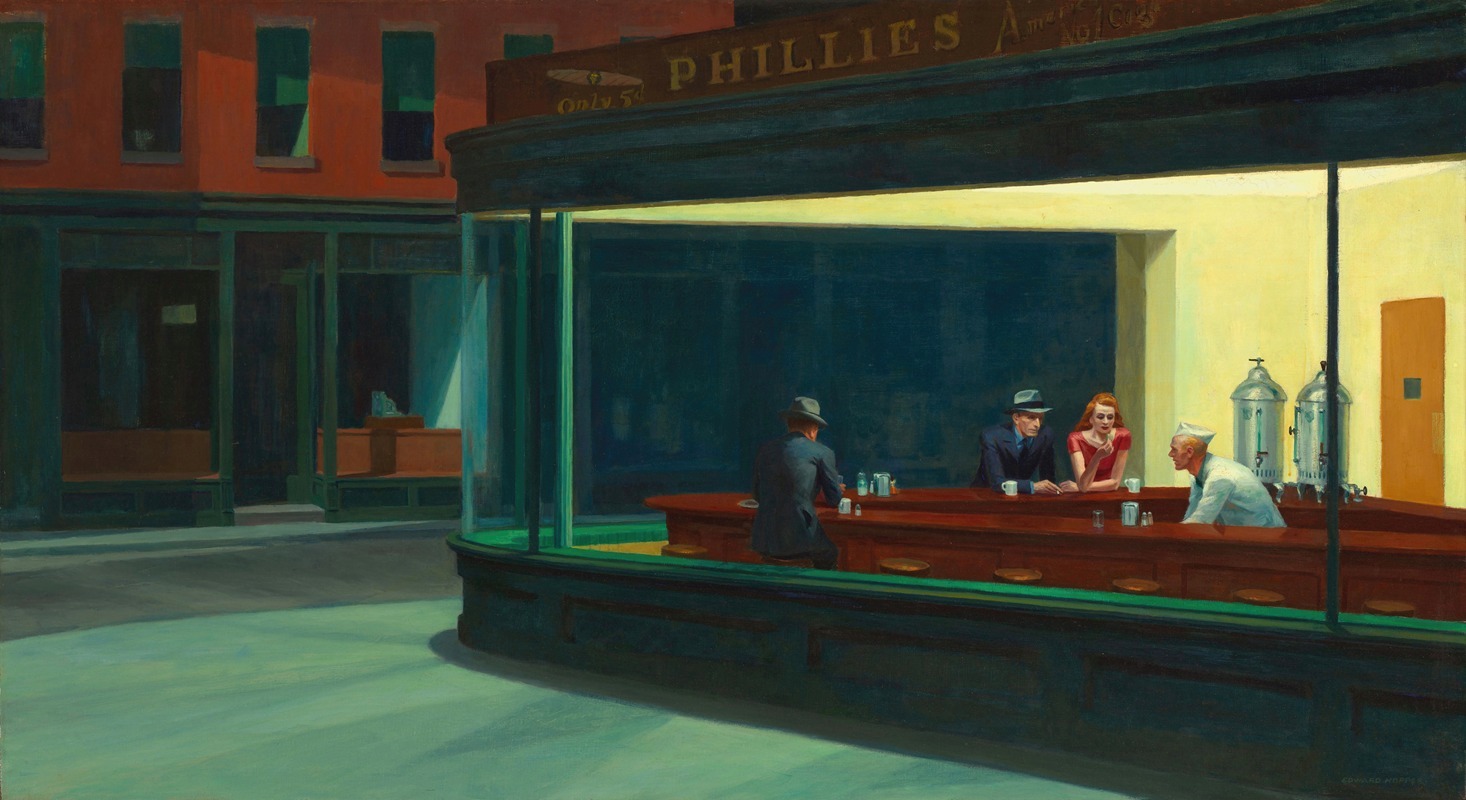
Nighthawks
1942
- Dimensions
- 84.1 × 152.4 cm
- Medium
- Oil on canvas
- Collection
- The Art Institute of Chicago
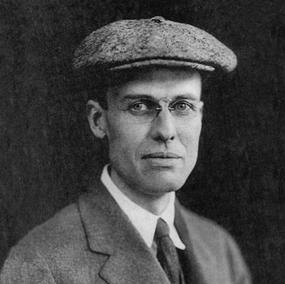
A defining figurative painter of twentieth-century American art, he captured urb…
A quiet refusal of deliberate symbolism and social critique. A sanctuary of light fashioned alongside his wife in the solitude of his studio, while anxiety of war hung heavy over the city.
✦ Highlights (technique & color)
Applied flatly over a smooth ground, the paint is layered without noticeable impasto. Sharp architectural lines and the curved pane of glass guide the viewer's gaze into the interior, yet the absence of any visible entrance creates a subtle visual resistance, pushing the eye back toward the surface.
✦ The setting of this painting
New York in the dead of night, just before dawn. The red-brick building across the street is shuttered and dark, and the sidewalk is kept immaculately clean, reduced to an absolute minimum of detail. While long believed to depict an actual diner, this urban setting is in fact an imaginary composite drawn from neighboring architecture and Hopper’s own studio memories.
✦ Historical context
Between late 1941 and early 1942, immediately following the United States' entry into World War II. In New York, blackouts were enforced amid fears of air raids, cloaking the city in darkness and unease. This was also the dawn of fluorescent lighting, whose cool, artificial glow Hopper incorporated into the canvas.
On a dark street corner late at night, a diner emerges, casting a pale glow.
At the cherry-wood counter sit three silent patrons.
In the background stand large coffee urns with a metallic gleam.
Only the server in his white uniform seems to gaze out at the world outside.
The loneliness of a great city.
A gathering of strangers, indifferent to one another.
A scene that truly existed in New York's Greenwich Village.
For years, this painting has been spoken of in such terms.
Yet, in truth, the diner depicted here never existed.
And the solitary patrons inside are not strangers at all.
Hopper lived for years in his Manhattan studio.
A city he walked every day and knew intimately.
Yet in December 1941, that familiar scenery changed completely.
With the attack on Pearl Harbor, the United States plunged into war.
Air-raid sirens wailed across the streets of New York.
At night, blackouts were enforced for fear of enemy submarines and air raids.
A city shrouded in darkness and anxiety.
Amid it all, the fifty-nine-year-old Hopper shut himself inside his studio.
As if seeking refuge from the turmoil outside, he turned to the canvas.
He pieced together memories of buildings from his neighborhood,
creating an imaginary diner that existed only in his mind.
Whom did he ask to pose as the patrons?
No one.
Hopper stood before a mirror and posed for himself.
The solitary man seen from behind.
The man holding a cigarette, seated beside the woman.
Both were figures of the artist himself.
And the woman in the red blouse, holding a sandwich.
Her model was his wife, Jo.
She supported her husband's creative work, keeping detailed records in a ledger.
Walls of dull yellow ochre.
Base of the facade, a strong jade green.
Together in the studio, the two built this quiet world.
In a letter to her sister-in-law, Jo wrote:
"Ed has been steadily at it for a month and a half."
"Hardly having time to be caught up in the excitement of war."
About 164 more words
Unlock this story's ending, and every article on MusicStory
- 42
Stories1–2 new every week
An archive of paintings paired with great music, made for a weekend night and a cup of coffee
- 282
Paintings with commentarygrowing daily
From simply looking to truly reading — the brushwork and the obsession of the masters
- 10
Music Librarygrowing daily
Know it first, and what reaches your ear changes — background music becomes art you keep for life
My Notes, unlimited
Every reading adds to a digital art notebook that is yours alone
Already have an account? Log in
Your Note
Write down what this painting made you feel in your art notebook.
Please sign up to write notes.
Sign up for freeRecommended Artworks
.webp)
Sources & references
More artists
If you find an error in this content, please let us know here
This site is protected by reCAPTCHA, and the Google Privacy Policy and Terms of Service apply.