
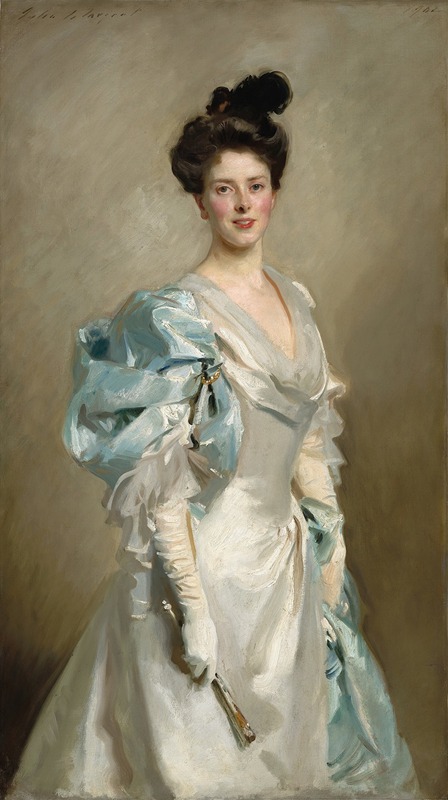
Mary Crowninshield Endicott Chamberlain (Mrs. Joseph Chamberlain)
1902
- Dimensions
- 150.5 × 83.8 cm
- Medium
- Oil on canvas
- Collection
- National Gallery of Art, Washington, D.C.
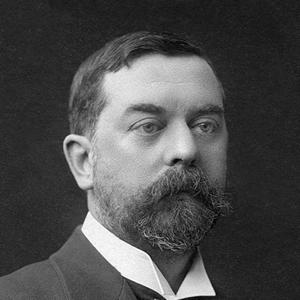
Born in Italy to American parents, he spent his early years in Paris before esta…
✦ Highlights (technique & color)
A notable feature of the work is the contrast between the fluid, bravura brushwork of the dress and the smooth rendering of the face. The white silk gown is painted with sweeping strokes, while the powder-blue fabric over her right shoulder creates a sense of dynamic movement. Her eyes are subtly differentiated in color—grey-blue on the right and nearly green on the left—which, alongside the faint smile on her fuchsia-pink lips, captures an impression of keen intelligence.
✦ The setting of this painting
Painted in Sargent's studio at 33 Tite Street in London. The background is rendered in deep, muted dark brown tones evocative of classical Victorian and Edwardian domestic interiors. This dark setting functions as a dramatic backdrop that heightens the luminous brilliance of the sitter and her white silk gown.
✦ Historical context
Painted in 1902, when Sargent was at the height of his critical and social acclaim in both Britain and the United States. This period coincided with the Gilded Age, epitomized by the "Dollar Princesses"—heiresses from wealthy American families marrying into the British aristocracy—against a backdrop of deep political and social ties between the elite of both nations.
Against a dark brown background, a white silk dress gleams brilliantly.
Powder blue fabric flows from her right shoulder, fastened with a gold ring.
Her name was Mary Crowninshield Endicott.
She was born in 1864 into a distinguished family in Salem, Massachusetts, USA.
Her father, William, was a prominent political figure who served as the U.S. Secretary of War.
In 1888, she crossed the ocean.
It was to marry the British politician, Joseph Chamberlain.
The marriage of wealthy American heiresses to the British aristocracy was a symbolic event, uniting the elite classes of the U.S. and Britain.
They were known as 'Dollar Princesses'.
One might assume that, backed by the wealth of a rising nation, she made a flamboyant and uninhibited debut in society.
This is often thought to be the case.
However, in reality, she chose a completely different path.
In British high society at the time, revealing dresses were prevalent.
The circle surrounding the Prince of Wales, later Edward VII, was known for its unrestrained behavior.
Temptation and scandal.
But Mary was different.
She firmly rejected revealing dresses.
She consistently preferred to wear modest and discreet attire.
She also clearly distanced herself from the playboys.
She became deeply involved in her husband's political activities.
She accompanied Joseph, who would later become Colonial Secretary, on his foreign tours.
For over a decade, she continued to support her husband.
She was not merely a wife, but his 'most trusted and true counselor'.
Her demeanor was highly regarded even at the British court.
She received direct favor from Queen Victoria herself.
What the Queen recognized was her 'modesty and discretion'.
About 185 more words
Read stories of masterpieces for free
Your Note
Write down what this painting made you feel in your art notebook.
Please sign up to write notes.
Sign up for freeRecommended Artworks

Sources & references
More artists



If you find an error in this content, please let us know here
This site is protected by reCAPTCHA, and the Google Privacy Policy and Terms of Service apply.