
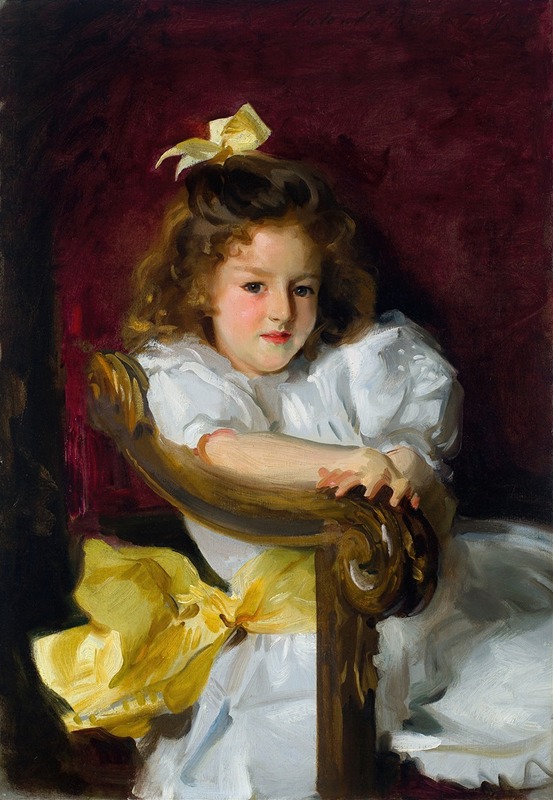
Portrait of Charlotte Cram
1900
- Dimensions
- 88.3 × 61 cm
- Medium
- Oil on canvas
- Collection
- Saint Louis Art Museum

Born in Italy to American parents, he spent his early years in Paris before esta…
✦ Highlights (technique & color)
Sargent employed the alla prima technique, applying paint directly to the canvas without preparatory drawing. The white taffeta dress and yellow ribbon were captured in swift, fluid brushstrokes that convey the sheen of the fabric. The deep wine-red background vividly accentuates the girl's fair skin and brown eyes.
✦ The setting of this painting
This painting is set in Sargent's studio on Tite Street in Chelsea, London. The young girl is seated on an opulent wooden chair, intricately carved and gilded in the 18th-century Régence style. The contrast between this lavish adult furnishing and the small child lends a unique tension to the scene.
✦ Historical context
Painted in 1900, this work dates to the height of the Gilded Age in Anglo-American society. It was an era when the newly wealthy, who had amassed immense fortunes through rapid industrialization, eagerly commissioned prestigious portraits to display their social standing and cultural refinement.
A huge wooden chair, adorned with lavish gold leaf.
In it, a girl in a white dress sits deeply.
Around her waist, a large, vibrant yellow ribbon.
She twists her body slightly, gazing straight at us.
Her name is Charlotte Cram.
Painted in 1900, this work seems to depict a wealthy and happy girl.
At the time, the newly rich, who had amassed vast fortunes, eagerly commissioned portraits from artists to display their status.
She, too, was likely portrayed as the daughter of such a privileged family.
But in fact, she never knew her parents.
When this painting was created, she was already an orphan.
London, 1893.
Just five days after Charlotte was born, her mother passed away.
The tragedy didn't end there.
When she was two years old,
her father also died during a trip to Egypt.
Charlotte, having lost both parents,
was left with an enormous inheritance.
It was a trust fund from her grandfather, Egerton Leigh Winthrop.
She inherited an extraordinary sum for the time, burdened with immense wealth.
At the age of seven, she visited Tite Street in London.
It was the studio of John Singer Sargent.
At that time, Sargent was at the pinnacle as a portrait painter for high society.
However, his spirit was weary.
Adult portraits were full of flattery and exaggeration.
He felt a heavy burden from such formal work.
For him, painting children was a special time.
Children required no exaggeration or falsehoods.
He could gaze upon their pure inner selves.
For the painter, it was a time of salvation.
About 154 more words
Read stories of masterpieces for free

Your Note
Write down what this painting made you feel in your art notebook.
Please sign up to write notes.
Sign up for freeRecommended Artworks




Sources & references
More artists







If you find an error in this content, please let us know here
This site is protected by reCAPTCHA, and the Google Privacy Policy and Terms of Service apply.