
 日本語 (JA)
 English (EN)
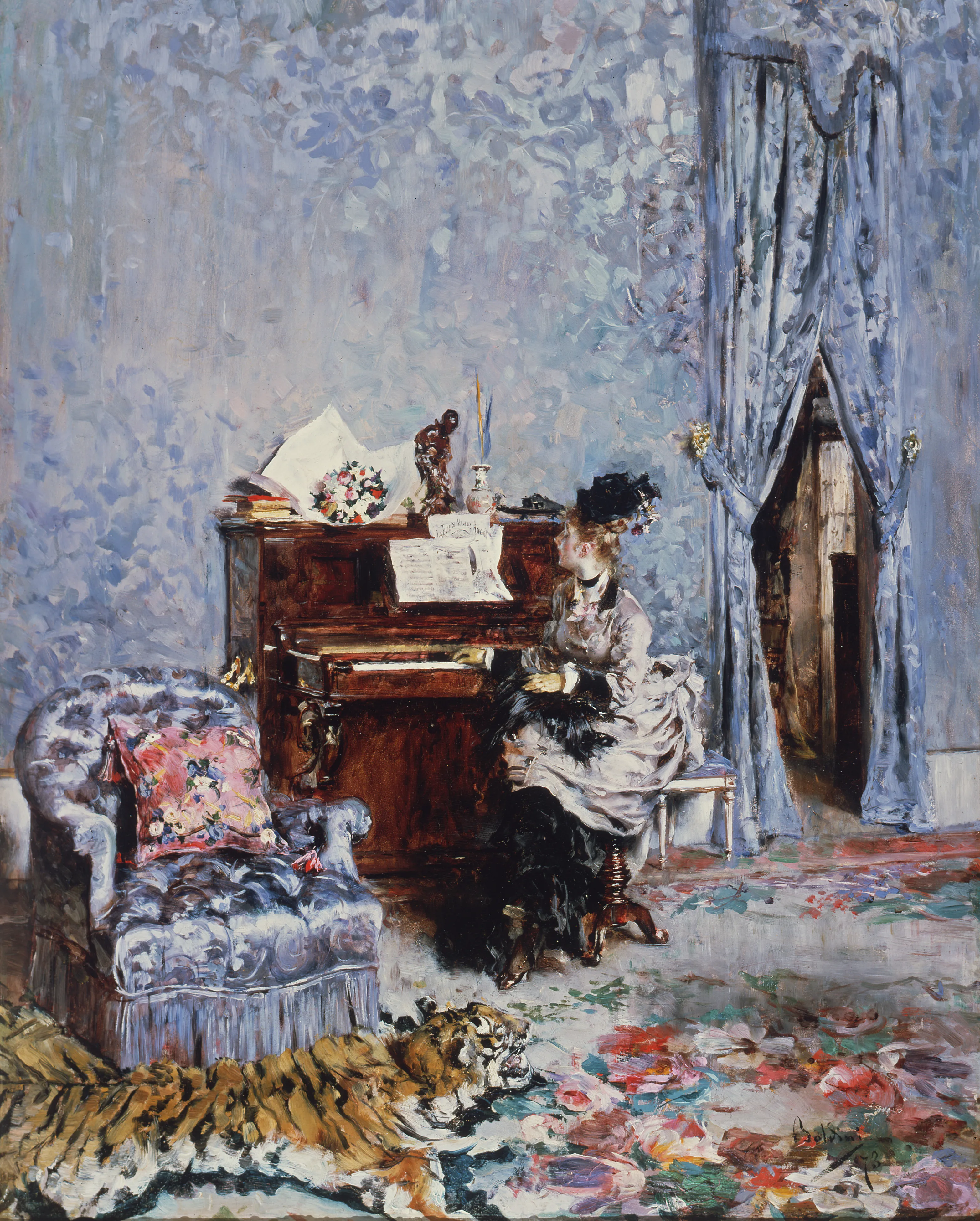
Interior with woman at the piano
1873
- Dimensions
- 67.0 × 53.0 cm
- Medium
- Oil on panel
- Collection
- Private collection
19世紀末から20世紀初頭にかけて、パリが最も華やいだ「ベル・エポック」期を代表する画家。
A quiet infusion of personal sentiment into the refined bourgeois taste demanded by the commercial art market. An intimate testament of love, preserving forever the beloved studio and the presence of his muse.
✦ Highlights (technique & color)
Painted in oil on wooden panel (tavola) rather than canvas. Because the panel absorbs less paint, it allowed for the layering of remarkably precise and delicate brushstrokes with a fine brush. The diagonal composition, receding from the foreground ornamentation into the depth of the room, exquisitely captures the intricate play of reflected light on the dress and the piano.
✦ The setting of this painting
The scene is set in the salon of the artist's studio and residence at 14 Place Pigalle, in the Montmartre district of Paris. Boldini moved into this actual space in early 1872 with his mistress, Berthe, and it was frequently visited by figures such as Edgar Degas. The piano in the center is an actual Érard instrument purchased by the painter himself.
✦ Historical context
In the early 1870s, Paris was experiencing economic recovery and urban modernization following the dramatic upheavals of defeat in the Franco-Prussian War and the turmoil of the Paris Commune. Amid the creative fervor of the avant-garde—with the First Impressionist Exhibition just a year away—playing the piano at home was embraced by the wealthy bourgeoisie as a hallmark of cultivation and refinement.
A sumptuous carpet spreads across the floor.
Gilded wall paneling and folding screens adorn the room.
A woman in an exquisite gown sits at a grand piano.
This work was painted in 1873 by Giovanni Boldini.
At first glance, it appears to be the residence of a wealthy bourgeois family.
An imaginary room painted using an anonymous model.
A piano placed as a conventional prop.
The painting is often described in such terms.
Yet, the truth is quite different.
This is no unfamiliar aristocratic mansion.
It is Montmartre, Paris.
The artist's own studio at 14 Place Pigalle.
The woman depicted is not an anonymous model.
Her name was Berthe.
Boldini's mistress.
Boldini settled in Paris from London in November 1871. In a city still bearing the scars of the Franco-Prussian War and civil strife, he met a young Frenchwoman named Berthe.
"I have found a mistress so wonderful she makes your mouth water,"
he wrote to a friend in Florence.
Strikingly beautiful and remarkably sweet-tempered,
she became the artist's muse.
In early 1872, the following year,
the two moved to 14 Place Pigalle.
It was a spacious residence and studio.
It soon became a salon frequented by Edgar Degas and other luminaries.
Boldini filled this space with his own aesthetic sensibilities.
In February of that year, he made a special acquisition:
a grand piano crafted by the prestigious French maker Érard.
"For whenever musical inspiration strikes,"
he explained to a friend.
The piano presiding over the center of the canvas was the artist's own treasured instrument.
In 1873,
as Boldini entered his early thirties,
he was under contract with the major art dealer Goupil & Cie.
What the market demanded
was a glimpse into the refined, everyday life of Paris—
chic interior scenes tailored for wealthy collectors.
A commercial necessity.
To answer it, he took up his brush.
Yet what he painted was no fictitious scene.
It was his own living quarters.
His beloved Berthe.
And his favorite piano.
Into a product crafted for the market, he had quietly woven his private life.
About 137 more words
Read the rest of this commentary —
and step into a secret gallery
opened just for you
An "art letter" delivered to you every Saturday morning
Works, music and words chosen for your sensibility, from your artist-type result and the paintings you love
A library of masterpieces and music you can enjoy "in your own words", not just look at
A "digital art notebook" (unlimited) where your impressions build into your own taste
Unlimited likes and notes
¥980 / month¥0 today
¥980/month (tax incl.) from day 8. Cancel anytime.
Already have an account? Log in
Your Note
Write down what this painting made you feel in your art notebook.
Please sign up to write notes.
Sign up for freeRecommended Artworks
Sources & references
More art movements
Pre-Baroque
1 artworks
Victorian era
10 artworks
Impressionism
48 artworks
Late Pre-Raphaelite
10 artworks
Baroque
2 artworks
American Impressionism
5 artworks
Realism
4 artworks
Pre-Raphaelite
3 artworks
Barbizon School
5 artworks
Academic art
5 artworks
Luminism
3 artworks
Rococo
2 artworks
Symbolism
22 artworks
Neo-Impressionism
3 artworks

Ukiyo-e
1 artworks
Japonism
4 artworks
Edo period
1 artworks
Fauvism
1 artworks
Naturalism
9 artworks
Russian Realism
1 artworks
Post-Impressionism
13 artworks
Genre painting
9 artworks
Neoclassicism
3 artworks
ウィーン分離派
7 artworks
自然主義
1 artworks
ナショナル・ロマンティシズム
1 artworks
未来派
1 artworks
More artists





If you find an error in this content, please let us know here
This site is protected by reCAPTCHA, and the Google Privacy Policy and Terms of Service apply.