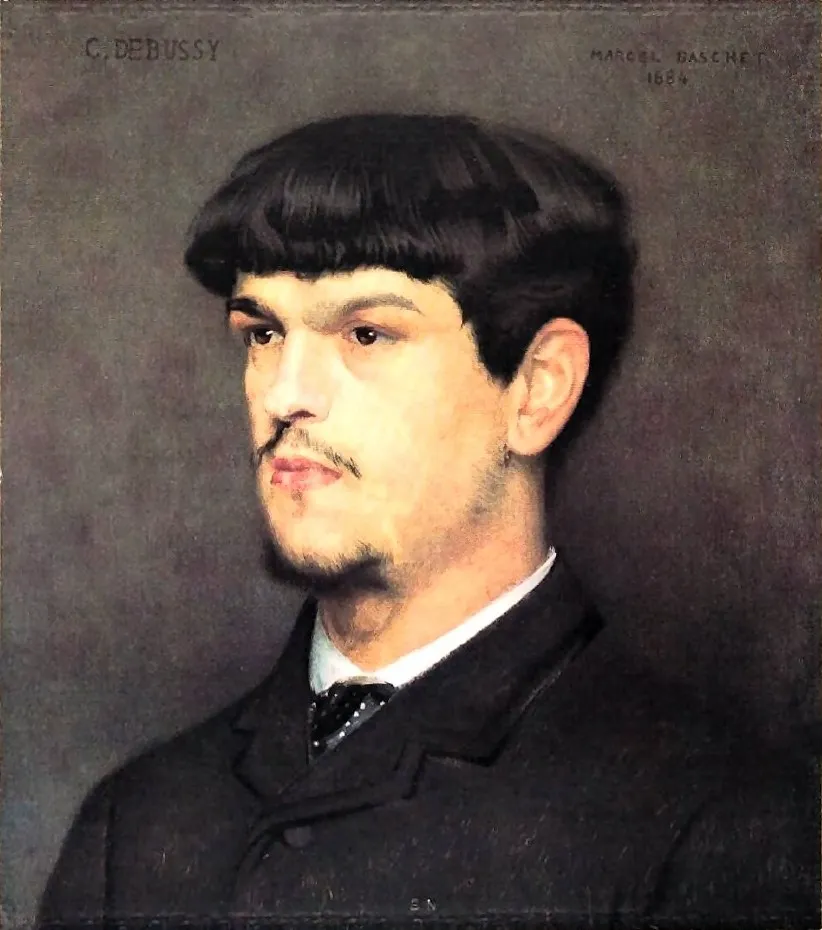
1862–1918 (France)
A leading master of modern French music, active from the late 19th to early 20th century. Breaking free from traditional…
A narrative of triumph and passion, seizing the radiant vitality and solar glory that Debussy attained at the journey's end of his elopement.
Listen to a recording
L'Isle joyeuse
Piece Guide & Analysis
The Scene Depicted — Why This Title?
Claude Debussy's solo piano work L'Isle joyeuse was conceived during a dramatic turning point in his private life, coinciding with a transition from his middle to late compositional style. What sort of island do we reach when we listen to this piece?
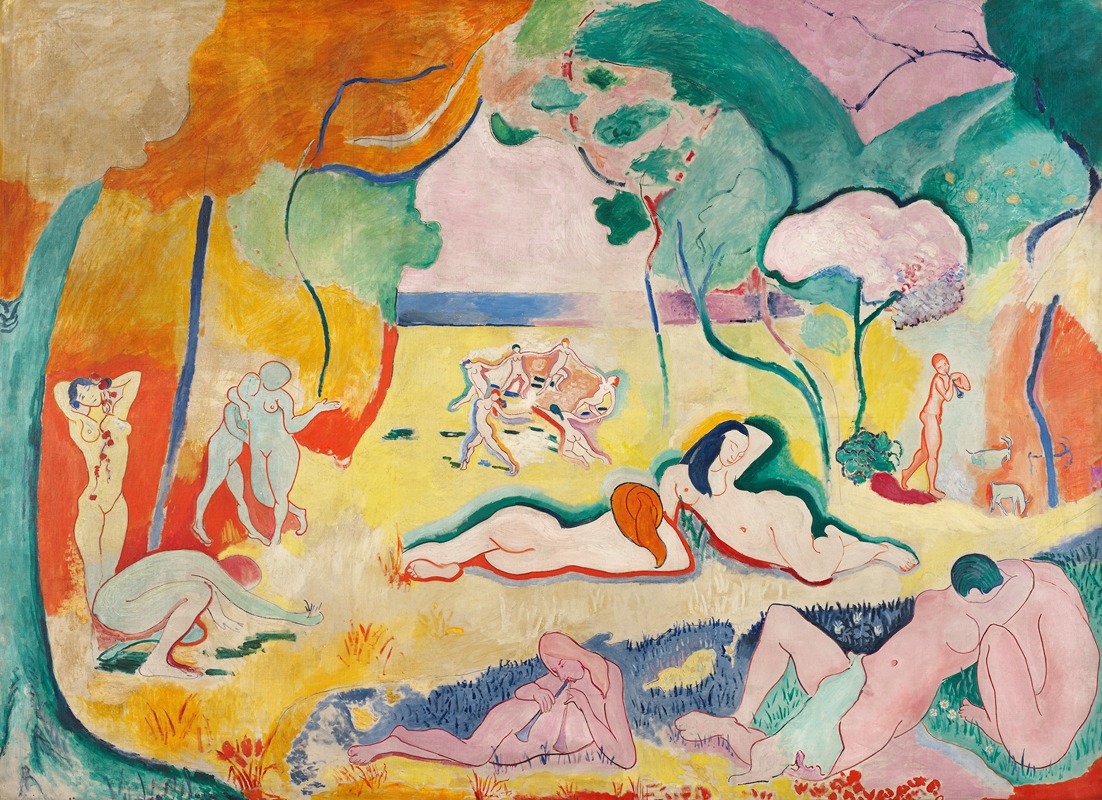
The title "L'Isle joyeuse" takes its direct inspiration from the 1717 painting The Embarkation for Cythera by French Rococo artist Jean-Antoine Watteau. Cythera was the sacred island where, according to ancient Greek mythology, Venus, the goddess of love, was born; it symbolizes a paradise where lovers journey in search of consummation. In later years, Debussy himself described the imagery of the piece: "Here one finds figures in Italian comedy masks, young women singing and dancing, and the whole concludes in the glory of the setting sun."
Behind the creation of this work lay Debussy's turbulent romantic life. While married to his first wife, Lilly, he fell in love with Emma Bardac, and in July 1904, the two fled together to the island of Jersey in the English Channel. For this reason, the work is often said to have been dashed off in a single surge of passion during this illicit getaway. In reality, he had already begun it in the summer of 1903, more than a year before the elopement, and had even played portions of it for his friend, the pianist Ricardo Viñes. The meticulous structure and harmonic experiments had already found their framework through profound reflection in Paris, well before the voyage to Jersey.
Moreover, while it is often regarded as purely programmatic music illustrating the scene of Watteau's painting, the truth is quite different. Beneath the surface of Watteau's canvas flows a distinct melancholy—a sorrow for the sweet hours slipping away, a wistful regret for fleeting happiness. Debussy, however, explicitly noted that his music had "little melancholy." Rather than mirroring the painting, he reconstructed the music into a "brilliant glory of the sun" and a "complete triumph of life," purged of all sorrow through the autobiographical energy of his real-life romantic triumph with Emma. Some scholars also suggest that the archaic spelling of the French title, "L'Isle" rather than the modern "L'Île," carries an intentional double meaning, referencing their refuge: the English Isle of Jersey.
The Story — What Unfolds in This Music
Although a single-movement piano piece, L'Isle joyeuse possesses an exceptionally symphonic and organic temporal structure. Lasting roughly five and a half to six and a half minutes, it encompasses an astonishing variety of scenes within its brief span.
The piece opens with an exceedingly rapid trill that seems to materialize out of nowhere. A cadenza descending like vaporizing sea spray leads the listener away from ordinary time and into this other-worldly "isle." Next, over the surging waves of the left hand, the right hand introduces a crisp, buoyant skipping motif—a joyful advance, like a small vessel cutting through the surf.
Before long, the meter shifts, and amidst the ripple-like figurations, a syncopated rhythm reminiscent of a languorous habanera is introduced. From a dry, almost pedal-less whisper, the music begins to swell with dramatic contours. Then appears the work's most luscious and singing melody—a cantilena that celebrates the joy of love, weightlessly floating above gravity.
In the central section, the right hand weaves a brilliant texture of delicate arpeggios. Beneath this shimmering surface, a melody with a powerful pulse emerges from the left hand, moving like a school of fish beneath the water. Traversing this vast ocean of sound, the music makes a triumphant return to the home key of A major. Whole-tone chord clusters burst forth; after a sudden hush, the formerly tender melody is grandly recapitulated in an overpowering fortissimo, accompanied by tempestuous swells in the bass. The piece concludes in a state of frenzied ecstasy, propelled by an ultra-fast passage soaring toward the heavens and a furious descending arpeggio that strikes the piano's lowest register.
Remarkably, this epic narrative was never meant to be a standalone piece. Debussy originally planned it as the finale of a "second Suite bergamasque," with Masques as the first movement and D'un cahier d'esquisses as the second. However, caught in a fierce bidding war between rival publishers, the rights to the middle movement were sold off to another house, making publication as a unified suite impossible and leaving the work to make its way into the world on its own. Furthermore, the orchestral work La Mer, composed during the same period, directly borrowed the fluid harmonies and wave-like trills first tested in L'Isle joyeuse, bearing witness to the latent symphonic architecture at the heart of this piano work.
Historical records show an intriguing discrepancy regarding the piece's public premiere. Sources from the Bibliothèque nationale de France indicate it took place on February 18, 1905, at the Salle Pleyel in Paris, whereas some English-language sources cite February 10, 1905, at the Salle Éolienne. In either case, it was unquestionably premiered by Debussy's close friend, the Catalan pianist Ricardo Viñes. Viñes's performance captivated the audience with its dazzling technique and vivid sonic palette, scoring an immediate triumph. Debussy, who had often been pigeonholed under the label of "vague and elusive impressionism," saw his reputation profoundly revitalized by the staggering dynamism and crystal-clear virtuosity displayed in this work.
Musical Analysis — Floating and Pulsing Through Mode and Rhythm
The incomparable sense of bliss and passion radiating from this piece is anchored by Debussy's precise musical calculation. Let us unpack these mechanisms through two dimensions: harmonic function and rhythmic transformation.
About 828 more words
Unlock this story's ending, and every article on MusicStory
- 42
Stories1–2 new every week
An archive of paintings paired with great music, made for a weekend night and a cup of coffee
- 282
Paintings with commentarygrowing daily
From simply looking to truly reading — the brushwork and the obsession of the masters
- 10
Music Librarygrowing daily
Know it first, and what reaches your ear changes — background music becomes art you keep for life
My Notes, unlimited
Every reading adds to a digital art notebook that is yours alone
Already have an account? Log in
Your Note
Write down what you felt and learned from this piece in your art notebook.
Please sign up to write notes.
Sign up for freeSources & references
- www.youtube.com
- www.youtube.com
- www.youtube.com
- imslp.org
- musicbrainz.org
- fr.wikipedia.org
- www.royhowat.com
- jeanmichelserres.com
- jeanmichelserres.com
- interlude.hk
- www.alpacablog.jp
- peter-hung.com
- www.youtube.com
- ja.wikipedia.org
- arion-music.com
- mediatheque.cnsmdp.fr
- www.laphil.com
- www.chopin.co.jp
- chopin-hanna.stores.jp
- academia-music.com
This site is protected by reCAPTCHA, and the Google Privacy Policy and Terms of Service apply.
If you find an error in this content, please let us know here