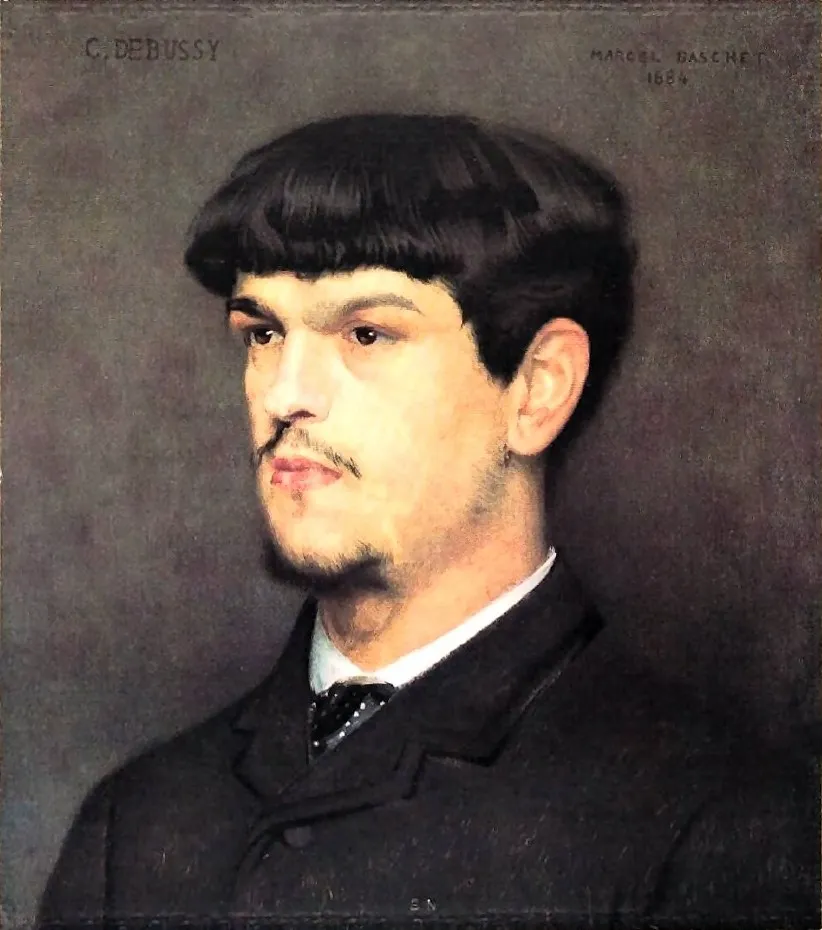
1862–1918 (France)
A leading master of modern French music, active from the late 19th to early 20th century. Breaking free from traditional…
A nostalgic masterpiece intertwining the shifting scenes of a rainstorm with traditional French nursery rhymes.
Listen to a recording
Estampes, No. 3: Jardins sous la pluie
Piece Guide & Analysis
The Scene and the Title: What Does the Piece Depict?
When you listen closely to the sound of falling rain, what memories surface in your mind?
Jardins sous la pluie (Gardens in the Rain), the third movement of Claude Debussy’s piano suite Estampes, is an extraordinarily original work that weaves atmospheric transformations together with a child’s inner world. The ceaseless patter of raindrops, a momentary clearing, and the returning surge of the downpour—these ever-shifting contrasts of light and sound are rendered with a palette of colors that seems to transcend the physical limitations of the piano.
A well-known anecdote has long circulated about how this piece came to be. It is often said that while the portraitist Jacques-Émile Blanche was sketching Debussy in a garden in Auteuil, west of Paris, a sudden torrential rain began to fall, casting a curious enamel-like green reflection from the trees onto the composer's face, inspiring the piece on the spot. Fascinating as that story is, the truth lies elsewhere: the genuine origins of the work date back nine years earlier, to 1894.
At the time, Debussy was staying with his partner Gabrielle Dupont—known as "Gaby of the green eyes"—in the town of Orbec in Normandy, residing at the historic 16th-century manor Hôtel de Croisy. Averse to fashionable, crowded resorts and the bustle of city life, Debussy grew deeply fond of the estate’s tranquil, historic garden. One rainy day, after taking a walk and feeling profoundly inspired by the downpour lashing the foliage and ground, he returned to the salon and jotted down his first sketches by the fireplace. This was the true genesis of Jardins sous la pluie.
Originally, this 1894 material took shape as the third movement of his piano suite Images oubliées, bearing the wryly verbose title "Quelques aspects de 'Nous n'irons plus au bois' parce qu'il fait un temps insupportable" (A Few Aspects of 'We'll Go No More to the Woods' Because the Weather Is Unbearable). Yet the suite went unpublished during Debussy's lifetime and was, quite literally, forgotten. In 1903, after nine years of silence and amid plans for a new suite, Debussy undertook a thorough revision of the early draft. By stripping away extraneous chromaticism and polishing the textures to crystalline clarity, he elevated the piece into Jardins sous la pluie, evoking a far more universal and symbolic imagery. The use of the plural "Jardins" in the title subtly hints at a sweeping expanse that reaches far beyond a single enclosure.
The Narrative: What Unfolds in the Music?
The music opens with a remarkably delicate portrayal of rain. Amidst a continuous, murmuring drizzle, the melody of the traditional French lullaby "Do, do, l'enfant do" gently emerges. It paints an intimate, nostalgic scene of a child lulled toward sleep inside a room on a rainy afternoon.
Before long, the rain intensifies and the wind begins to howl, but a brief respite soon arrives. Through the mist, another children's song, "Nous n'irons plus au bois" (We'll Go No More to the Woods), emerges, sung with a touch of hesitation and wistfulness. It evokes a tender, cozy moment where the melancholy of a child kept indoors blurs with the droplets trailing down the windowpane.
Yet the calm does not last. The storm returns with greater fury, and the music churns restlessly, conjuring fierce gusts of wind and distant rolls of thunder. Finally, accompanied by a flash of lightning that rends the dark clouds, radiant sunlight breaks through. As the wet grass glistens in the golden light, the two nursery tunes return triumphantly, bringing the piece to a jubilant, celebratory close.
By 1903, when this work was completed, Debussy was the subject of fierce public controversy following the sensational premiere of his opera Pelléas et Mélisande the year before. His personal life was equally turbulent, marked by the breakdown of his first marriage and the fateful encounter with the woman who would become his second wife. This surge of intense creative and emotional energy is vividly reflected in the dazzling virtuosity and brilliant color of the music.
The premiere took place in January 1904. The moment pianist Ricardo Viñes struck the final chord, the hall erupted in thunderous applause. The audience's demand for an encore was so persistent that Viñes interrupted the program to play the entire piece again from the beginning. For listeners of the day, hearing beloved French nursery songs woven so clearly into Debussy’s intricate, modernist Impressionist textures was not only a striking surprise, but an experience of profound warmth and familiarity.
This period also marked a major turning point in the musical depiction of water in France. In 1901, two years earlier, Maurice Ravel had published Jeux d'eau, introducing a revolutionary approach to piano writing that used lightning-fast arpeggiation to represent flowing water. The relentless sixteenth-note figurations in Jardins sous la pluie can be viewed as Debussy's brilliant reply to Ravel’s innovation—an artistic exploration that would lead directly to his orchestral masterpiece, La Mer.
Musical Analysis: When the Piano Becomes an Orchestra
Although written for solo piano, the piece resonates with the depth and variety of a full symphonic ensemble. Let us explore how Debussy draws an orchestral spectrum of colors from the keyboard, and what harmonic magic he employs to achieve it.
About 877 more words
- ・The True Origin of a Title That Overturns Conventional Wisdom
- ・A Brilliant Response to Ravel's "Water"
- ・Why Pianists with Small Hands Have the Advantage
- ・The Secret of the Golden Ratio Hidden in Free-Flowing Music
- ・A Rainy Landscape Transforms into Exquisite Architecture
Unlock this story's ending, and every article on MusicStory
¥07-day free trial
Unlimited access to 334 stories, paintings and pieces
- ・The first 7 days are completely free. Cancel within the trial and nothing is charged.
- ・From day 8, ¥980/month (tax incl.). Cancel anytime from your account page.
- 42Stories
- 282Paintings with commentary
- 10Music Library
- My Notes, unlimited
Already have an account? Log in
Your Note
Write down what you felt and learned from this piece in your art notebook.
Please sign up to write notes.
Sign up for freeSources & references
- museedupatrimoine.fr
- royhowat.com
- www.youtube.com
- www.youtube.com
- www.youtube.com
- content.alfred.com
- musescore.com
- en.wikipedia.org
- www.chandos.net
- www.fnac.com
- fr.wikipedia.org
- imslp.org
- echos-de-mon-grenier.blogspot.com
- www.sheetmusicplus.com
- www.discogs.com
- imslp.org
- grokipedia.com
- www.culture.gouv.fr
- jeanmichelserres.com
- www.youtube.com
This site is protected by reCAPTCHA, and the Google Privacy Policy and Terms of Service apply.
If you find an error in this content, please let us know here