
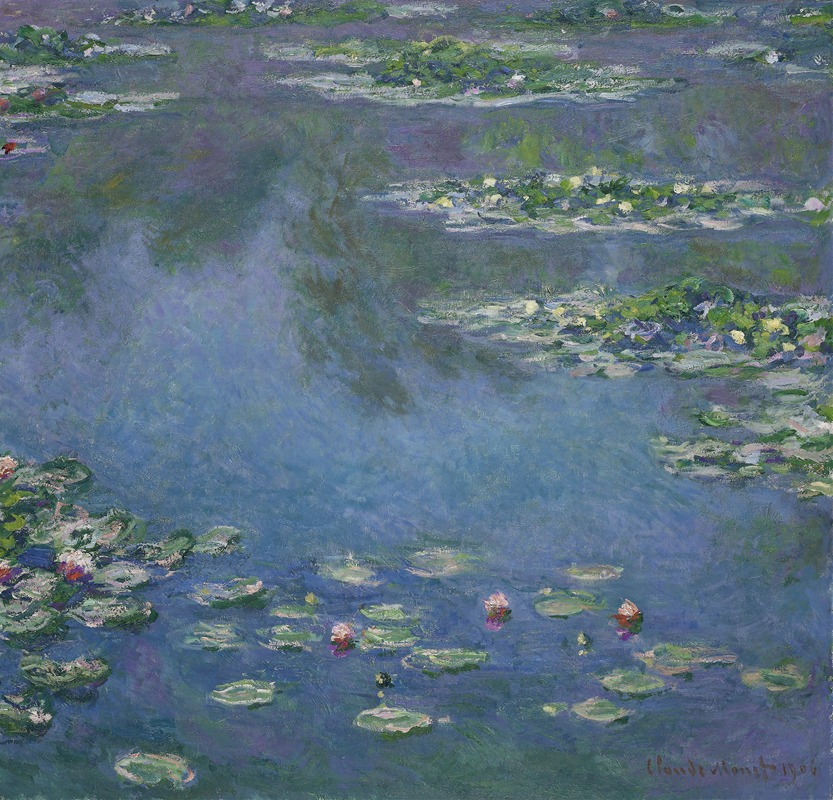
Water Lilies
1906
- Dimensions
- 89.9 × 94.1 cm
- Medium
- Oil on linen canvas
- Collection
- Art Institute of Chicago
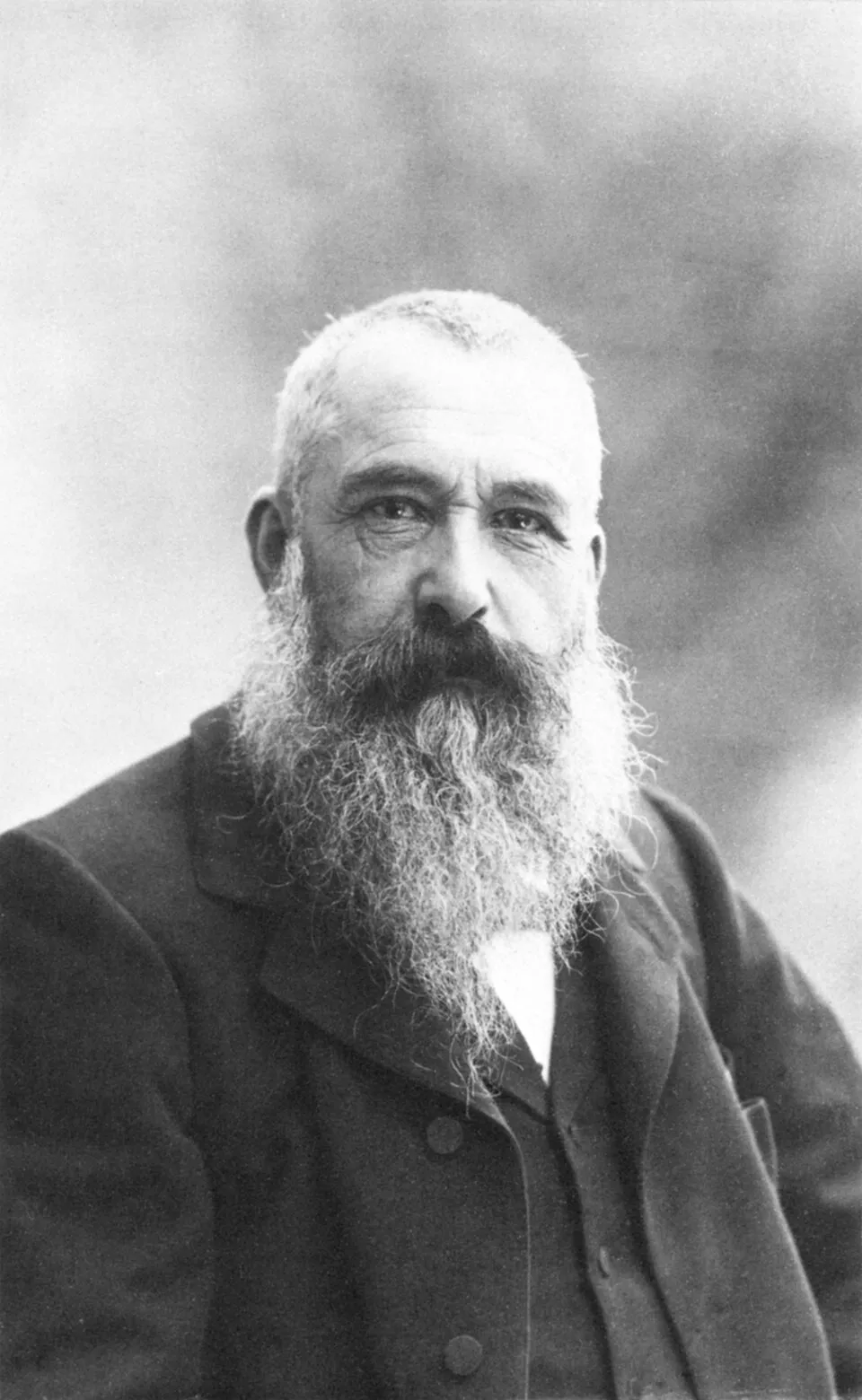
Celebrated as a founding figure of Impressionism, he is one of France’s most ren…
Abandoning conventional landscape rules amid failing health and sight, he poured his unfiltered obsession directly onto the canvas to capture the eternal, fleeting reflection of light.
✦ Highlights (technique & color)
To capture the luminosity of light, lead white was mixed into nearly all the pigments, lending the surface a distinctive sheen and body. The blues of the water were created by blending French ultramarine and cobalt blue. For the red petals in the foreground, organic red lake and vermilion were loaded onto the brush without prior mixing on the palette and applied directly to the canvas. Furthermore, strokes of costly cobalt violet—appearing as if squeezed straight from the tube—were applied to the shadowed ripples, heightening the effect of optical vibration.
✦ The setting of this painting
This scene depicts the garden of Monet's home in Giverny, roughly sixty kilometers northwest of Paris. After purchasing the property in 1890, Monet acquired adjacent land in 1893 to expand the pond and construct a Japanese-style arched footbridge. The diverse flora planted in this "water garden"—including exotic hybrid water lilies, willows, and irises—remained his primary source of inspiration for more than twenty-five years.
✦ Historical context
Created at the midpoint of Monet's intensive work on his Water Lilies series between 1903 and 1908, this piece was painted when his spatial experiments reached their zenith. Monet entirely eliminated traditional spatial anchors such as the horizon and the sky from the composition, opting for a nearly square canvas. By focusing the viewer's gaze purely on the reflections across the water's surface, this revolutionary approach became a decisive turning point that paved the way for abstract painting.
Vibrant water lilies float upon a surface where complex shades of blue and green intermingle.
About 60 kilometers northwest of Paris, this is the water garden Claude Monet created at his home in Giverny.
At first glance, it appears to be a lovely, tranquil painting capturing a serene waterscape.
And yet.
Monet obsessively painted over the water lily leaves he had initially brought to life on the canvas.
Having bought the Giverny property in 1890, Monet acquired adjacent land in 1893 to expand the pond, adding a Japanese-style arched bridge. Planted with exotic hybrid water lilies, weeping willows, and irises, this rich flora became his ultimate muse for over a quarter of a century.
By 1906, when this piece was painted, Monet was in his mid-sixties. Entering his twilight years, he was increasingly aware of his failing eyesight and physical decline. Even so, his passion for painting this pond burned with extraordinary intensity—a drive he described in letters as an "obsession."
He stripped the canvas of the traditional elements long considered essential to landscape art: the horizon, the banks, and the sky. Choosing a nearly square canvas, he dared to pioneer a radical spatial expression—focusing the viewer's gaze purely on the reflections dancing across the water.
About 283 more words

Read the rest of this commentary —
and step into a secret gallery
opened just for you
An "art letter" delivered to you every Saturday morning
Works, music and words chosen for your sensibility, from your artist-type result and the paintings you love
A library of masterpieces and music you can enjoy "in your own words", not just look at
A "digital art notebook" (unlimited) where your impressions build into your own taste
Unlimited likes and notes
¥980 / month¥0 today
¥980/month (tax incl.) from day 8. Cancel anytime.
Already have an account? Log in
Your Note
Write down what this painting made you feel in your art notebook.
Please sign up to write notes.
Sign up for freeRecommended Artworks
Sources & references
More artists







If you find an error in this content, please let us know here
This site is protected by reCAPTCHA, and the Google Privacy Policy and Terms of Service apply.