
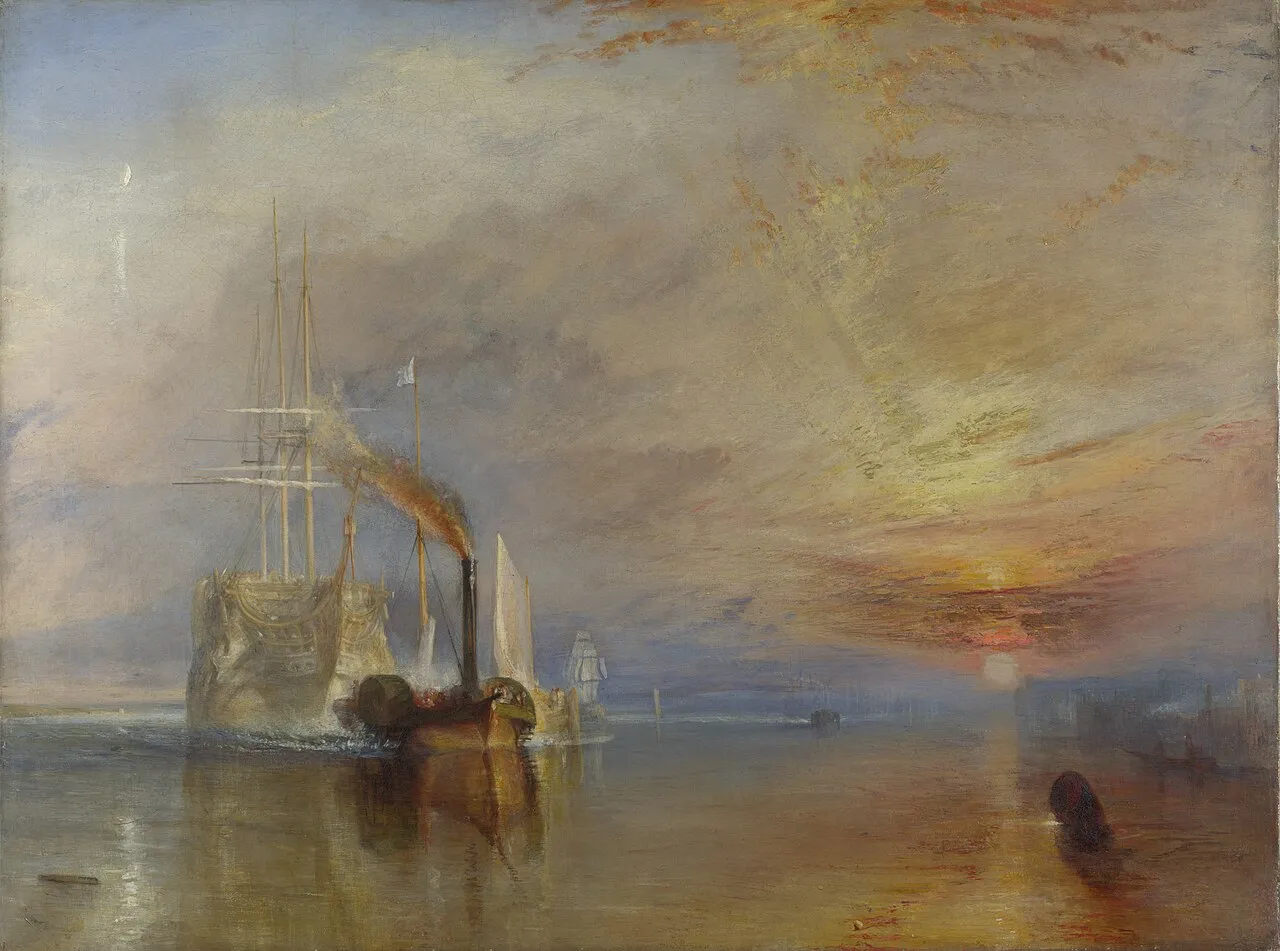
The Fighting Temeraire, tugged to her last Berth to be broken up, 1838
1839
- Dimensions
- 90.7 × 121.6 cm
- Medium
- Oil on canvas
- Collection
- The National Gallery, London

A Romantic painter who elevated landscape painting to the stature of history pai…
An elegy for the close of the age of sail and the dawn of a new era, composed by reimagining historical fact. A heroic lament for a faithful veteran vessel dedicated to the nation, bound to the inexorable future of the Industrial Revolution.
✦ Highlights (technique & color)
On the right side of the canvas, the setting sun and clouds are built up with thick impasto, their raised textures physically catching and reflecting the light. In contrast, the water and the hull of the warship are rendered with translucent glazes and scumbling—rubbing dry paint lightly across the surface. This creates a striking harmony of luminous clarity and a ghostly, ethereal presence.
✦ The setting of this painting
The setting of this painting is the River Thames, along the route from the naval base at Sheerness in Kent to a shipbreaker's yard in Rotherhithe, southeast London. In September 1838, during the spring tides, the ship was indeed towed up the river. Turner had known these waters intimately since childhood, yet he reimagined the scene on canvas, sacrificing geographical accuracy for poetic effect.
✦ Historical context
Britain in the 1830s was in the throes of profound technological innovation and sweeping social change. As the Industrial Revolution reached its height, paddle-wheel steamers and railway networks expanded rapidly. It was an era of transition—from wooden sailing vessels powered by the wind to an age of iron and coal-fired steam. With the end of the Napoleonic Wars, vast numbers of obsolete wooden warships were sent to the breaker's yard one after another.
A gigantic wooden warship floats pale and ghostly.
Just ahead of it churns a small, squat, black steam tug.
From its tall funnel billows thick smoke mingled with fiery sparks and reddish brown.
Kicking up a frothy white wake, it pulls the great warship by a heavy hawser.
Across the right half spreads a dazzling sunset shifting from crimson to gold.
In the sky to the upper left, a crescent moon hangs quietly, casting a cold, pale light.
The Temeraire, a hero of the Battle of Trafalgar that led Britain to victory.
Depicting her final voyage, this painting has long been accompanied by a familiar story:
Turner, sharing a small boat on the Thames with friends, witnessed the towing firsthand.
Deeply moved by the sight, he resolved to paint it on the spot.
An old veteran heading to the breaker's yard with graceful masts held high.
Everyone believed it to be a faithful record of that historic moment.
Yet in truth, the scene depicted in this painting never existed in reality.
In September 1838,
the decaying Temeraire was sold at an Admiralty auction.
Purchased by the shipbreaker John Beatson, she was towed up the Thames.
Before departing Sheerness, however, all her masts and yards had been dismantled.
The actual vessel sold was nothing more than a hollow wooden hull.
The tugs that towed her were actually two: the London and the Samson.
Furthermore, for a ship traveling westward, a sunset on the right is a geographical impossibility.
Turner completely reinvented the facts.
Sixty-three years old at the time,
he was a prominent figure at the Royal Academy,
enjoying firm critical acclaim and financial success.
Without a commission from anyone, he began this work purely on his own initiative.
In his studio, he retrieved an unfinished canvas he had previously abandoned.
Beneath its surface lay the broad sails of another vessel.
Over this, drawing on newspaper reports and his own memory, he painted in the missing masts.
Sacrificing geographical accuracy, he placed the setting sun on the right,
while suspending a rising crescent moon on the left.
The heroic past of the Royal Navy, driven by wind and canvas.
The pragmatic future of the Industrial Revolution, dominated by coal and steam.
He wished to express the pathos brought about by this transitional era in technology.
Many wealthy collectors offered to purchase the work,
yet he refused them all.
“This painting is my darling.”
Calling it so, he kept it by his side, determined from the start to bequeath it to the nation.
Throughout his lifetime, the painting was never sold.
About 97 more words
Read stories of masterpieces for free
Your Note
Write down what this painting made you feel in your art notebook.
Please sign up to write notes.
Sign up for freeRecommended Artworks
Sources & references
More artists






If you find an error in this content, please let us know here
This site is protected by reCAPTCHA, and the Google Privacy Policy and Terms of Service apply.