
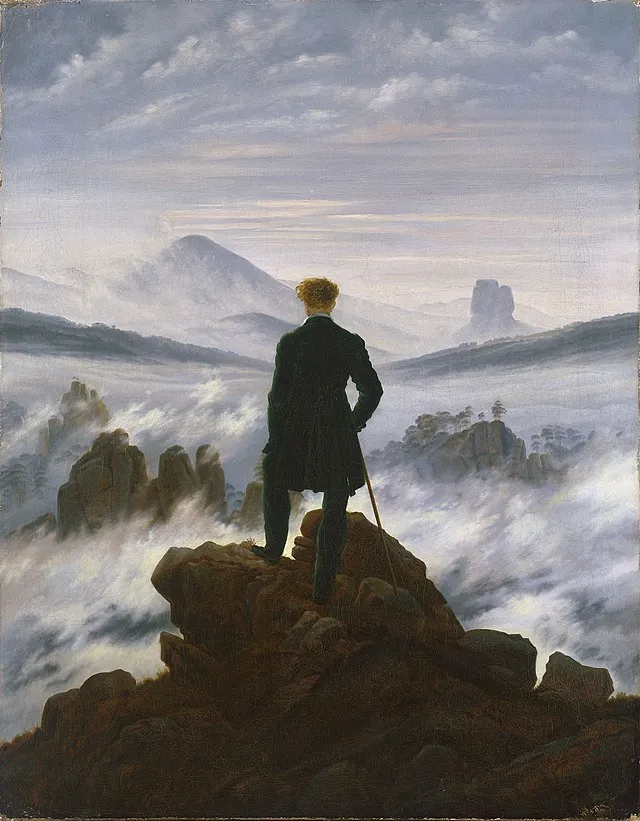
Wanderer above the Sea of Fog
1818
- Dimensions
- 94.8 cm × 74.8 cm
- Medium
- 油彩、カンヴァス
- Collection
- ハンブルク美術館(ハンブルク美術コレクション財団所有・永久貸与)
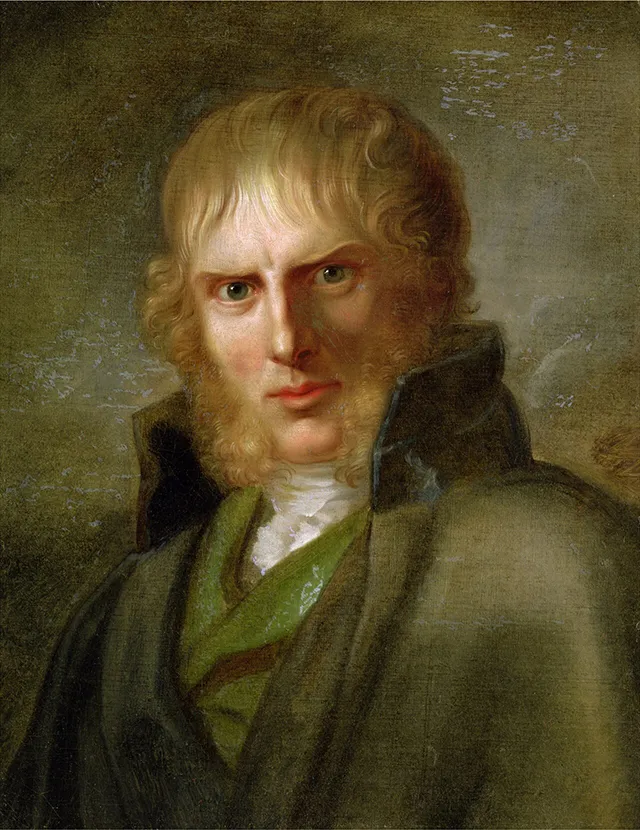
Active from the late eighteenth to the early nineteenth century, this German pai…
As state suppression and censorship deepened, he assembled memories etched amidst the flames of war, leaving behind a silent message of political protest for freedom on the canvas.
✦ Highlights (technique & color)
画面の中央を通る垂直線上に男の身体軸が配置されている。周囲の山稜や霧の流れる斜線は、男の胸部(心臓の位置)へと集中的に収束する構造である。黄金比の水平線が男の目の高さを通り、頭部のみが天空の領域へ突き出している。手前の暗い逆光による岩場と、奥の空気遠近法による色彩の対比が無限の奥行きを生み出している。
✦ The setting of this painting
描かれている景色は実在する単一の場所ではなく、ザクセン・スイスやボヘミア地方の山々(カイザークローネ、ガムリヒ、ツィルケルシュタイン、ローゼンベルク山など)で描かれた写生をアトリエで組み合わせた合成風景である。1813年、ナポレオン軍のドレスデン侵攻を逃れて疎開したクリッペン滞在中などに描かれたスケッチが直接のモチーフとなった。
✦ Historical context
作品が制作された1810年代後半のドイツは、ナポレオン戦争後のウィーン体制下における復古主義と厳しく政治的抑圧の時代であった。 1819年のカールスバート決議に象徴される検閲と自由主義運動の弾圧の中、作中の男が着用する「古ドイツの衣装(Altdeutsche Tracht)」は、自由とドイツ統一を求める市民や愛国者の象徴であり、体制に対する画家の静かな政治的抗議の意思表示でもあった。
A Painting Undiscovered for 150 Years
A man in a dark green frock coat stands atop a precipice.
In his right hand, he grips a walking stick.
Standing with his back turned to us, beneath his feet stretches a vast, billowing sea of white fog into the distance.
A gust of wind sweeps through, ruffling his reddish-blond hair.
Sheer crags and sharp peaks emerge through the rifts, while distant mountain ridges fade into a blue haze.
A profound sense of distance lingers between the foreground and the depths beyond.
The viewer's gaze is effortlessly drawn out across the fog.
The composition, with a figure's back commanding the center, is striking.
Viewers across the world see in it a solitary traveler confronting the grandeur of nature.
Yet when this painting first came into being, no one sought to record its existence.
Nowhere on the canvas is the artist's signature.
Not even a date marks the year of its creation.
A nameless work, it was quietly brought into the world in an atelier.
The place of its birth was a quiet studio in Dresden, around 1817 to 1818.
Its creator, Friedrich, was not a painter who merely copied scenery.
He assembled inner perceptions to conjure an entirely new world.
The rugged rocks and hazy mountain ranges depicted here were a composite landscape found on no actual map.
The sketches that served as the foundation for this scene were made during a time of great upheaval.
In 1813, Dresden was engulfed in the fierce turmoil of war following the invasion of Napoleon's army.
Fleeing the city, Friedrich sought refuge in Krippen, in Saxon Switzerland.
Wandering through unfamiliar mountains, he quietly accumulated sketch after sketch.
On June 3, 1813, he climbed a rocky hill called the Kaiserkrone.
In the margin of a pencil sketch, he noted: "Atop the highest peak, so high is the horizon."
Those sketches, made amidst the shadow of war, were transformed years later into the rocky crag beneath the figure's feet.
Completed in the studio without a title, the painting continued to drift beneath the surface of history long after the artist was gone.
Who Is This Figure from Behind?
The painter left behind no record regarding the identity of the man standing at the center.
About 425 more words
Unlock this story's ending, and every article on MusicStory
- 42
Stories1–2 new every week
An archive of paintings paired with great music, made for a weekend night and a cup of coffee
- 282
Paintings with commentarygrowing daily
From simply looking to truly reading — the brushwork and the obsession of the masters
- 10
Music Librarygrowing daily
Know it first, and what reaches your ear changes — background music becomes art you keep for life
My Notes, unlimited
Every reading adds to a digital art notebook that is yours alone
Already have an account? Log in
Your Note
Write down what this painting made you feel in your art notebook.
Please sign up to write notes.
Sign up for freeRecommended Artworks

More artists

If you find an error in this content, please let us know here
This site is protected by reCAPTCHA, and the Google Privacy Policy and Terms of Service apply.