
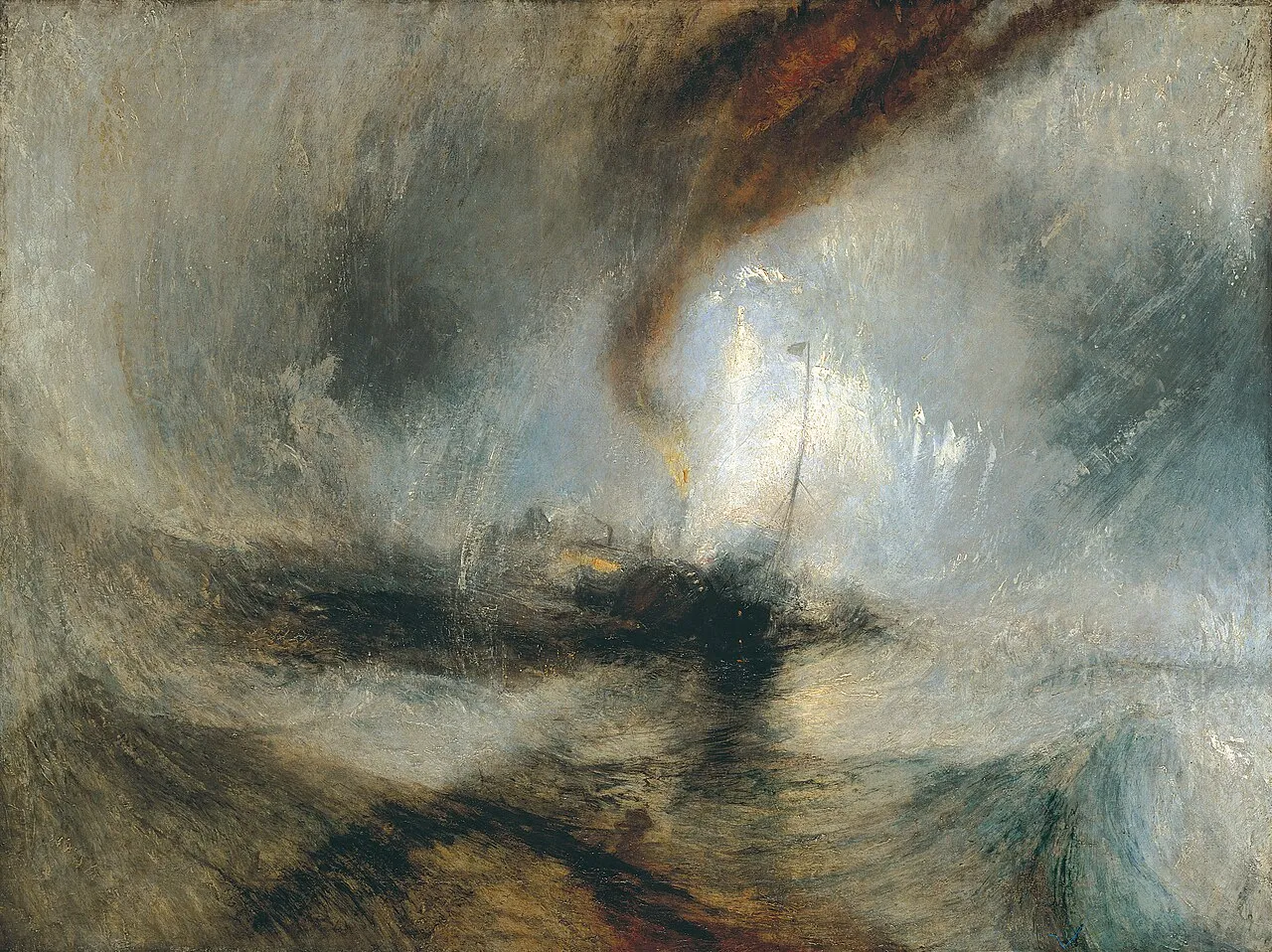
Snow Storm: Steam-Boat off a Harbour's Mouth
1842
- Dimensions
- 91.4 × 121.9 cm
- Medium
- Oil on canvas
- Collection
- Tate Britain, London
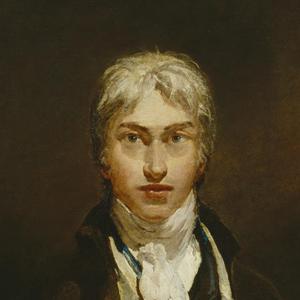
A Romantic painter who elevated landscape painting to the stature of history pai…
A fierce defiance against uncomprehending critics who derided his work as 'soapsuds and whitewash.' In humanity's desperate struggle against the fury of nature, Turner carved his own solitary devotion to his art—a visceral cry from the soul.
✦ Highlights (technique & color)
Across a white-ground canvas, thinned paint was swept rapidly to establish translucent layers. Over this, thick passages of paint were vigorously struck onto the surface with stiff brushes and palette knives. Through raw, physical gestures—scraping the paint and smudging it with his fingers—Turner recreated the visceral shock of a snowstorm. The composition is defined by its dynamic vortex, entirely forsaking conventional perspective.
✦ The setting of this painting
The entrance to the harbor off Harwich, a port town in Essex on England's east coast. In this period, Harwich was a primary departure point for packet boats bound for continental Europe. Plagued by shifting sandbanks and shoals, these treacherous waters posed a grave risk of running aground during stormy nights. The painting depicts the depth of a winter night in the throes of a fierce blizzard.
✦ Historical context
In the mid-19th century, the advent of coal-fired paddle steamers spurred a transportation revolution, supplanting traditional wooden sailing ships. Turner harbored a profound fascination with the smoke, speed, and dynamism of emerging technologies. This was also an era in which vanguard scientific discoveries—such as Faraday's experiments in electromagnetism and contemporary theories of optics—exerted a direct influence on the artist's interpretation of light and tone.
A steamboat tossed about in violent, raging waves. Billowing black smoke mixes with the swirling blizzard, forming a massive vortex. There is a famous legend surrounding this painting, told by Turner himself. To capture a storm with complete accuracy, he had himself tied to the mast of a steamboat for four hours. So the story has been passed down.
In reality, however, it has been concluded that this tale was merely Turner’s own invention. At the time of its creation, around 1841 to 1842, Turner was already 67 years old. Had a man in his late sixties been tied to a mast for four hours in the freezing North Sea in winter, he would almost certainly have lost his life. Furthermore, an investigation of harbor records at Harwich—the supposed setting—revealed no record of the Ariel, the ship he claimed to have boarded. It was all made up. Why, then, did he fabricate such a story?
At the time, Turner stood at the pinnacle of the British art world. He served as a professor at the Royal Academy and was exceptionally wealthy. Yet, he wrestled with the physical decline and health anxieties of aging. Still, his passion for creation never waned. Uncommissioned by anyone, this painting was produced entirely on his own initiative.
When the painting was unveiled at an exhibition in 1842, critics reviled it harshly. They dismissed the entire canvas as nothing more than "soapsuds and whitewash." Turner was deeply hurt. On the night of those scathing reviews, he reportedly muttered over and over in frustration by the fireplace: "'Soapsuds and whitewash'?" He later protested to a friend: "I did not paint it to be understood, but I wished to show what such a scene was like."
He channeled into the canvas decades of experience accumulated through keen observation. He incorporated cutting-edge scientific knowledge as well. The swirling composition of the picture applied the patterns of magnetic lines of force from the experiments of his contemporary, the physicist Michael Faraday. He wanted to depict the overwhelming power of nature. He wanted to compel viewers to believe in its absolute authenticity. That was precisely why he cast himself as the protagonist who threw himself into the storm.
About 125 more words
Read stories of masterpieces for free
Your Note
Write down what this painting made you feel in your art notebook.
Please sign up to write notes.
Sign up for freeRecommended Artworks
.webp)
Sources & references
More artists
If you find an error in this content, please let us know here
This site is protected by reCAPTCHA, and the Google Privacy Policy and Terms of Service apply.