
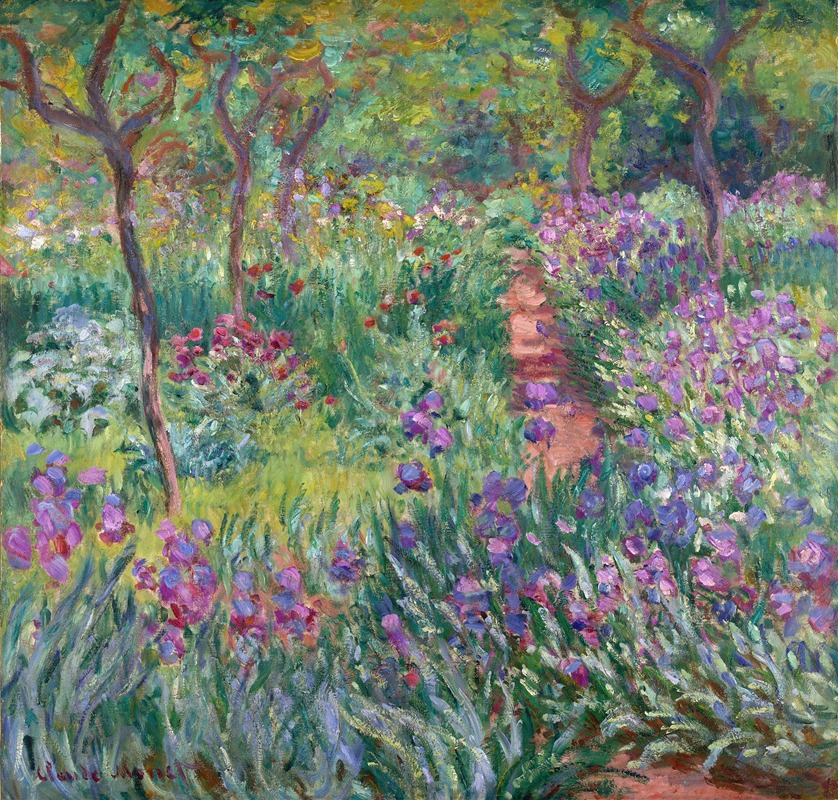
The Artist’s Garden in Giverny
1900
- Dimensions
- 81.6 × 92.6 cm
- Medium
- Oil on canvas
- Collection
- Musée d'Orsay
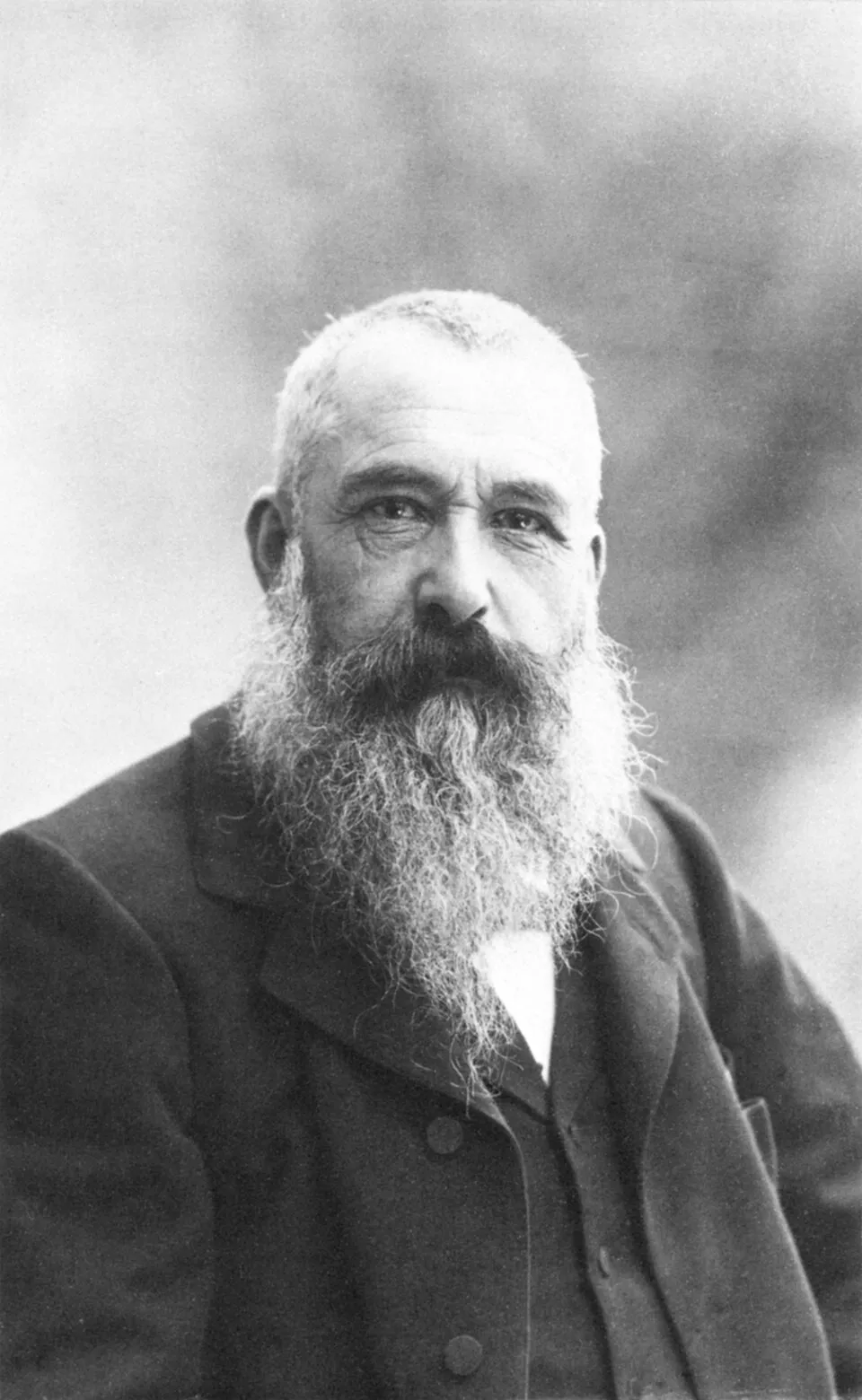
Celebrated as a founding figure of Impressionism, he is one of France’s most ren…
✦ Highlights (technique & color)
While the diagonal path leading from the foreground into the distance creates a deep sense of perspective, the composition also emphasizes a flat, decorative quality through the mottled patterns of irises, intricate play of dappled light, and vertical lines of the trees. Against the dominant purple of the irises, touches of red, yellow, blue, and green create a rich harmony of color. By applying swift, spontaneous brushstrokes and placing unblended paints side by side, Monet captured the shimmering flicker of sunlight directly onto the canvas.
✦ The setting of this painting
This setting depicts the Clos Normand, the vast garden situated directly in front of Monet's home in Giverny, in the Eure department of France. Landscaped by Monet himself, it is densely planted with irises in varying gradations of purple and pink. Tall trees rise up to canopy the blooms, giving the composition a vertical structure, while Monet's famed pink-brick house can be seen softly shimmering in the distance between the tree trunks.
✦ Historical context
In 1900, at the age of sixty, Monet was enjoying unprecedented success in the art market and considerable wealth. That year, he was simultaneously pursuing two ambitious series: the modern urban landscapes along London's River Thames, and the garden series featuring the Water Garden and the Clos Normand, both of which he had spent years cultivating at his home in Giverny. To Monet, this garden was far more than a hobby—it was a "living studio" conceived perfectly for his painting.
On both sides of the gravel path, irises bloom in dense profusion, forming a subtle gradation of purple and pink.
Through the towering tree trunks arching above, the pink brick house is dimly visible in the distance.
The year 1900.
Having reached the age of sixty, Claude Monet had achieved unrivaled success in the art market and amassed great wealth.
That year, he was working concurrently on two ambitious series.
One depicted the modern urban landscape along London's River Thames,
and the other, the grounds of his estate in Giverny, in the French department of Eure—
a garden series featuring the "Water Garden" and the "Clos Normand," which he had spent years cultivating himself.
To Monet, this garden at Giverny was far more than a simple hobby.
He personally selected every plant, from wild daisies to prized, exotic Oriental species.
He carefully orchestrated the harmony of colors and the interplay of heights.
Designed so that flawless painterly compositions would naturally emerge as the seasons shifted, it served as a "living studio" conceived purely for his art.
Possessing an almost fanatical passion for botany,
Monet maintained close ties with figures such as Prime Minister Georges Clemenceau and fellow painter Gustave Caillebotte.
They enthusiastically shared and exchanged rare seedlings and horticultural techniques.
"My garden is a slow work, pursued with love,"
he once remarked.
About 221 more words

Sign up free and enter Your Museum
Read the stories behind great paintings and music for free, in Your Museum
Your Note
Write down what this painting made you feel in your art notebook.
Please sign up to write notes.
Sign up for freeRecommended Artworks
_Claude_Monet_(W_P_76).webp)
Sources & references
More artists

If you find an error in this content, please let us know here
This site is protected by reCAPTCHA, and the Google Privacy Policy and Terms of Service apply.