
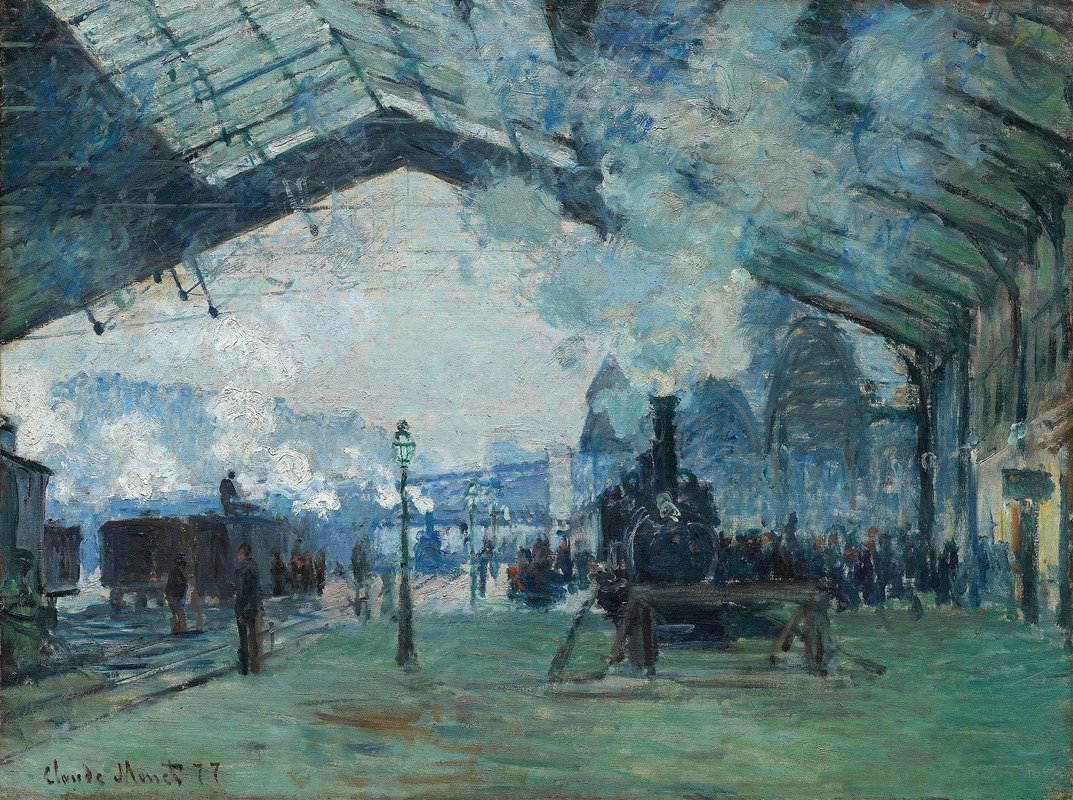
Arrival of the Normandy Train, Gare Saint-Lazare
1877
- Dimensions
- 60.3 × 80.2 cm
- Medium
- Oil on canvas
- Collection
- The Art Institute of Chicago

Celebrated as a founding figure of Impressionism, he is one of France’s most ren…
✦ Highlights (technique & color)
Highlights are formed by leaving the white and cream ground exposed. The clash between the hot, opaque steam and the cool natural light filtering through the glass roof is rendered through juxtapositions of blue, violet, pink, and white pigments. The figures are captured using pure, unblended brushstrokes.
✦ The setting of this painting
Inside the platforms of the Gare Saint-Lazare in Paris. This scene unfolds beneath the vast canopy of iron arches and glass panes before the station was rebuilt in its present form in 1889. Serving eleven million passengers annually, it bustled with energy as a vital artery linking Paris to the provinces.
✦ Historical context
In 1870s France, the burgeoning railway network and steam locomotives were quintessential symbols of the Industrial Revolution and modernity. Yet traditional academic painting shunned stations and railways as vulgar byproducts of contemporary life, deemed unworthy of fine art. The Impressionists deliberately embraced these modern urban vistas as their subjects.
Save your favorite paintings
Your Note
Write down what this painting made you feel in your art notebook.
Please sign up to write notes.
Sign up for freeRecommended Artworks




Sources & references
More artists






If you find an error in this content, please let us know here
This site is protected by reCAPTCHA, and the Google Privacy Policy and Terms of Service apply.