
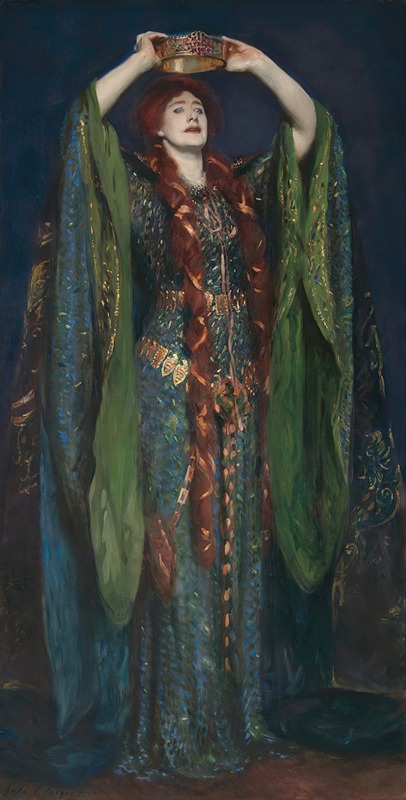
Ellen Terry as Lady Macbeth
1889
- Dimensions
- 221.0 × 114.3 cm
- Medium
- Oil on canvas
- Collection
- Tate Britain (London)
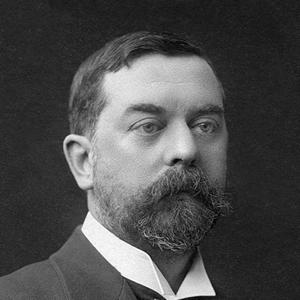
Born in Italy to American parents, he spent his early years in Paris before esta…
✦ Highlights (technique & color)
The luminous blue-to-green sheen of beetle wings is recreated on the canvas through sharp, layered strokes of paint. A striking color contrast emerges from the red wig braided with gold cord, the iridescent green of the gown, and the heather-toned velvet cloak hand-embroidered with red griffins.
✦ The setting of this painting
Somber shadows evoke the interior of a heavy, ancient Scottish stone castle. Rather than depicting a specific scene from the play, it serves as a visual backdrop for a dramatic, imagined pose conceived by Sargent himself.
✦ Historical context
In 1888, a new production of Macbeth directed by Henry Irving opened at the Lyceum Theatre in London. While Victorian conventions required gentlewomen to wear corsets, Ellen Terry and her circle rejected them in favor of liberating the natural body.
A gloomy, stone fortress-like background.
A red-haired woman holds a crown aloft with both hands.
The green dress she wears, exuding an otherworldly aura, cascades down to her feet.
The climax of Shakespeare's tragedy, Macbeth.
It appears as if a famous scene from the play, where Lady Macbeth, filled with madness and ambition, crowns herself, has been directly transferred onto the canvas.
However, this is not actually a specific scene from the play.
It is an imagined pose, conceived by Sargent himself.
December 29, 1888.
At the Lyceum Theatre in London, a new production of Macbeth premiered.
Sargent, who attended the opening night, was overwhelmed by the eerie beauty of Ellen Terry's portrayal of Lady Macbeth.
Almost immediately after the premiere, he decided to paint her portrait.
This overwhelming presence is created by the costume she wears.
It was designed by Alice Comyns Carr.
It was woven from soft green wool and blue tinsel threads.
Over 1,000 real beetle wings were hand-stitched onto its surface.
A bewitching shimmer, like snake scales.
The director, Henry Irving, demanded of Terry:
That she wear a corset, a norm for Victorian ladies.
She flatly refused.
What Terry and Carr chose was the liberation of the natural body, free from corsets.
The playwright Oscar Wilde witnessed an incredible sight on Tite Street in London.
On a dreary, rainy morning,
Terry, in full makeup and the complete Lady Macbeth costume, was riding in a hansom cab on her way to Sargent's studio.
Wilde was captivated.
“This street, which has given me the vision of Lady Macbeth in full regalia riding majestically in a hansom cab, will never again be like any other dull street.”
He also described the costume's unreal opulence thus:
“She herself seems to have done all her shopping in the far-off Byzantine Empire.”
About 148 more words
Read stories of masterpieces for free
Your Note
Write down what this painting made you feel in your art notebook.
Please sign up to write notes.
Sign up for freeRecommended Artworks
Sources & references
- Ellen Terry as Lady Macbeth - Wikipedia
- Ellen Terry as Lady Macbeth, 1889 - John Singer Sargent - WikiArt.org
- 'Ellen Terry as Lady Macbeth', John Singer Sargent, 1889 | Tate
- Ellen Terry as Lady Macbeth by John Singer Sargent - TheHistoryOfArt.org
- J. Singer Sargent: Ellen Terry as Lady Macbeth - Elizabeth Hawksley
- Ellen Terry as Lady Macbeth | Art UK
- Ellen Terry as Lady Macbeth | Beside Every Man - WordPress.com
- "Beetlewing dress" worn by Ellen Terry as Lady Macbeth in the Lyceum Theatre production of "Macbeth", 1888 & "Ellen Terry as Lady Macbeth", painting by John Singer Sargent, 1889 : r/fashionhistory - Reddit
- John Singer Sargent's Ellen Terry as Lady Macbeth
- Beyond the Brushstroke: Ellen Terry as Lady Macbeth | Tate Britain
More artists
If you find an error in this content, please let us know here
This site is protected by reCAPTCHA, and the Google Privacy Policy and Terms of Service apply.