
Girl with Dog
1873
- Dimensions
- 55.2 × 45.7 cm
- Medium
- Oil on canvas
- Collection
- The Barnes Foundation (Philadelphia, Pennsylvania, USA)
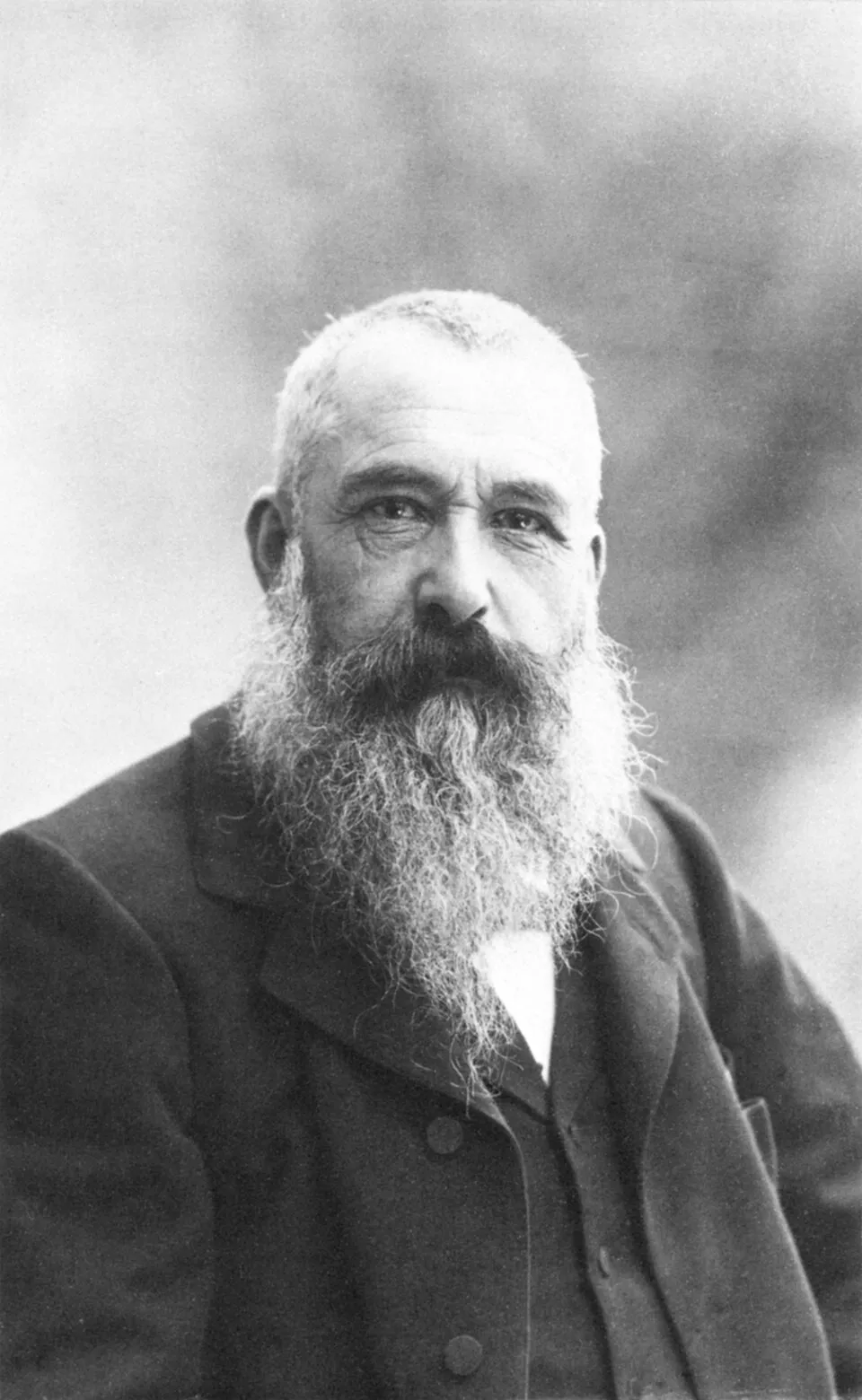
Celebrated as a founding figure of Impressionism, he is one of France’s most ren…
✦ Highlights (technique & color)
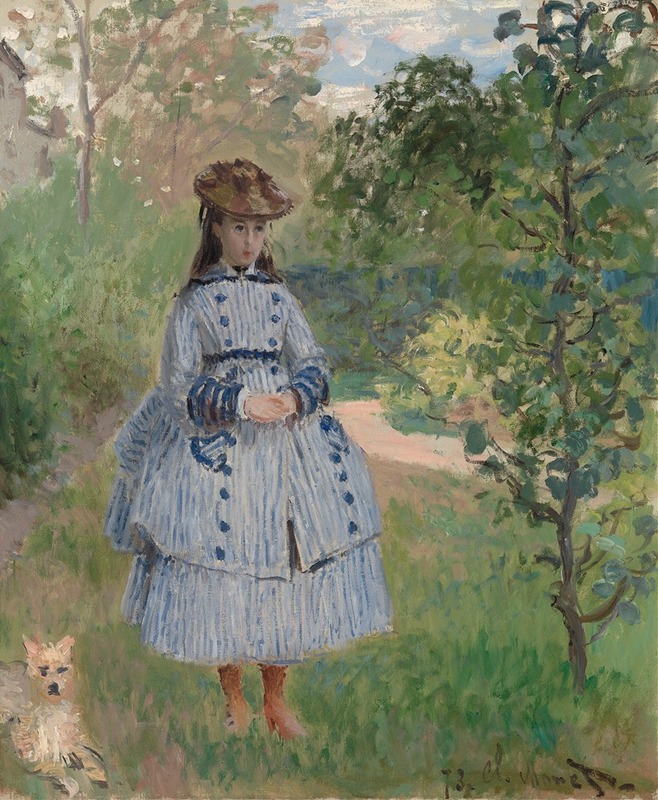
The work is distinguished by its exceptionally rapid, irregular, and liberated brushwork. In the background sky, the foliage dances across the canvas in spontaneous, painterly scrawls, capturing the gentle stir of a breeze through the air. A harmonious interplay of soft blues and warm greens masterfully evokes the serene, refreshing atmosphere of a late summer afternoon.
✦ The setting of this painting
The setting is the garden of Monet's home in Argenteuil—a suburban town a fifteen-minute train ride from Paris—or a lush walking path nearby. Monet settled in this town in late 1871, a bustling recreational haven for urban Parisians enjoying sailing and boat races. With its mosaic of nature and modernization, the landscape proved an ideal terrain for Monet to pioneer a revolutionary pictorial language.
✦ Historical context
The year of its creation, 1873, was a landmark moment in art history. Seeking independence from the conservative jury of the official Salon, Monet, Renoir, and their circle founded a cooperative society that would serve as the foundation for the First Impressionist Exhibition the following year. It was the eve of an artistic awakening that celebrated the fleeting, lived moment rather than retreating into history or mythology.
以下が、これまでのシリーズと同等のトーンと質感を保った、自然でエレガントな英語の翻訳です。
A young girl in a blue-and-white striped dress stands quietly upon a green lawn. At her feet, a small dog sits perched, gazing straight out at us.
Painted in 1873, this work is often discussed within art historical contexts as a quintessential example of Impressionist master Claude Monet. Indeed, the bustle, panniers, and delicate side-buttoned boots worn by the girl represented the height of contemporary middle-class fashion.
Celebrating the living present rather than escaping into history or mythology—one might assume the "correct" way to appreciate this work is alongside other Impressionist paintings, as an unfiltered statement of Impressionist ideology.
In reality, however, the venue where this painting hangs today completely rejects such conventional art historical wisdom.
The key to the story lies with Dr. Albert C. Barnes, an American pharmaceutical magnate and art collector.
Let us turn back the clock a bit.
From late 1871, Monet resided in Argenteuil, a suburb of Paris that served as a mecca of leisure for city dwellers enjoying yachting and boat races. In this town where nature and modernization intersected, Monet continually sought new modes of expression.
The year 1873 was a monumental one, marking the formation of the joint-stock company that would become the foundation for the First Impressionist Exhibition held the following year. In this portrait of a girl—who may have been a young relative of Monet’s wife, Camille, or perhaps a neighbor’s child—the stylistic hallmarks of Impressionism had already fully materialized.
Time moved forward to 1924. At a solo exhibition of Monet organized by Paul Rosenberg, a pioneering modern art dealer in Paris, this painting took center stage.
Dr. Barnes acquired this extraordinary work directly from the show, bringing it back to the Barnes Foundation, his private museum in Philadelphia, Pennsylvania.
However, Dr. Barnes chose not to arrange his collection chronologically or by artist. Instead, he crafted unique, three-dimensional spatial compositions he termed "ensembles."
Today, on the west wall of Room 8, this portrait of a girl hangs alongside a surprising group of companions: Van Gogh’s Houses and Figures, Cézanne’s Bathers by the Sea, and Renoir’s Girl in a Blue Skirt. That much, one might still comprehend.
Yet Dr. Barnes went further, placing the painting in strict symmetry with utilitarian antique iron hinges, a fireplace toasting fork, and an intricately decorated keyhole escutcheon.
About 159 more words
Read stories of masterpieces for free
Your Note
Write down what this painting made you feel in your art notebook.
Please sign up to write notes.
Sign up for freeRecommended Artworks
Sources & references
More artists






If you find an error in this content, please let us know here
This site is protected by reCAPTCHA, and the Google Privacy Policy and Terms of Service apply.