
Rain, Steam and Speed – The Great Western Railway
1844
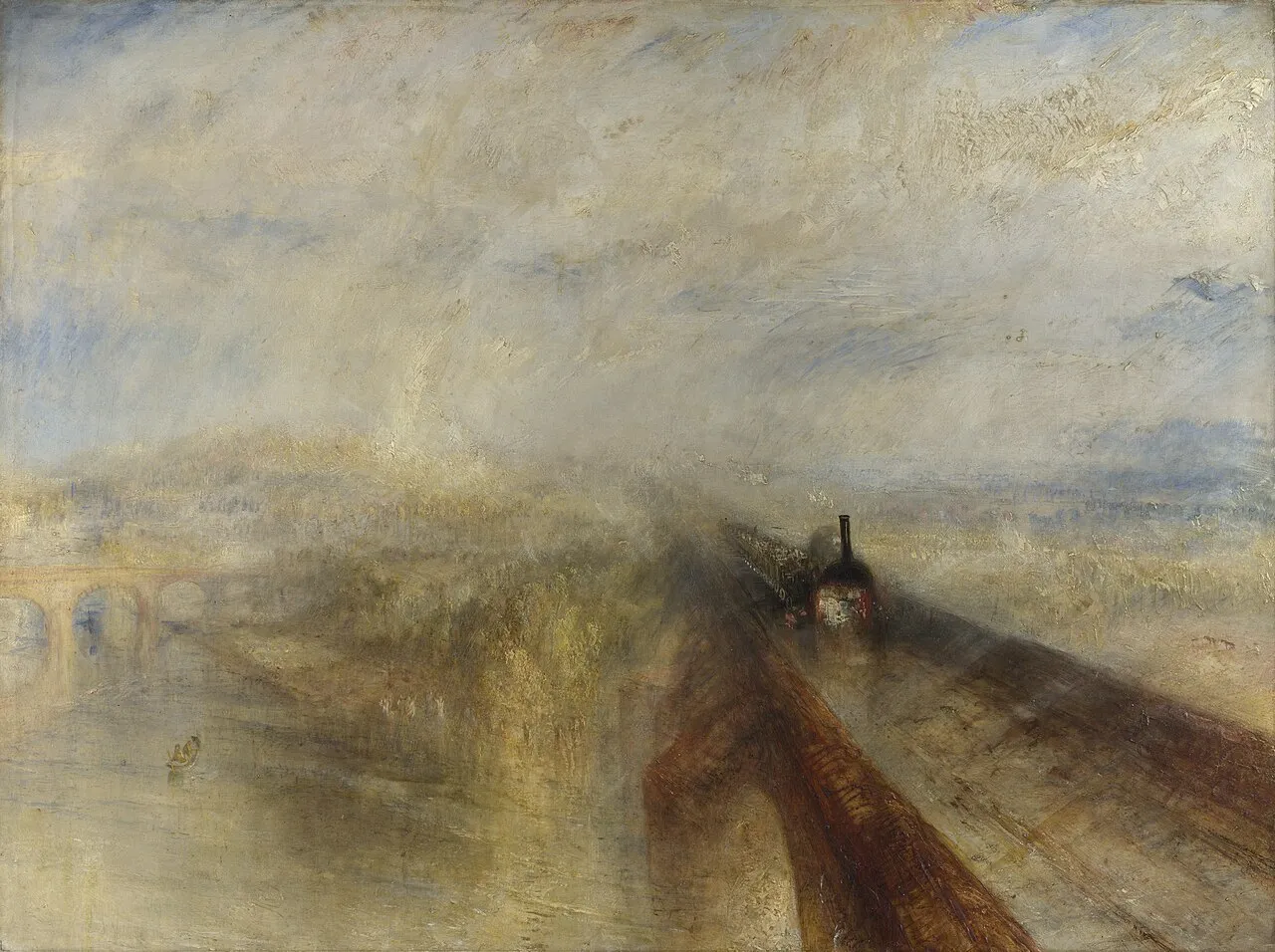
- Dimensions
- 91.0 × 121.8 cm
- Medium
- Oil on canvas
- Collection
- The National Gallery, London
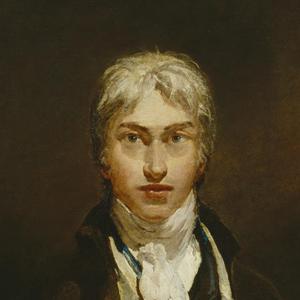
A Romantic painter who elevated landscape painting to the stature of history pai…
An intense curiosity about modern mechanical speed at a time when his peers grew increasingly conservative. A tenacious visualization by the 69-year-old artist, capturing the raw energy of a new era and atmospheric turbulence on canvas.
✦ Highlights (technique & color)
An impasto technique with thickly applied paint is used for the locomotive's chimney, reflections of light, and the texture of the falling rain. In contrast, thin glazes of color are layered over the river's surface and the sky, rendering particles of light dissolving into the atmosphere. The sharp diagonal composition and dramatic foreshortening create a visual effect that underscores the train's ferocious speed.
✦ The setting of this painting
The painting is set at the Maidenhead Railway Bridge on the Great Western Railway, which connects London and Bristol. Spanning the River Thames, it captures a train departing London and heading west through a heavy shower between early morning and midday in early summer. At the time, the viaduct was a cutting-edge structure featuring the world's widest and flattest arches.
✦ Historical context
In the early 1840s, Britain was at the height of "Railway Mania," with tracks being laid across the nation. While travel speeds were transformed fundamentally, social structures were also shifting dramatically—following a fatal derailment in 1841, the Railway Regulation Act of 1844 was enacted to mandate improved conditions for third-class passengers.
A damp atmosphere where torrential rain mingles with mist.
Crossing diagonally over a colossal viaduct, a black steam locomotive hurtles forward at breakneck speed.
From deep within the boiler, a crimson glow of fire peeks through.
This painting has often been interpreted as a protest against modernization and the destruction of nature by the railways.
Or as a scene born from the artist leaning his head out of a train carriage window for nine whole minutes during a storm to experience it firsthand.
Such dramatic legends have frequently accompanied it.
Yet in reality, Turner was an enthusiastic traveler by train.
He embraced new technological innovations as a welcome subject for his art.
In 1844, Turner was sixty-nine years old.
He had already cemented his reputation as an artistic titan and was financially secure.
While painters of his generation were drifting toward retirement or settling into rigid styles,
he frequently rode the Great Western Railway at the cutting edge of the Industrial Revolution, living fully in an era when the very concept of travel speed was being revolutionized.
At the time, third-class passengers paying lower fares were typically consigned to open, roofless carriages.
In December 1841, heavy rains caused an embankment to collapse, derailing a mixed passenger and goods train.
It was a catastrophe that claimed the lives of ten stonemasons riding in an open carriage coupled directly behind the locomotive.
A tragic disaster.
Faced with public outrage, the British Parliament passed a new law in 1844.
It mandated that all passengers be provided with enclosed carriages fitted with seats and a roof.
What Turner depicted trailing behind the engine in this painting
is the dark silhouette of third-class passengers huddling together against the wind and rain.
They were the working poor, captured on the verge of vanishing through that very legislative reform.
About 180 more words
Read stories of masterpieces for free
Your Note
Write down what this painting made you feel in your art notebook.
Please sign up to write notes.
Sign up for freeRecommended Artworks
.webp)
Sources & references
More artists
If you find an error in this content, please let us know here
This site is protected by reCAPTCHA, and the Google Privacy Policy and Terms of Service apply.