
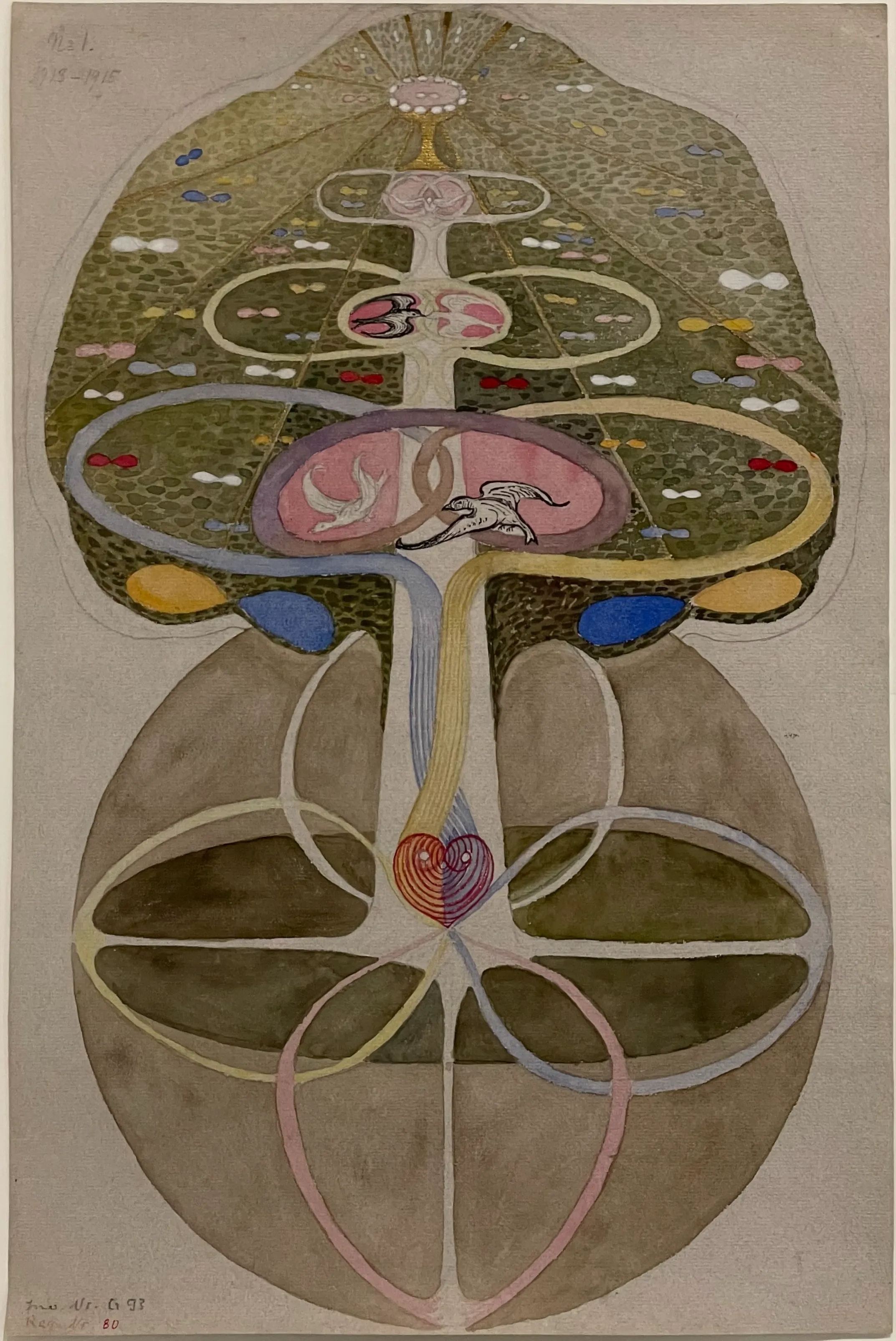
Tree of Knowledge, No. 1
1915
- Dimensions
- 45.7 × 29.5 cm
- Medium
- Watercolor, gouache, graphite, ink, and metallic paint on paper
- Collection
- Glenstone Museum (Potomac, Maryland, USA)

One of Sweden's foremost women artists, she studied at the Royal Academy of Fine…
A pioneering abstract expression claimed through intellect, rising above cold rejection by the artistic establishment. It embodies a quiet resolve to move beyond the role of a passive medium and autonomously construct a cosmic order.
✦ Highlights (technique & color)
The work employs a mixed technique on paper combining translucent watercolor, gouache, graphite, ink, and metallic paint. Transparent washes of watercolor evoke an atmospheric quality, while opaque gouache distinctly delineates the forms. All hesitant traces of preliminary sketching have been eliminated in favor of impeccably calculated, graceful curves, and at the very top, a chalice radiates a sacred luster rendered in metallic paint.
✦ The setting of this painting
The setting of this painting is not a physical landscape, but a metaphysical realm—the invisible spiritual world. Conceived in a Stockholm studio and during spiritualist séances, it synthesizes the mythological concept of the axis mundi with the biblical Tree of Knowledge. Here, the flow of unseen energies and multidimensional structures are rendered visible on a two-dimensional plane.
✦ Historical context
Created between 1913 and 1915, this work emerged during an era of remarkable breakthroughs in the natural sciences, including the discovery of X-rays and electrons. While a newfound realization spread that the material world visible to the naked eye was not everything, Europe was hurtling toward the devastation of the First World War. Amid this societal turmoil, people sought a universal, indestructible spiritual order.
Within a large, ovoid outline stands a solitary white tree.
From its base, blue and yellow lines surge forth, intertwining like a mesh as they ascend into the heights.
Within this circle, black and white birds rest quietly.
Hilma af Klint.
She is a Swedish painter who was completely forgotten by art history for many years.
"She never showed her paintings to anyone during her lifetime, keeping them hidden in an attic."
"She entered a trance, her hand guided autonomously by spirits."
Online commentary and introductory texts often lean heavily on such occult lore, portraying her as a mad genius painting in a state of pure unconsciousness.
Yet in truth, this is simply not the case.
During her lifetime, she showed her paintings to specialists.
And this piece was by no means painted unconsciously under the sway of spirits.
It is the result of meticulous calculation—
a crystallization of her own resilient will, forged through profound adversity.
In 1906,
following spiritual guidance, she began work on a monumental series.
This took place in her Stockholm studio.
At the time, she regarded herself as a conduit for delivering messages from higher beings.
In 1908,
she invited a visitor into her studio:
Rudolf Steiner, a prominent intellectual of the era and the leading authority on anthroposophy.
She presented her work to him,
believing that someone who explored the same spiritual realm would surely understand.
Or so she hoped.
However,
Steiner's words utterly crushed her expectations.
He outright dismissed her passive, mediumistic method of creation.
A profound shock.
Rejection from an authority figure.
She laid down her brushes.
For the next four years, she was unable to paint at all.
In 1912,
breaking her long silence, she took up the brush once more.
She was no longer merely following the dictates of spirits.
Her own intellect.
The deliberate refinement of theoretical composition.
She cast off the role of a passive medium, transforming her expression through an autonomous approach.
About 178 more words
Unlock this story's ending, and every article on MusicStory
- 42
Stories1–2 new every week
An archive of paintings paired with great music, made for a weekend night and a cup of coffee
- 282
Paintings with commentarygrowing daily
From simply looking to truly reading — the brushwork and the obsession of the masters
- 10
Music Librarygrowing daily
Know it first, and what reaches your ear changes — background music becomes art you keep for life
My Notes, unlimited
Every reading adds to a digital art notebook that is yours alone
Already have an account? Log in
Your Note
Write down what this painting made you feel in your art notebook.
Please sign up to write notes.
Sign up for freeRecommended Artworks

Sources & references
More artists



If you find an error in this content, please let us know here
This site is protected by reCAPTCHA, and the Google Privacy Policy and Terms of Service apply.