A Swedish painter who arrived at non-objective expression in 1906, predating Kandinsky and others, mapping the invisible cosmic order and spiritual truths across monumental diagrammatic canvases.
LifeLife and works
Born in 1862 on the outskirts of Stockholm, she received formal training in traditional drawing and painting at the Royal Swedish Academy of Fine Arts. Following her graduation, she pursued a conventional career as a figurative painter, producing portraits and landscapes while earning an income by illustrating detailed anatomical plates for veterinary publications.
Yet her interests reached far beyond the depiction of visible reality. In 1896, she formed a spiritualist circle with fellow women artists of her generation, meeting weekly to meditate and engage in mediumistic automatic drawing and writing while in trance states. Through these collective sessions, she began cultivating an entirely original visual vocabulary.
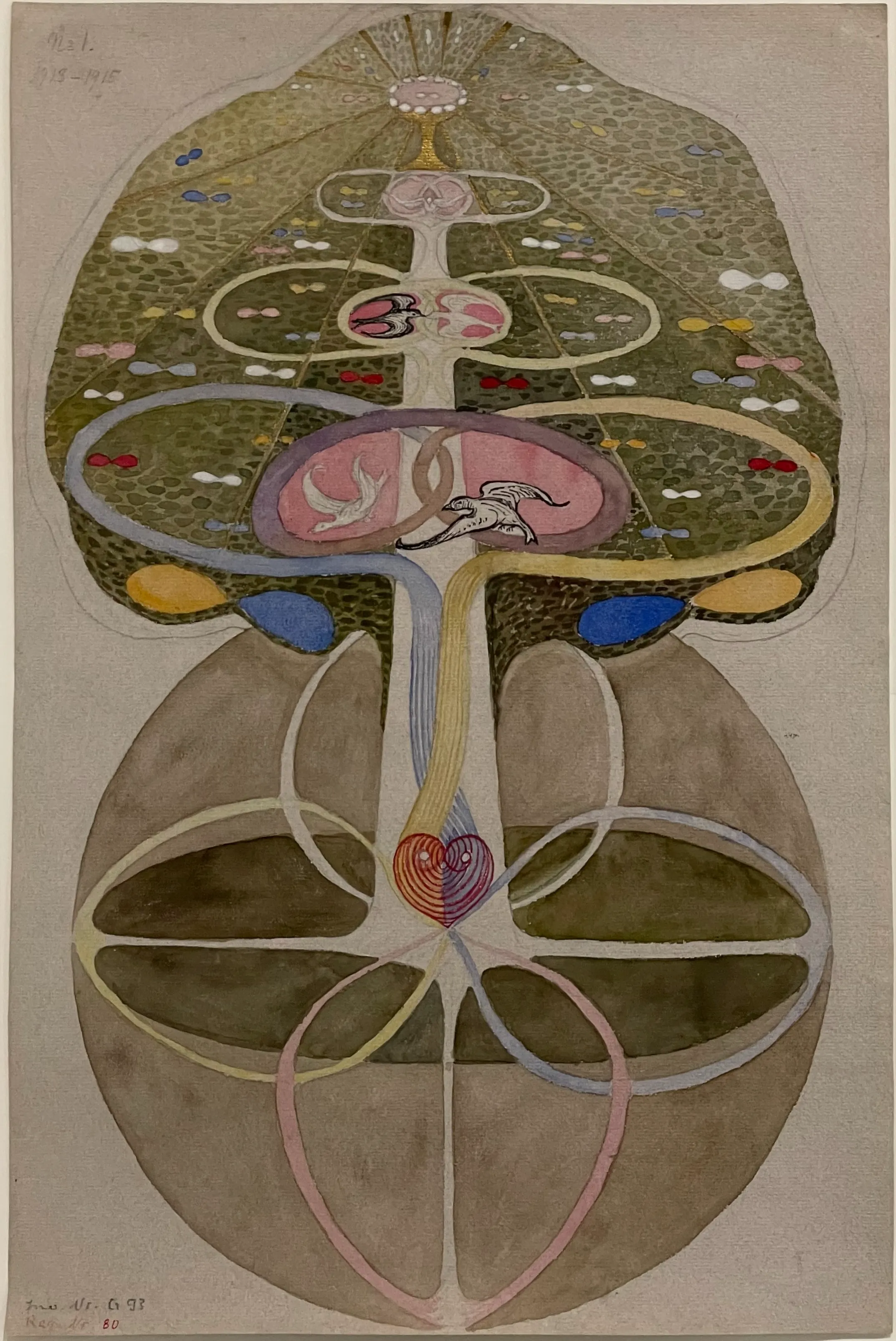
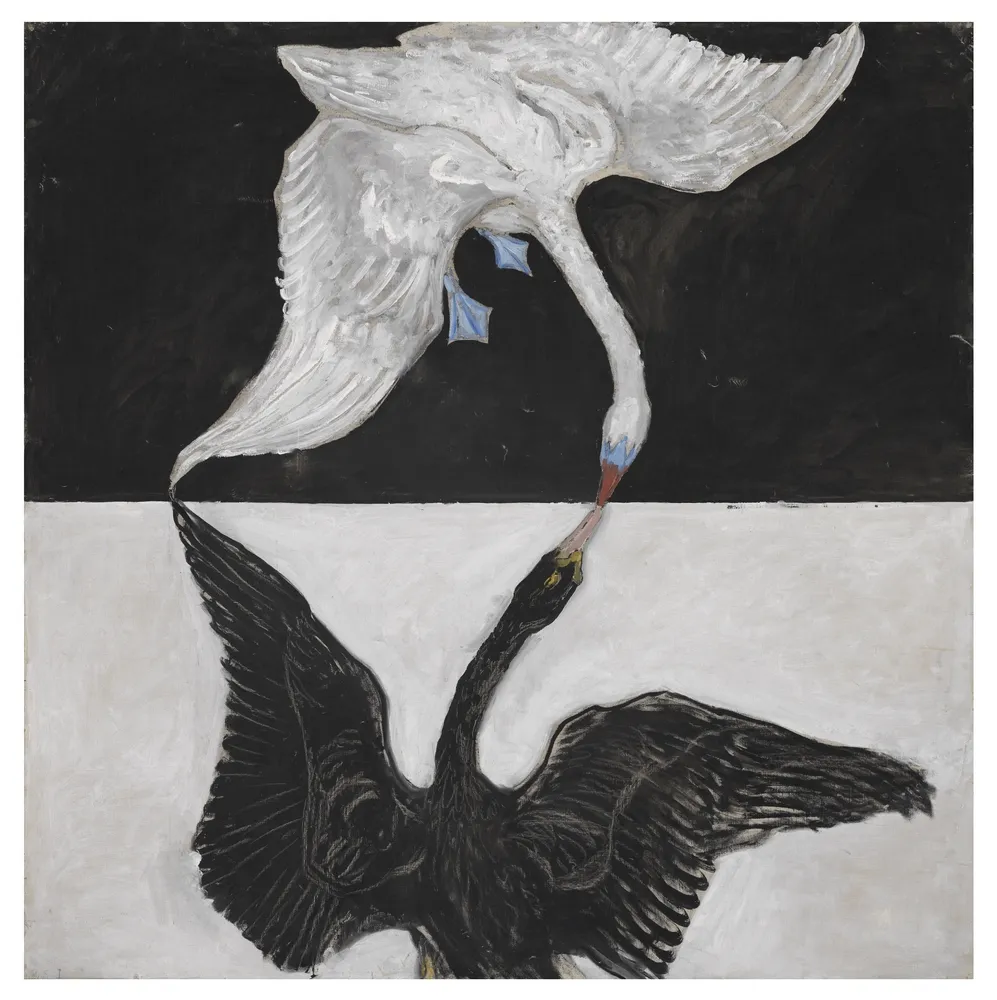
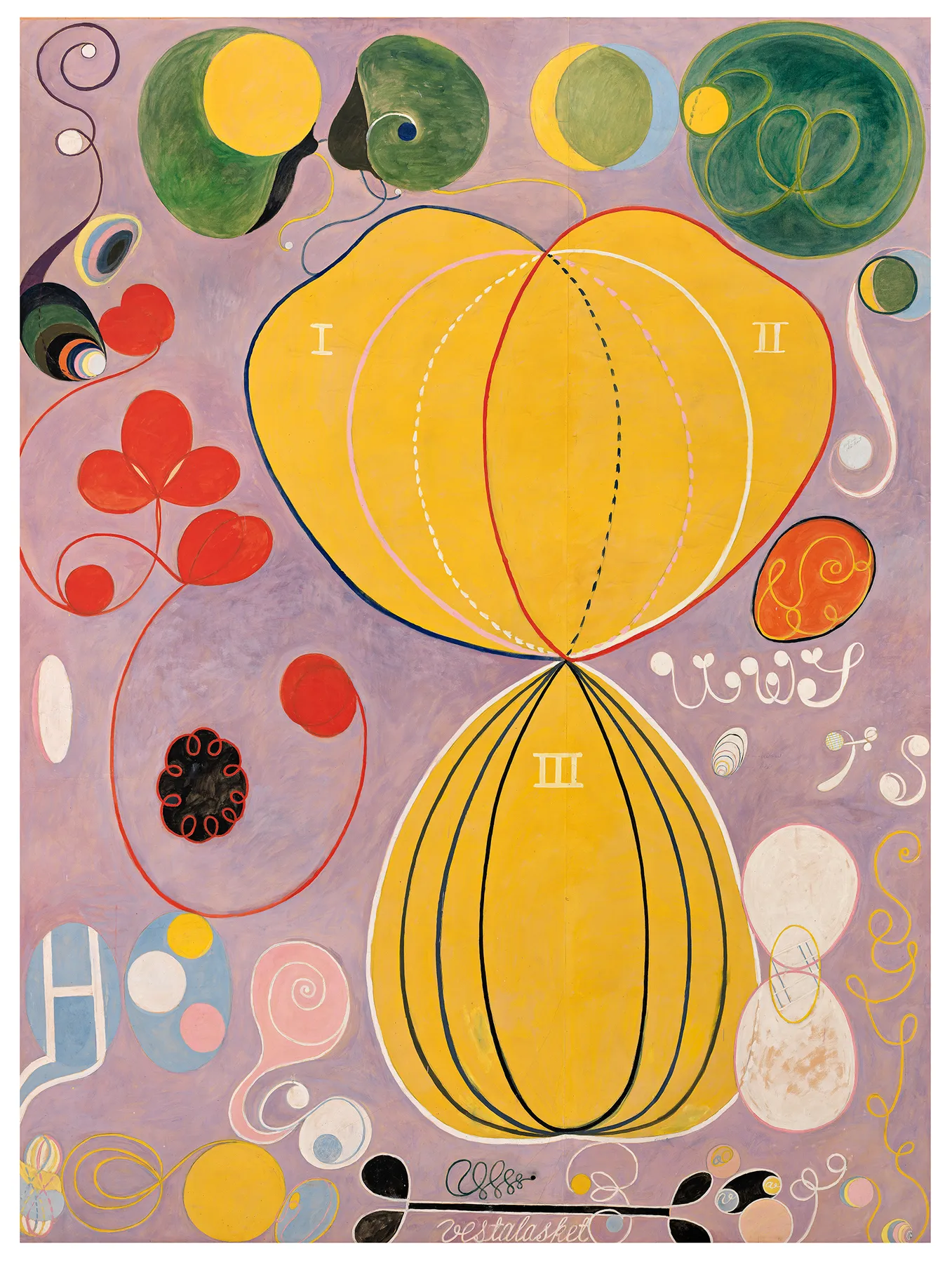
In the autumn of 1906, she began producing paintings devoid of any objective reality, prompted by messages from higher spiritual entities during a séance commissioning works for a temple. From this point, her visual language underwent a dramatic metamorphosis, turning to geometric diagrams, vibrant colors, and organic spirals evoking botanical growth. In 1907, she completed a monumental cycle of works on paper, each standing over three meters tall, depicting the stages of human life.
Her creative output was also intimately tied to the scientific breakthroughs of her day. A fascination with invisible physical phenomena discovered from the 1890s onward—including X-rays, radioactivity, and atomic theory—lent her paintings a rigorous structural logic. In works from 1916 onward, spectrally divided circles, triangles, and precise grids increasingly dominated her compositions. Through concentric rings and radiating lines, she sought to demonstrate that the energetic vibrations governing the vast cosmos were equally present within the atom, the smallest unit of matter.
Following the death in 1920 of her mother, with whom she had lived, her expressive technique transformed once again. Relinquishing the sharp contours of oil paint, she adopted a watercolor method that allowed pigment to bleed into wet paper. In doing so, she created images that captured not the outward appearance of plants, but the dynamic fields of energy emanating from them.
She never exhibited these non-objective works in commercial galleries or modern art exhibitions. Sustaining herself and her practice through conventional commissions, anatomical drawings, and family resources, she kept more than a thousand paintings entirely withheld from the art market. Influenced in part by the philosopher Rudolf Steiner, who visited her studio in 1908 and suggested that her contemporaries would not understand her art, she resolved to entrust her life's work to future generations.
In her later years, she relocated to the university cities of Uppsala and Lund, where she worked quietly to transcribe and index her 26,000 pages of notebooks on a typewriter. When she passed away in 1944 at the age of eighty-one, she left strict instructions that her abstract oeuvre must remain entirely hidden from the public for twenty years after her death. Today, her vast body of work and written records is preserved by a dedicated foundation and held on permanent deposit at the Moderna Museet in Stockholm.