
Dante and Virgil in Hell
1850
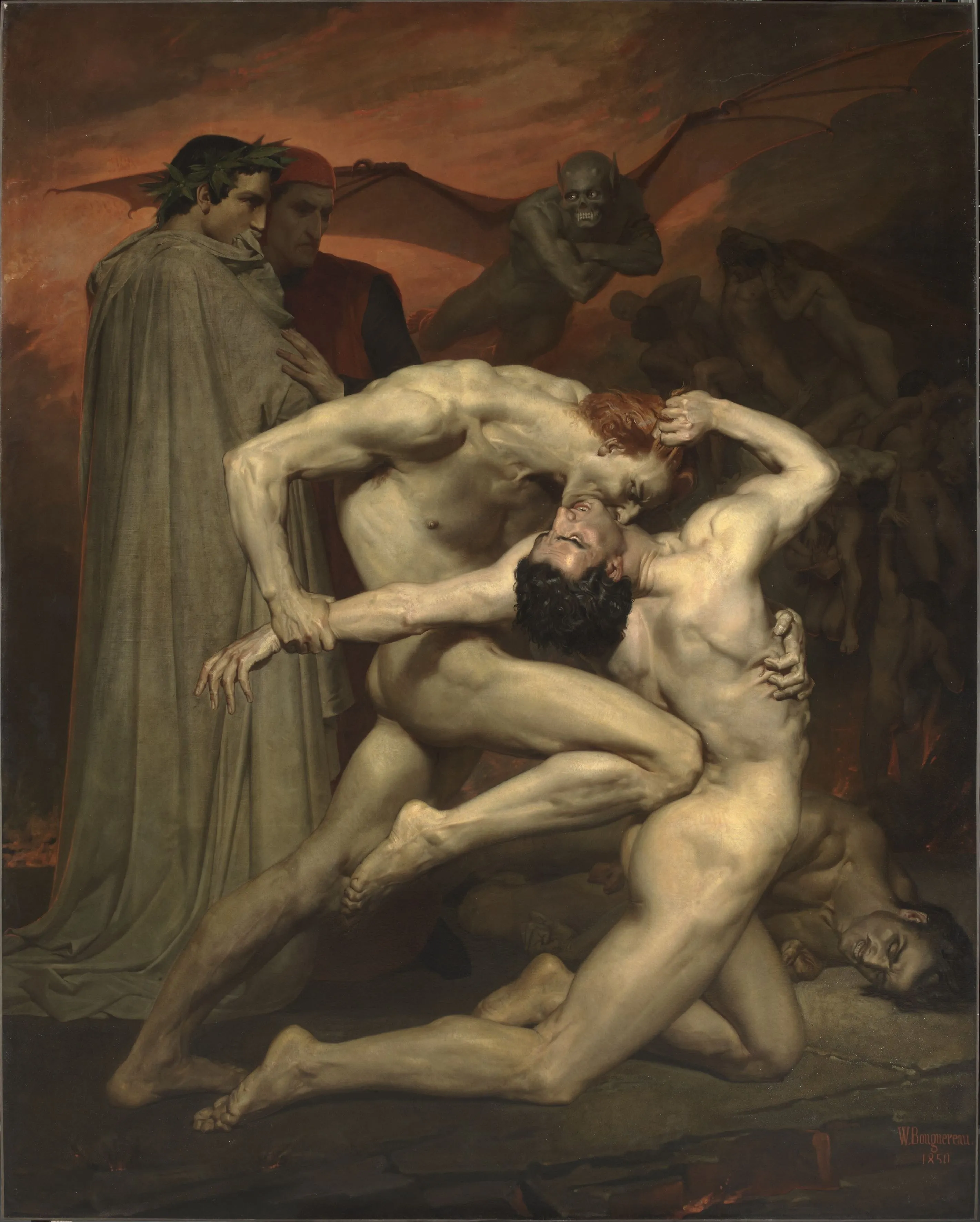
- Dimensions
- 280.5 × 225.3 cm
- Medium
- Oil on canvas
- Collection
- Musée d'Orsay, Paris
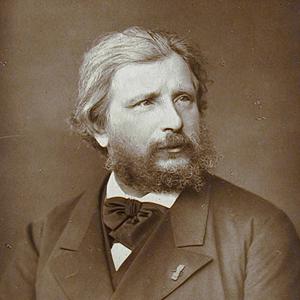
The crystallization of ambition and fighting spirit from a young painter striving for the pinnacle of the Academy. A wholly independent work that etched an overwhelming portrayal of the human body onto canvas, shocking the public.
✦ Highlights (technique & color)
Extreme chiaroscuro brings the two nude figures into stark relief, as if illuminated by a spotlight against the dark brown murk of Hell. The seamless rendering of flesh, with brushstrokes virtually invisible, combined with a clinically precise depiction of muscles and veins, creates an overwhelming sense of vivid realism.
✦ The setting of this painting
Set in the tenth chasm of Malebolge, the eighth circle of Hell, from Canto XXX of Dante's Inferno in the Divine Comedy. This desolate abyss is where falsifiers—such as alchemists and impostors—are condemned, languishing in perpetual plague and madness.
✦ Historical context
In 1850, France was experiencing political and social turbulence under the Second Republic following the February Revolution. Among young artists, fascination grew with unsettling themes such as human madness and violence, as "Dark Romanticism" and a rediscovery of Dante swept through literature and the visual arts.
Under dark clouds tinged with red, two naked men grapple fiercely.
One thrusts up his opponent's hip, sinking his sharp teeth deep into the side of the other's neck.
Twisting in agony, the bitten man collapses, every muscle in his body convulsing in pain.
This painting was created by the 19th-century French artist William Bouguereau.
He is often remembered as an elegant, sentimental Academic painter who spent his career portraying sweet young girls and tender angels.
That was the label affixed to his name.
Yet his artistic beginnings were entirely different.
In his youth, he painted a terrifying, brutal, and visceral world of darkness.
Paris, 1850.
The 25-year-old Bouguereau, studying at the École des Beaux-Arts, burned with ambition.
He was determined to win the Grand Prix de Rome, the gateway to success for emerging talents,
and to firmly establish his place in the art world.
He conceived a work meant to stun the public—
an entirely self-initiated project created without a commission.
For his subject, he chose Dante's epic poem, the Divine Comedy.
It portrays a gruesome scene in the depths of Hell, where the counterfeiter Gianni Schicchi attacks the alchemist Capocchio, sinking his teeth into his neck and dragging him across the ground.
Viewers often mistake the two men in the foreground for Dante and Virgil, but that is not so.
Dante is the figure in the background on the left, covering his mouth in horror, while Virgil looks on with calm composure.
Bouguereau hired professional Italian models.
Over nearly thirty grueling posing sessions,
capturing the straining neck muscles, the taut abdomen, and the raised networks of veins,
he hurled the human body pushed to its absolute limits onto the canvas with scientific precision.
At the Salon of 1850,
this monumental canvas was unveiled to immense critical acclaim.
Critics hailed it as an astonishing display of combat rendered through muscle, nerve, sinew, and tooth.
A raw, overwhelming physicality filled the work.
Yet, because of its shocking and cruel subject matter, not a single buyer stepped forward.
About 218 more words
Unlock this story's ending, and every article on MusicStory
- 42
Stories1–2 new every week
An archive of paintings paired with great music, made for a weekend night and a cup of coffee
- 319
Paintings with commentarygrowing daily
From simply looking to truly reading — the brushwork and the obsession of the masters
- 10
Music Librarygrowing daily
Know it first, and what reaches your ear changes — background music becomes art you keep for life
My Notes, unlimited
Every reading adds to a digital art notebook that is yours alone
Already have an account? Log in
Your Note
Write down what this painting made you feel in your art notebook.
Please sign up to write notes.
Sign up for freeRecommended Artworks
Sources & references
More artists
If you find an error in this content, please let us know here
This site is protected by reCAPTCHA, and the Google Privacy Policy and Terms of Service apply.